
A flatbed trailer is an open trailer with a flat deck and no fixed sides or roof, so you can load from the back, the sides or with a forklift from above. The right flatbed trailer for you comes down to four things: how wide your load is, how long it is, how much it weighs, and how you want to get it on. For garden machines, quads and building materials, a 5×10 to 7×16 utility flatbed is usually enough. For skid steers, mini diggers and cars, a tandem axle equipment or tilt flatbed of 7×16 to 7×22 with a GVWR of 10,000 lb or more is the normal choice. For pallets, bales and wide machines, a 102 in deckover flatbed trailer is the one to buy. We sell all of these, new and used, and we deliver worldwide.
This guide explains the main types of flatbed trailer, how to read the size and weight figures, how much more you pay for features like tilt decks or galvanizing, and which flatbed trailers in our range suit which jobs. Where a fact comes from an official body or a manufacturer, we link to it. Where it’s our own view from selling trailers, we say so.
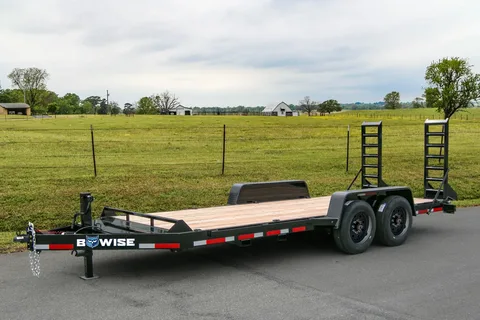
What is a flatbed trailer?
In everyday use, “flatbed trailer” covers any open trailer with a flat load deck. That includes small utility trailers with low rails, equipment trailers with ramps, car haulers, tilt trailers and big deckover trailers. What they share is a deck you can load from more than one side and strap almost anything to. What separates them is the width of the deck, the weight they’re rated for, and how the load gets on.
People in the trucking industry sometimes use “flatbed” to mean a semi-trailer pulled by a big rig. This article is about the trailers most buyers tow behind a pickup, SUV, van or light truck, which is what we sell. Many of the same ideas apply, but the sizes and weights here are for bumper pull and gooseneck trailers up to about 35 ft.
Flatbed trailer vs enclosed trailer
A flatbed trailer is lighter, cheaper for its size, easier to load with a forklift, and takes odd-shaped or tall loads that won’t fit through a door. An enclosed trailer keeps the load dry and locked up. If you carry machines, timber, steel, pallets or anything wide or tall, a flatbed trailer is usually the better buy. If you carry tools, furniture or stock that needs to stay dry and secure, look at enclosed. We compare the two in detail in enclosed vs open trailer.
The main types of flatbed trailer
Here are the flatbed trailer types we sell, from smallest to biggest, with what each one does best.
Utility flatbed trailers
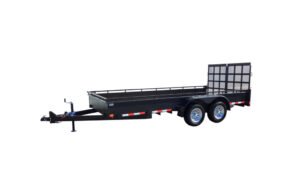
These are the small and mid-size open trailers most homeowners, gardeners and small trades start with. Sizes run from 5×8 to about 7×20. They usually have low rails or mesh sides, a fold-down ramp gate, and a single axle up to about 3,000 lb GVWR or a tandem axle up to about 10,000 lb. A utility flatbed trailer is right for mowers, quads, garden waste, furniture, sheet materials and general hauling.
Examples from our range: the 5×8 steel utility trailer (2,990 lb GVWR), the 5×10 steel utility trailer (3,500 lb GVWR), the 6×12 aluminum utility trailer, the 7×14 steel tandem utility trailer (7,000 lb GVWR) and the 7×18 steel tandem utility trailer (9,900 lb GVWR). See all utility trailers.
Equipment flatbed trailers
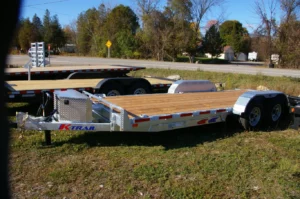
An equipment trailer is a heavier flatbed trailer built for machines. The deck sits between the wheels, close to the ground, with stand-up or slide-out ramps at the back. Frames are heavier, axles are tandem, and GVWR usually starts around 7,000 lb and goes past 14,000 lb. This is the flatbed trailer type for skid steers, compact tractors, mini diggers and small rollers.
Examples: the 7×16 equipment trailer (7,700 lb GVWR), the heavier 7×16 equipment trailer at 15,400 lb GVWR, the 7×18 galvanized equipment trailer and the 7×20 equipment trailer (10,000 lb GVWR). See all equipment trailers, and our skid steer trailer guide if that’s your machine.
Car hauler flatbed trailers
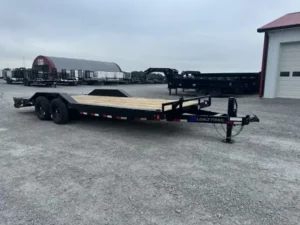
A car hauler is a flatbed trailer sized and set up for vehicles: about 18 to 20 ft of deck, often with a short dovetail at the back, slide-in ramps, and tie-down points placed for wheel straps. Many have open steel decks or wood decks with drive-over fenders. Our galvanized car hauler (10,000 lb GVWR) and galvanized car hauler (14,000 lb GVWR) are both listed as 18+2 ft decks, meaning 18 ft flat plus 2 ft of dovetail.
Tilt flatbed trailers
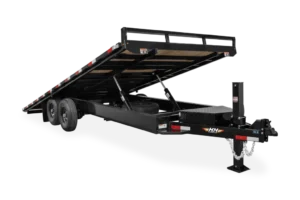
On a tilt trailer the whole deck (or the rear section) tips down to the ground, so there are no ramps to lift. Gravity tilt decks tip when the load rolls past the balance point; hydraulic or power tilt decks are raised and lowered with a pump. A tilt flatbed trailer gives a gentler loading angle, which helps with low cars, rollers, scissor lifts and anything with little ground clearance.
Examples: the 6×12 manual tilt trailer, the 6×12 gravity tilt trailer at 7,000 lb GVWR, the 7×20 tilt and load trailer (15,400 lb GVWR), the 7×18 hydraulic power-tilt trailer and the 8×24 tilt and load trailer. See all tilt and load trailers and our tilt trailer buying guide.
Deckover flatbed trailers
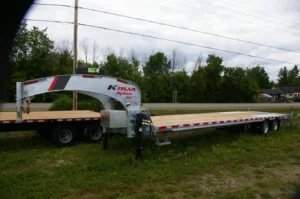
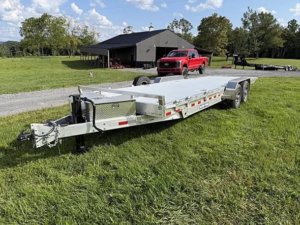
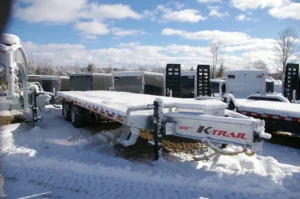
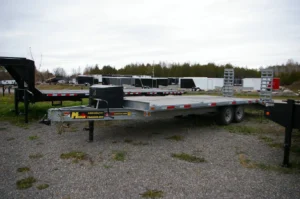
A deckover trailer puts the deck on top of the wheels instead of between them. That makes the deck full width, usually 96 in or 102 in, with no fenders in the way, so you can load from the side with a forklift and carry wide machines or two rows of pallets. The trade-off is a higher deck, so you need longer ramps or a dovetail. When most people picture a big flatbed trailer, this is it.
Examples: the 8×20 deckover trailer (15,400 lb GVWR), the 102×20+5 deckover, the 102×30+5 galvanized deckover and the 8×22 deckover hydraulic power-tilt trailer. Read more about the layout in gooseneck vs bumper pull, since many large deckovers come with a gooseneck hitch.
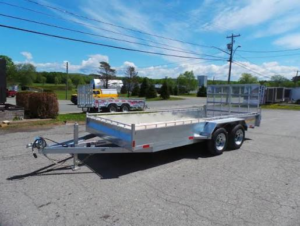
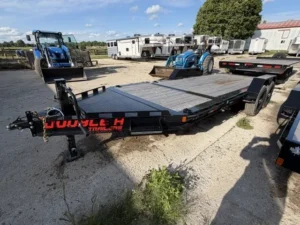
Carrying quads or a side-by-side rather than machinery? Our ATV trailer guide sizes open, tilt and enclosed trailers for ATVs and UTVs.
Deck width: between the wheels or over them
Width is the first thing to check, because it decides which type you can use at all. On a trailer with the deck between the wheels, the usable width is the gap between the fenders. On our range that’s 5 ft on the smallest trailers, 77 in (about 6.4 ft) and 80 to 83 in on the mid-size and equipment trailers. On a deckover the deck runs right across, at 96 in or 102 in.
The outside width matters too, because there are legal limits. In the US, the federal width limit for commercial vehicles on the National Network is 102 in, as the Federal Highway Administration explains. In Great Britain, a trailer towed by a car can be up to 2.55 m wide, according to GOV.UK guidance on towing weight and width limits. Other countries set their own limits, so check yours. A 102 in deck is right at the US limit, which is why you rarely see a wider flatbed trailer on a normal licence.
Our rule of thumb: measure the widest point of your load, including mirrors, buckets, tracks or overhanging parts, and add at least a few inches each side. If that doesn’t fit between the fenders, you need a deckover.
Deck length and dovetails
Length is easier. Measure your longest load, then add room for the straps at each end and to place the weight correctly. On a bumper pull trailer the heavy part of the load usually sits slightly forward of the axles, so you need deck space in front of the axles as well as behind them. In practice that means a machine that’s 12 ft long rarely fits well on a 12 ft deck.
A dovetail is a short sloped section at the rear of the deck. It lowers the loading angle so ramps can be shorter, and it’s common on car haulers and deckovers. When a listing says “20+5” or “30+5”, it means 20 or 30 ft of flat deck plus 5 ft of dovetail. Count the flat part when you plan where the load sits; the dovetail is mostly for getting on.
GVWR, payload and empty weight
Every flatbed trailer has a GVWR, the gross vehicle weight rating. It’s the most the trailer is allowed to weigh fully loaded, trailer included. Ford’s towing guide gives the same definition for vehicles: GVWR is “the maximum allowable weight of the fully-loaded vehicle” (Ford 2026 RV and Trailer Towing Guide).
Your real carrying capacity, the payload, is the GVWR minus the trailer’s own empty weight. A steel equipment trailer can weigh a good share of its GVWR before you put anything on it, so the payload is always less than the headline number. When you shop for a flatbed trailer, ask for the empty weight, and work it out:
Payload = GVWR − empty trailer weight
Then compare that with what you plan to carry, including attachments, fuel, straps, tools and anything else on the deck. If the answer is close, go up a size. We’ll give you the empty weight of any trailer we sell on request.
GVWR bands in our flatbed trailer range
| GVWR | Typical flatbed trailer | Typical loads |
|---|---|---|
| About 3,000 to 3,500 lb | 5×8, 5×10, 6×12 single axle utility | Mowers, quads, garden waste, materials |
| About 7,000 to 7,700 lb | 7×14 to 7×20 tandem utility, 7×16 equipment | UTVs, small tractors, two mowers, light machines |
| About 10,000 lb | 7×20 equipment, car haulers, power tilt | Cars, skid steers, mini diggers |
| About 14,000 to 15,400 lb | Heavy equipment, tilt and deckover trailers | Larger skid steers, track loaders, mixed machine loads |
| 17,000 lb and up | 8×24 tri-axle tilt, 102 in deckovers | Heavy machines, pallets, contractor fleets |
Tongue weight and your tow vehicle
A loaded flatbed trailer pushes down on your hitch. That downward force is the tongue weight, and getting it right is one of the biggest factors in how stable the trailer feels. Ford’s guide says that for conventional trailers over 2,000 lb, “tongue load is 10% of loaded trailer weight,” and for fifth-wheel trailers king pin weight is 15% (Ford). Other makers give a range of around 10 to 15% for bumper pull trailers, so check your own vehicle’s handbook.
Do the sum before you buy. A flatbed trailer that weighs 10,000 lb loaded puts roughly 1,000 lb or more on the hitch. Your vehicle must be rated for the trailer weight, the tongue weight and the combined weight of everything together, which Ford calls the GCWR, “the maximum allowable weight of the towing vehicle and the loaded trailer.” In Great Britain, GOV.UK says the towing weight can be found in the vehicle handbook or on its VIN plate (GOV.UK). If your vehicle can’t handle a heavy flatbed trailer, a lighter aluminum model or a smaller size is the fix, not overloading.
How the load gets on: ramps, tilt or dovetail
This is where flatbed trailer types really differ, and it’s worth thinking about how often you’ll load.
- Fold-down ramp gate. Common on utility trailers. Quick and simple for mowers and quads. It adds weight at the back and catches wind, though mesh gates help.
- Stand-up or slide-in ramps. Common on equipment trailers and car haulers. Stronger and better for heavy machines. Slide-in ramps keep the back of the trailer clear when you carry long loads.
- Dovetail plus ramps. Used on deckovers and car haulers to cut the angle.
- Gravity tilt. No ramps; the deck tips under the load. Fast and simple, with fewer moving parts.
- Hydraulic or power tilt. The deck is raised and lowered under control. Best for low-clearance loads and for anyone who loads every day.
If you’ll load a few times a year, ramps are fine. If a crew loads and unloads several times a day, a tilt flatbed trailer often pays for itself in saved time, in our view.
Deck materials: wood, steel or aluminum
Most flatbed trailers have a treated wood deck, which is grippy, cheap to replace and kind to tyres and tracks. Steel decks (often diamond plate) are tougher but heavier and slippery when wet. Aluminum decks are light and don’t rust, and are usually found on all-aluminum trailers. Look for tie-down points, stake pockets and a rub rail along the edges, which give you more places to strap.
Steel, galvanized or aluminum frames
A painted steel flatbed trailer costs the least and is easy to repair. A hot-dip galvanized steel trailer is coated in zinc inside and out, which resists rust far better than paint, especially where roads are salted or near the coast. The American Galvanizers Association estimates coating life from coating thickness and the local climate, and notes that “time to first maintenance” is not the same as service life (American Galvanizers Association). An aluminum flatbed trailer is the lightest, which helps if your tow vehicle is near its limit, and it doesn’t rust. We go through the pros and cons in aluminum vs steel trailer.
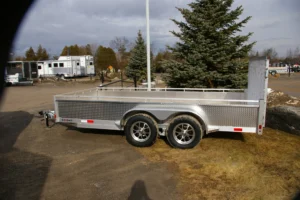
Galvanized options in our range include the 7×18 galvanized equipment trailer, the 80×20 galvanized tilt and load trailer, the used 102×25 galvanized deckover and the galvanized car haulers. Aluminum options include the 7×14 aluminum tandem, the 80×16 aluminum tandem and the 7×20 aluminum tandem.
Axles, tyres and brakes
Single axle trailers are lighter, cheaper and easier to move by hand, and they’re fine up to about 3,000 to 3,500 lb in our range. Past that, tandem axles are the norm. Two axles share the load, ride more steadily, and keep you moving if a tyre fails. The heaviest trailers we sell, like the 8×24 tri-axle tilt and load trailer at 22,679 lb GVWR, use three axles. Our tandem axle trailer guide covers the choice in detail.
Brakes depend on weight and on the rules where you live. Many countries and states require trailer brakes above a certain loaded weight, and nearly every heavy flatbed is fitted with electric or hydraulic brakes. Check the brake type on the listing and make sure your vehicle has the right brake controller. If a listing doesn’t say, ask us.
Tie-down points and securing the load
A flatbed has no walls, so straps and chains do all the work. Before you buy, count the tie-down points and check where they are. Good flatbeds have D-rings or stake pockets along both sides and at the corners, and heavy equipment trailers have chain anchors rated for machines.
In the US, the FMCSA cargo securement rules for commercial vehicles give a useful benchmark even if you’re towing for yourself. They say the total working load limit of the tie-downs “must be at least one-half the weight of the article,” and that an article over 10 ft long needs two tie-downs for the first 10 ft plus one more for each extra 10 ft or part of it (FMCSA cargo securement rules). The rules apply to commercial vehicles in interstate commerce, and other countries have their own, but the logic holds for any open trailer: more and stronger straps, placed well, keep the load where it should be. For straps, chains and binders, see our guide to securing a load on a trailer.
Which flatbed trailer for which load
This table matches common loads to the trailer type we’d normally suggest. It’s a starting point; always check the weight and width of your own load.
| Load | Suggested type | From our range |
|---|---|---|
| Garden waste, mulch bags, furniture | 5×8 or 5×10 utility | 5×8 steel, 5×10 steel |
| Ride-on mower, quad | 5×10 or 6×12 utility | 5×10 aluminum, 6×12 aluminum |
| UTV, two mowers | 77×14 to 7×16 tandem utility | 77×14, 7×16 aluminum |
| Timber, pipe, long materials | 7×18 to 82×20 utility | 82×18, 82×20 |
| Compact tractor | 7×16 to 7×18 equipment | 7×16 equipment, 7×18 galvanized |
| Skid steer or compact track loader | 7×16 to 7×20 heavy equipment or tilt | 7×16 15,400 lb, 7×20 tilt |
| Car | 18+2 car hauler or 7×18 to 7×22 tilt | car hauler, 7×18 power tilt |
| Low car, scissor lift, roller | Hydraulic power tilt | 7×18 power tilt 14K, 7×22 power tilt |
| Pallets, bales, wide machines | 8×20 to 102×30 deckover | 8×20 deckover, 102×20+5 |
| Two machines or a machine plus pallets | 8×24 tilt or 102×30 deckover | 8×24 tilt, 102×30+5 |
If you’re stuck between two sizes, go up one. In our experience, buyers more often wish they’d bought bigger than smaller.
Worked example: a skid steer on a flatbed
Bobcat lists the S70 skid-steer loader at 2,892 lb operating weight, 35.5 in wide and 75.6 in long without the bucket (Bobcat S70 specifications). It’s one of the smallest skid steers, so it makes a good example.
- Width: 35.5 in fits easily between the fenders of almost any trailer we sell.
- Length: about 6.3 ft for the machine; with a bucket and room for chains, plan on 10 ft of deck or more.
- Weight: 2,892 lb plus a bucket and fuel. That’s already near or above what a 3,000 lb single axle trailer allows once you take off the trailer’s own weight.
So even a small skid steer belongs on a tandem axle flatbed. A 7×16 equipment trailer at 7,700 lb GVWR gives plenty of margin for the S70 and attachments. Bigger machines in the 5,000 to 9,000 lb range need a 15,400 lb equipment trailer or a 14,000 lb power-tilt. Always use the real weight of your own machine, with attachments.
Worked example: how many pallets fit
ISO 6780 lists standard flat pallet sizes including 1200 x 800 mm, 1200 x 1000 mm, 1219 x 1016 mm (48 x 40 in) and 1140 x 1140 mm (ISO 6780 sample). Here’s how that works on our decks, by floor space only:
- 82 in (2,083 mm) wide, between the fenders: two 1200 x 800 pallets side by side (1,600 mm) or two 1200 x 1000 pallets (2,000 mm), with little room left over.
- 96 in (2,438 mm) deckover: three 1200 x 800 pallets across on the 800 mm side (2,400 mm), a tight fit.
- 102 in (2,591 mm) deckover: three 800 mm pallets across with more margin, or two 1200 mm pallets turned sideways.
- 30 ft (9,144 mm) of flat deck: seven rows of 1200 mm pallets, so about 21 pallets three across.
On a flatbed, weight usually runs out before floor space does. Twenty-one loaded pallets can weigh far more than any trailer we sell can carry, so work out the total and compare it with the payload. The real value of a deckover is that you can load the pallets from the side with a forklift.
What features cost: price differences in our range
Rather than quote prices that change, here’s how features change the price across trailers we sell today. These are our own catalogue figures, worked out as percentages, so they show the relative cost of each choice.
- Aluminum vs steel: our 7×14 aluminum tandem costs about 86% more than our 7×14 steel tandem. You pay for less weight and no rust.
- More GVWR on the same size: the 7×16 equipment trailer at 15,400 lb GVWR costs about 31% more than the 7×16 at 7,700 lb. That’s a lot of extra capacity for the money if you might move up to a bigger machine.
- Tilt vs ramps: the 7×20 tilt and load trailer at 15,400 lb costs about 86% more than the 7×20 equipment trailer at 10,000 lb. Part of that is the higher rating, part is the tilt deck.
- Hydraulic power tilt: the 7×18 power-tilt at 10,000 lb costs about 68% more than our 7×18 galvanized equipment trailer with ramps.
- Deckover vs between the wheels: our 8×20 deckover at 15,400 lb is priced the same as our 7×20 equipment trailer at 10,000 lb. Right now it’s one of the best-value flatbeds we stock, in our view.
- Length on big deckovers: the 102×30+5 costs about 50% more than the 102×20+5.
- Used vs new: our used 2021 102×25 galvanized deckover costs about 34% less than the new 102×20+5, though its GVWR is lower (14,000 lb against 33,000 lb), so it suits lighter loads.
The pattern: extra capacity and a deckover layout are cheap upgrades for what they give you. Tilt decks and aluminum frames cost more, and they’re worth it if you load often or your tow vehicle is close to its limit.
Buying a used flatbed trailer
A used flatbed can save a lot of money, and open trailers are easy to inspect because everything is in plain sight. Our used trailers include the 2021 102×25 galvanized deckover and a 2024 8.5×25 gooseneck tilt and load trailer. When you look at any used flatbed, check:
- The VIN or serial plate and GVWR label are present and readable.
- The frame and cross members for cracks, bends and heavy rust, especially near the hitch and the axle mounts.
- The deck boards for rot, soft spots or missing fixings.
- Tyres for age cracks and uneven wear, which can point to a bent axle.
- Brakes, wiring and lights, all working.
- Ramps, tilt hinges and hydraulic cylinders for leaks and play.
- Tie-down points for cracks or bends from overloading.
Our trailer maintenance checklist shows what good care looks like, which helps you spot a trailer that’s been neglected.
Common mistakes when buying a flatbed trailer
- Buying on deck size alone. A 7×16 at 7,700 lb and a 7×16 at 15,400 lb look alike and carry very different loads.
- Forgetting the empty weight. Payload is GVWR minus the trailer, not the GVWR itself.
- Ignoring the tow vehicle. Check towing capacity, tongue weight and combined weight before you buy.
- Choosing too narrow. Wide machines and pallets need a deckover; fenders don’t move.
- Skipping tie-down points. Few or badly placed anchors make every load harder.
- No brakes on a heavy trailer. Check your local rules, and fit brakes when in doubt.
- Buying too small to save money. Most upgrades cost less than selling and buying again.
Flatbed trailers for businesses
For a business, a flatbed trailer is a working tool, and the right one saves time on every job. Landscapers often run a 77×16 or 7×18 tandem utility with a ramp gate (see our landscape trailer guide). Hire and rental companies prefer tilt and power-tilt decks for fast, safe loading. Builders’ merchants and farms favour deckovers for forklift loading. Car dealers and recovery firms use car haulers and power-tilts. If you run several crews, it can make sense to buy one heavy flatbed for machines and one lighter trailer for materials, rather than one trailer that’s a compromise for both. For dirt and gravel, a flatbed is the wrong tool; a dump trailer tips the load out for you, and we sell those too in our dump trailer range.
Gooseneck or bumper pull flatbeds
Most flatbeds up to about 20 ft are bumper pull, hitched to a ball or pintle at the back of the vehicle. Bigger deckovers and tilt trailers are often offered as goosenecks, which hitch to a ball in the pickup bed. A gooseneck puts the weight over the rear axle of the truck, turns tighter and usually feels more settled with heavy loads, but it needs a pickup with a bed hitch and takes up the bed. Our used 8.5×25 gooseneck tilt and load trailer is one example. If you’re unsure which suits your truck, read gooseneck vs bumper pull.
Hitches and couplers
Check the coupler size on any trailer before you buy, and make sure your hitch ball matches it and is rated for the trailer’s full loaded weight. Heavier trailers in our range, like the 102×25 deckover, are listed with a 2 5/16 in coupler, which is a common size for heavier bumper pull trailers. Lighter utility trailers often use smaller couplers. The ball, the hitch receiver and the drawbar all carry a rating, and the lowest one sets your limit. When we quote a trailer, we’ll tell you the coupler size so you can check your setup before delivery.
Loading a flatbed safely
Whatever you carry, the same habits help:
- Hitch the trailer to the vehicle and put the jack stand down before loading heavy machines, so the trailer can’t tip up.
- Place the heaviest part of the load a little in front of the axles, so the tongue carries its share. Too far back and the trailer can sway; too far forward and you overload the hitch.
- Keep the load centred side to side.
- Strap or chain every item, and check the straps again after the first few miles.
- Lower buckets and arms on machines and set the parking brake.
- Cover loose material so it can’t blow off the open deck.
More on this in our trailer towing tips.
Three example buyers
These buyers are made up. They show how the choices above come together.
A homeowner with a large garden
He carries a ride-on mower, garden waste and the odd load of timber, and tows with a mid-size SUV. Weight is low and he wants to save money, so a 5×10 steel utility trailer with a ramp gate does the job. If his SUV were closer to its limit, the aluminum 5×10 would be the better pick.
A small contractor with a mini digger and materials
She tows with a three-quarter-ton pickup and carries a machine of around 4,000 lb plus attachments, and sometimes pallets of blocks. The machine rules out a light trailer, and the pallets argue for a full-width deck. An 8×20 deckover at 15,400 lb GVWR covers both, and in our range it costs the same as a smaller 7×20 equipment trailer.
A car enthusiast with a lowered car
His car has little ground clearance, so steep ramps would scrape the bumper. A hydraulic power-tilt with a 7×18 deck lets the car roll on at a gentle angle, and the 10,000 lb rating leaves room for a heavier car later.
Looking after a flatbed
Open trailers are simple to keep in good shape. Wash off road salt and mud, grease the hubs and tilt pivots, check tyre pressures before each trip, and look over the deck boards and tie-down points every few months. Replace worn straps rather than knotting them. Galvanized and aluminum trailers need less work on rust but still need the same checks on brakes, lights, tyres and bearings.
Choosing your flatbed trailer step by step
- Measure the widest, longest and heaviest thing you’ll carry.
- Check whether it fits between the fenders. If not, choose a deckover.
- Add the weight of attachments, straps and anything else on the deck.
- Pick a GVWR that leaves margin after taking off the trailer’s empty weight.
- Check your vehicle’s towing capacity, tongue weight limit and GCWR.
- Decide how you’ll load: ramp gate, ramps, dovetail, gravity tilt or power tilt.
- Choose painted steel, galvanized or aluminum for your climate and budget.
- Count the tie-down points, and confirm brakes and lights.
For a broader version of these steps that covers every trailer type, read how to choose a trailer, and for sizes, our trailer size guide.
Why buy your flatbed trailer from us
We sell trailers, not just one brand of them, so we can point you at the type that fits the job rather than the one we happen to have most of. Every listing in our range shows the deck size, axle setup and GVWR, and we’ll send the empty weight, coupler size, brake type and deck material for any flatbed trailer you’re looking at. If you tell us what you carry and what you tow with, we’ll check the numbers with you before you order: payload, tongue weight and width. We also stock used trailers alongside new ones, which gives you a cheaper route to a big deckover or tilt deck if your loads are on the lighter side. And because we ship to many countries, we can quote delivery to your door along with the trailer, so you see the full cost up front. There’s no charge for advice and no obligation to buy.
Delivery worldwide
We sell and deliver trailers to buyers in many countries. Flatbeds are simple to ship because they have no body, but big deckovers and long tilt trailers can need special transport. Ask for a delivery quote on the exact trailer you want, and tell us your country so we can check that the width, lights and brakes suit your local rules.
Flatbed trailer FAQ
What is a flatbed trailer used for?
Carrying anything that’s easier to load from the side, the back or from above: machines, vehicles, timber, steel, pallets, bales and building materials.
What size flatbed trailer do I need?
Measure your biggest load and add a foot or two of length. Mowers and quads suit 5×10 to 6×12. Skid steers and small tractors suit 7×16 to 7×20 tandems. Cars suit 18 to 20 ft. Pallets and wide machines suit a 102 in deckover.
How much weight can a flatbed trailer carry?
Its payload is the GVWR minus its empty weight. In our range, GVWR runs from about 3,000 lb on small single axle trailers to 35,250 lb on our biggest deckover.
Is a deckover better than a standard flatbed?
It’s better for wide loads and forklift loading because the deck is full width. A between-the-wheels trailer sits lower, so it’s easier for machines to drive on.
Do I need brakes on a flatbed trailer?
It depends on the loaded weight and on the rules where you live. Most heavier flatbeds come with brakes, and we’d fit them on any trailer carrying machines.
Is galvanized worth the extra?
If you tow on salted roads, near the sea or store the trailer outside, galvanizing resists rust much better than paint. In dry climates with indoor storage, painted steel is fine.
Can I tow a flatbed with an SUV?
Often a small one, yes. Check your vehicle’s towing capacity and tongue weight limit in the handbook, and remember tongue load is around 10% of the loaded trailer weight on conventional trailers.
Shop flatbed trailers
We stock flatbeds from 5×8 utility trailers to 102×30 deckovers, new and used, with delivery worldwide. Browse utility trailers, lawn and garden trailers, equipment trailers, tilt and load trailers and used trailers, or see everything in the shop. Not sure which one fits? Contact us with what you’ll carry and what you’ll tow with, and we’ll suggest two or three that suit. For more reading, see types of trailers and our trailer towing tips.
Sources and References
- Ford: 2026 RV and Trailer Towing Guide (GVWR, GCWR and tongue load)
- FMCSA: Cargo securement rules (working load limits and number of tie-downs)
- US Federal Highway Administration: federal size regulations FAQ (102 inch width)
- GOV.UK: Towing with a car, weight and width limits
- American Galvanizers Association: Estimating the life of hot-dip galvanized coatings
- Bobcat: S70 skid-steer loader specifications
- ISO 6780:1988, flat pallets principal dimensions (sample)