
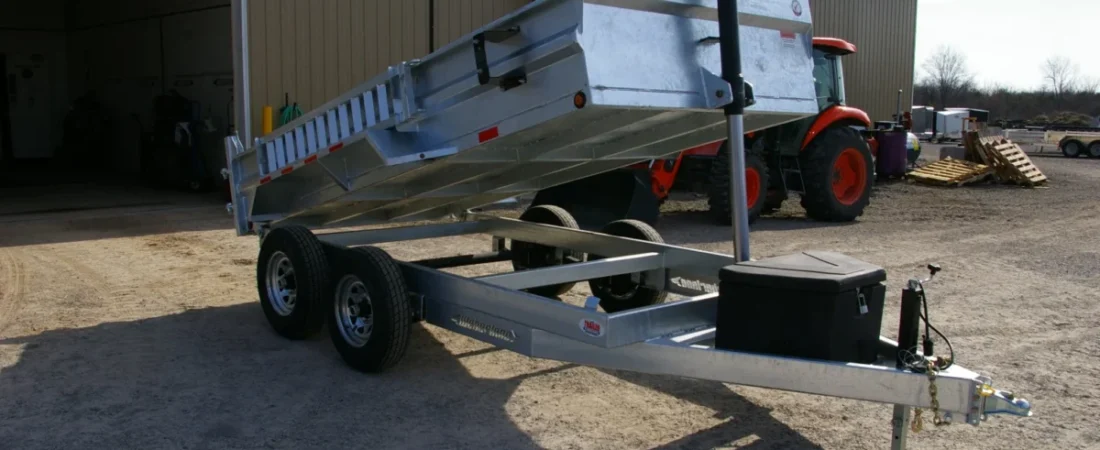
A dump trailer is a trailer with a hydraulic lift that tips the bed so loose loads like soil, gravel, mulch and demolition waste slide out the back in seconds. For homeowners and small jobs, a 5×10 or 6×12 tandem axle dump trailer rated 7,000 to 10,000 lb is usually enough. Contractors and landscapers who haul every day generally need a 7×14 or 83×14 rated around 14,000 to 15,400 lb, and the right truck to pull it. The most important thing to understand before you buy is that heavy materials fill a dump trailer by weight long before they fill it by volume.
That’s the quick answer. This guide covers dump trailer sizes, how much each material actually weighs, lift types, gates, galvanized versus painted steel, the hydraulic system and battery, tarps, towing, safety around the raised bed, and which dump trailers from our stock fit which kind of buyer. We sell every dump trailer mentioned here and deliver worldwide. Specs and prices come from our own listings, outside facts are linked to their sources, and where something is our opinion, we say so.
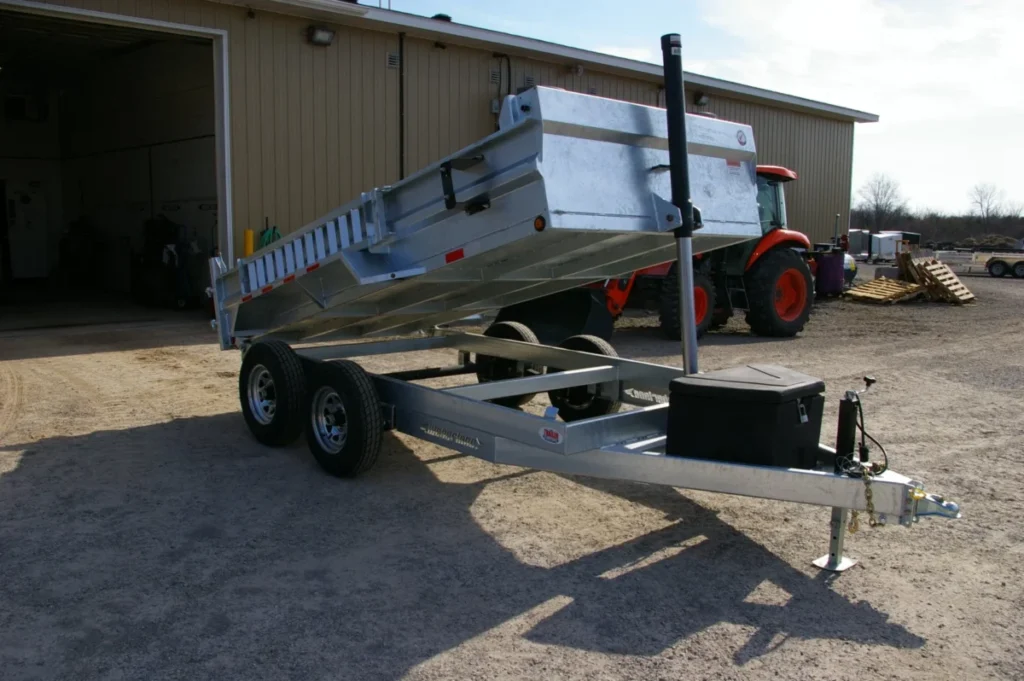
Dump trailer sizes at a glance
Here’s how we usually match a dump trailer to the job. It’s a starting point, and the sections below explain how to check it against your own loads and truck.
| Who it suits | Typical loads | Dump trailer to look at | From our stock |
|---|---|---|---|
| Homeowner, small property, renovation | Garden waste, mulch, bathroom demo, junk | 5×10, about 7,700 lb GVWR | 5×10 dump trailer |
| Small landscaper or builder | Soil, mulch, stone in part loads, site cleanup | 6×12, about 10,000 lb GVWR | 6×12 galvanized dump trailer |
| Contractor, landscape company, demolition | Gravel, rock, concrete rubble, roofing tear-offs | 7×14 or 83×14, about 14,000 to 15,400 lb | 7×14 dump trailer, 83×14 dump trailer |
| Bulky but lighter loads | Green waste, mulch, junk removal, leaves | 16 ft long bed | 82×16 galvanized dump trailer |
The pairings are our recommendation, based on what we sell and the jobs buyers describe to us.
What a dump trailer is good for, and what it isn’t
The whole point of a dump trailer is the hydraulic lift. You back up, press a button, and the bed tilts so the load slides out. A load that would take two people half an hour to shovel off a flat trailer comes off in under a minute. That saving repeats on every trip, which is why landscapers, builders, demolition crews, roofers, junk removal businesses and farmers buy them.
It’s also a decent general-purpose trailer. With the gate open, many will carry a mini excavator, skid steer or pallets (our 7×14 and 83×14 are the usual picks for that), provided the box is wide enough and has tie-down points. The trade-offs are weight and price. It weighs more and costs more than an open utility trailer of the same size, because of the heavy box, the hydraulics and the battery. Its floor sits higher, too, which makes loading machinery steeper.
If you mostly move mowers and tools, an open trailer such as our 5×10 steel utility trailer or 7×16 aluminum trailer is cheaper and lighter. Our landscape trailer guide covers that side. If you move loose material regularly, the lift pays back quickly in labour alone. That’s our view from how customers use them, not a fixed rule.
The big one: weight versus volume
Dump trailers get overloaded more than any other trailer we sell. The reason is simple. The box looks only half full, but the material in it already weighs more than the trailer can carry.
How much loose material weighs
- Soil. The USDA Natural Resources Conservation Service gives a bulk density of about 1.33 g/cm³ for a medium-textured soil. By our arithmetic that’s roughly 1,000 kg, or about 2,200 lb, per cubic yard of dry soil. Damp soil from a supplier’s pile weighs more, because the water adds weight.
- Crushed stone and gravel. The Ohio Department of Transportation’s construction specification uses conversion factors of 3,800 lb per cubic yard for crushed stone and 3,900 lb per cubic yard for crushed gravel. Those figures are for compacted aggregate in a road base, so loose stone in a trailer will be somewhat lighter. It’s still far heavier than most people expect.
- Mulch, wood chips and green waste. Much lighter, but it varies a lot with type and moisture. Use the weight ticket from your supplier.
- Concrete rubble, brick and roofing shingles. Heavy. Treat them like stone until you know better.
A worked example
Take our 7×14 dump trailer, rated 15,400 lb GVWR. Suppose the sides are 2 ft high. That’s an assumption for the example, so ask us for the real side height of any model.
- Box volume: 7 × 14 × 2 = 196 cubic feet, or a little over 7 cubic yards.
- Dry soil at about 2,200 lb per cubic yard: about 16,000 lb.
- Crushed stone at even 3,000 lb per cubic yard, a loose figure we’ve assumed below the compacted Ohio factor: about 21,800 lb.
Both are more than the trailer’s entire GVWR, before you add the weight of the trailer itself. So with heavy material, you load by weight, not by eye. Ask the yard how much each bucket weighs and stop at your payload. With mulch or green waste, you’ll fill the box long before you reach the weight limit.
Payload, not GVWR
GVWR is the total the trailer may weigh, itself plus load. Payload is GVWR minus the empty weight. These trailers are heavy empty, because of the box and hydraulics, so payload can be a lot lower than the headline figure. Always ask for the empty weight. We’ll give it to you for any trailer we sell.
Dump trailer lift types
How the bed is lifted affects capacity, dump angle, price and upkeep. Four designs are common:
| Lift type | How it works | Strengths | Watch for |
|---|---|---|---|
| Single ram | One hydraulic cylinder under the front of the bed | Simple, cheap, fine for light and medium loads | Less lifting power for heavy, full loads |
| Dual ram | Two cylinders side by side | More lifting force, steadier lift | More cylinders to service |
| Scissor hoist | A scissor frame under the bed pushed by a cylinder | Strong, stable lift, popular on heavier trailers | More pivot points to grease |
| Telescopic | A multi-stage cylinder at the front of the box | High lift, steep dump angle, good for sticky loads | Usually the most expensive |
For most buyers, the lift design matters less than whether the lift is rated for the trailer’s full capacity, and whether you’ll keep it maintained. A steep dump angle helps wet clay and sticky material slide out. Ask what angle any trailer you’re considering reaches, ours included.
Gates: barn doors, spreader or combo
The rear gate decides how the load comes out and what else the trailer can do.
- Spreader gate: hinged at the top. You can open it a little to spread gravel or road base in a strip as you drive forward slowly. Handy for driveways and paths.
- Barn doors: two doors swinging out to the sides. They clear the opening completely for bulky loads and for driving equipment in on ramps.
- Combo gate: works as either barn doors or a spreader. Popular because it does both jobs.
- Ramps: some dump trailers have slide-in or fold-down ramps for loading machinery. Check the ramp rating against your machine.
If you plan to carry a skid steer or mini excavator in the dump box, you’ll want barn doors or a combo gate plus ramps. Our skid steer trailer guide covers machine weights and tie-downs in detail.
Box size and side height
Box length and width are only part of the volume story. Side height matters as much. Low sides suit heavy material, because you’ll hit the weight limit early anyway. Higher sides, or add-on side extensions, suit bulky light loads like mulch, leaves and junk.
- 5×10: narrow and short. Fits garden gates and side passages, and tows behind smaller trucks.
- 6×12: a popular all-rounder for small landscapers and builders.
- 7×14: the standard contractor size.
- 83 in wide: wider than a 7 ft box, which gives more volume and makes loading with a bucket easier.
- 16 ft: a long box for bulky loads in fewer trips.
The width also decides whether a machine fits between the sides. Measure your machine across the tracks or tires and ask for the inside width of the box.
Galvanized or painted steel?
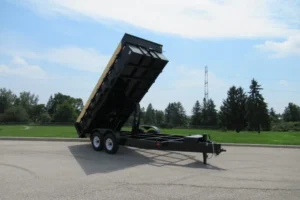
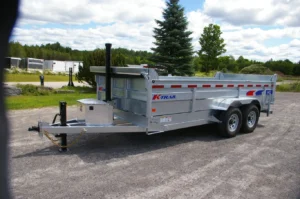
These trailers live a hard life: wet soil, sharp stone, salt on winter roads, and the inside of the box scraped by every load. Painted steel is cheaper and easy to repair, but paint wears off the floor and sides quickly, and bare steel rusts. Hot-dip galvanized steel has a zinc coating that protects the steel much longer, which is why our 6×12 and 16 ft galvanized dump trailers are popular with landscapers who wash out wet loads every day.
Our view: if your trailer will live outside, see salt, or carry wet loads most days, galvanized usually pays for itself in resale value and repainting you don’t have to do. If budget comes first and you’ll touch up the paint, black steel is fine. Our aluminum vs steel trailer article covers the wider materials question.

The hydraulic system and battery
Most dump trailers use a 12 volt electric-hydraulic pump powered by a battery on the trailer. The pump pushes fluid into the lift cylinder, and a valve lets it back out to lower the bed. A few points matter:
- Battery. A deep-cycle battery copes better with repeated lifts than a car starting battery. Many owners keep it topped up with a charge line from the truck, a solar panel on the trailer, or a plug-in charger at the yard.
- Remote. A wired or wireless remote lets you stand clear of the trailer while dumping.
- Fluid. Check the reservoir level and look for leaks at hoses and fittings.
- Cold weather. Hydraulic fluid thickens in the cold, and batteries lose capacity. Slow lifting in winter is normal, but a weak battery makes it worse.
A flat battery is the most common reason the bed won’t lift. That’s our experience from customer calls, not a statistic, and it’s worth carrying a charger or jump pack.
Safety around a raised bed
A raised dump bed is heavy, and hydraulics can fail. US workplace safety rules for construction trucks with dump bodies require positive means of support, permanently attached, that can be locked in position to stop the body lowering accidentally during maintenance or inspection. They also require dump controls with a latch to stop accidental tipping, and tailgate trip handles placed so the operator stays clear. Those rules are written for trucks, but the same logic applies to any dump trailer.
- Never work under a raised bed without the safety prop or bed lock in place.
- Look up before you lift. OSHA’s overhead power line guidance lists raised dump trucks among the equipment that can contact lines, and says to never get closer than 10 feet to an overhead power line. A NIOSH investigation describes a road crew foreman who was electrocuted when a raised dump bed touched a 7,200 volt line during paving work.
- Dump on level ground. A dump trailer on a side slope can tip over when the bed is raised, especially with a load stuck at the top.
- Keep people clear of the back and sides while the bed goes up and the gate swings.
- Lower the bed before moving, except for the slow forward creep used when spreading.
How to load so it tows straight
Where the material sits in the box changes how the whole rig behaves on the road. A few habits help:
- Spread the load evenly from side to side. A heap on one side leans the trailer and loads one set of tires and springs more than the other.
- Keep a little more toward the front. Aim for the tongue weight range in the towing section below. A load piled at the back takes weight off the hitch and invites sway.
- Don’t drop heavy rock from height. A loader bucket emptied from high up can dent the floor and shock the springs. Lower the bucket and let the material roll out.
- Level the top before you tarp, so the cover sits flat and doesn’t flap.
- Check the gate is latched and the bed is fully down before you move off.
For a mixed load, put the heaviest material in first and spread it over the floor, then add the lighter bulk on top. It tows better, and it tips out more cleanly.
Spreading gravel with the gate
With a spreader gate, you can lay a strip of gravel or road base straight from the trailer instead of tipping one big heap. The usual method:
- Open the gate chains a little so the gate can swing only a few inches.
- Raise the bed slowly until material starts to flow under the gate.
- Drive forward at a crawl, keeping a steady speed.
- Adjust the chain length or the bed angle until the strip is the depth you want.
It takes a couple of tries to get the feel of it. Practise on a spot where the result doesn’t matter much. Once you have it, a driveway or path that would take hours with a wheelbarrow takes a few minutes.
Unloading at the tip or landfill
If you haul waste, you’ll be dumping at transfer stations and landfills. Some practical points:
- Check what each site accepts. Many separate green waste, inert rubble, metal and general waste, and some refuse certain materials outright.
- Know the weighbridge routine. Many sites weigh you in and out and charge by weight. Uncovered loads may be charged extra at some sites.
- Sort before you load if you can. Mixed loads are often charged at the highest rate.
- Follow the site staff’s directions on where to back up and when to tip, and watch for people and other vehicles behind you.
Rules and charges vary from place to place, so call ahead the first time you use a new site.
Covering and securing loads
Loose loads blowing off a trailer are a real road safety problem. The AAA Foundation for Traffic Safety estimated an average of about 50,658 police-reported road debris crashes a year in the US from 2011 to 2014, and said about two-thirds of debris crashes involve items falling from vehicles.
Many places require loose loads to be covered. Washington State’s law is a clear example: RCW 46.61.655 requires vehicles carrying dirt, sand or gravel on paved public roads to be covered to prevent spillage, unless six inches of freeboard is kept in the bed. Rules differ elsewhere, but a tarp is cheap insurance. A roll tarp kit on the front of the box makes covering the load a ten-second job, which means it actually gets done.
Machines and equipment carried in the box need proper tie-downs too. Our guide to securing a load on a trailer explains straps, chains and working load limits.
Towing a dump trailer
A loaded dump box is one of the heaviest things most people ever tow. Check three things before you buy:
- Your truck’s towing capacity, tongue weight and payload, from its owner’s manual. A big contractor dump trailer usually needs a three-quarter-ton or one-ton truck.
- Tongue weight. GMC’s towing guide says a conventional trailer should put 10 to 15 percent of its loaded weight on the hitch, and a gooseneck 15 to 30 percent. On a loaded 14,000 lb bumper pull dump trailer, that’s 1,400 to 2,100 lb on the truck. Load material evenly, a little toward the front of the box.
- Brakes. Tandem dump trailers have brakes, usually electric, controlled by a brake controller in the truck. Check that they work on every axle and that the breakaway system is charged.
Some buyers choose a gooseneck dump trailer for very heavy daily work, because it puts more weight over the truck’s rear axle. Our gooseneck vs bumper pull guide explains the trade-offs, and our trailer towing tips cover braking and backing up with a heavy trailer. All the dump trailers in our current range are tandem axle. Our tandem axle trailer guide explains why that matters.
Owning versus hiring a skip or a truck
Before buying, many people compare a dump trailer with the alternatives: hiring a skip or roll-off bin, paying a haulage company, or hiring a trailer by the day.
- Skip or roll-off bin: convenient for one big clear-out. You pay for the bin, the delivery, the collection and often by weight, and it sits on your drive until it’s collected. For repeated jobs, the costs add up quickly.
- Haulage company: no equipment to own, but you work to their schedule and pay for every load.
- Hiring a trailer: fine for the occasional weekend. Not practical if you need it every week.
- Owning: you pay once, plus running costs, and the trailer is ready whenever you are. It also keeps resale value if it’s looked after.
To compare, add up what you spent on skips, haulage or hire over the last year or two and set it against the price of a trailer plus running costs. For anyone moving loose material more than a few times a month, owning usually comes out ahead. That’s our view from talking to buyers, so do the sum with your own numbers.
Dump trailers we sell
Prices are in US dollars and correct when this was written. Click through for current prices, photos and full specs.
- 2027 5×10 dump trailer: 5 x 10 ft box, tandem axle, steel, black, 7,700 lb GVWR, $5,900. Compact enough for homeowners and tight access, with a generous rating for its size.
- 2027 6×12 galvanized dump trailer: 6 x 12 ft bed, tandem axle, hydraulic lift, galvanized steel, silver, 10,141 lb GVWR, $5,700. Our pick for small landscapers and builders.
- 2027 83×14 dump trailer: 83 in x 14 ft box, tandem axle, steel, black, 15,119 lb GVWR, $6,700. The wider box makes bucket loading easier.
- 2027 7×14 dump trailer: 7 x 14 ft, tandem axle, hydraulic lift, steel, black, 15,400 lb GVWR, $7,800. The highest rating in our dump trailer range.
- 2026 82×16 galvanized dump trailer: 82 in x 16 ft box, tandem axle, galvanized, silver, 14,000 lb GVWR, $7,900. Long box for bulky loads.
See all dump trailers.

If you don’t need the lift
Some buyers find that what they really need is a cheaper open trailer. For mowers, tools and palletized materials, look at our 7×14 utility trailer ($2,200, 7,000 lb GVWR) or 7×18 utility trailer ($3,800, 9,900 lb GVWR). For machines, the 7×16 heavy duty equipment trailer ($5,100, 15,400 lb GVWR) or a hydraulic power tilt trailer may suit better. For a ride-on mower or small machine, a gravity tilt trailer or 7×20 tilt trailer is worth a look. Browse all utility trailers and equipment trailers.
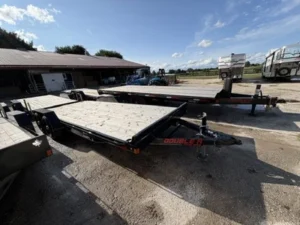
Four buyers and the dump trailer we’d match to each
These are typical situations buyers describe to us, with our suggestion for each. Run your own material weights through the sums above before deciding.
The homeowner with a big project
A garden makeover, a renovation, years of clutter, and a half-ton pickup or a large SUV. The 5×10 dump trailer fits through gates and down side passages, and its 7,700 lb rating gives headroom for part loads of soil or stone. Load heavy material to the weight limit, not the top of the box.
The small landscaper
Mulch most weeks, soil and stone some weeks, a three-quarter-ton truck. The 6×12 galvanized dump trailer handles both, shrugs off wet loads and washes out clean. Add a roll tarp.
The contractor moving rock and rubble every day
Gravel, base, concrete rubble and dirt from excavations, loaded by machine, a one-ton truck. The 7×14 at 15,400 lb or the 83×14 at 15,119 lb are built for this. Pick the 83×14 if you load with a wide bucket.
The junk removal or green waste business
Bulky, mixed, mostly lighter loads, lots of trips. The 16 ft galvanized dump trailer gives the most volume per trip. Side extensions make it hold even more.
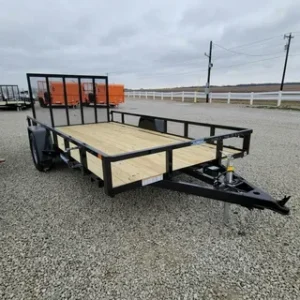
One big trailer or two smaller ones?
Growing businesses sometimes ask whether to buy one large trailer or two smaller ones. Some points to weigh:
- Two smaller trailers let two crews work at once, fit tighter sites and can be towed by smaller trucks.
- One large trailer moves more per trip with one driver and one truck, but needs a heavier truck and more room on site.
- Mixed fleets are common: one heavy contractor box for rock and rubble, and a lighter, smaller one for mulch and garden jobs.
Our view: if you often have two jobs on the same day, two smaller trailers usually earn more. If you mostly run one crew on large jobs, one bigger box is simpler. Talk to us about your work and we’ll suggest a mix.
Matching the loader to the box
If you load with a skid steer, compact track loader, backhoe or wheel loader, check that the bucket clears the sides and reaches the middle of the box. A box that’s too tall for your machine means material spilling over the side. An 83 inch wide box, like our 83×14, is easier to fill evenly with a wide bucket than a narrower one. Ask us for the side height of any model and compare it with your machine’s dump height.

Using it in winter
Cold weather brings its own problems for a hydraulic tipping box:
- Frozen loads. Wet soil and gravel can freeze to the floor and sides overnight. Don’t leave damp loads in the box in freezing weather if you can avoid it. A light coat of release agent on the floor before loading helps some materials slide.
- Slow lift. Hydraulic fluid thickens and batteries lose power in the cold. Keep the battery charged and give the pump time.
- Salt. Rinse the frame, hinges and running gear after driving on salted roads, especially on painted steel.
- Snow and ice in the box. Clear them before loading, or they add weight you didn’t plan for.
- Winter work. Many owners use the same trailer to haul salt, sand and grit for winter maintenance contracts, which keeps it earning all year.
Putting a tipping trailer to work in a business
For a lot of buyers, the trailer isn’t a tool for one job. It’s the start of a service. Common ways owners put one to work:
- Landscape supply runs: collecting soil, mulch and stone for your own jobs instead of paying for delivery.
- Junk and clearance work: house clearances, garden clearances and renovation waste.
- Site cleanup for builders: removing rubble and offcuts so the site stays clear.
- Roofing tear-offs: backing up to the house so old shingles go straight in the box.
- Farm and property work: moving manure, feed waste, firewood and fencing materials.
- Winter grit and salt: as above.
We can’t tell you what any of these will earn, because prices and demand vary so much by area. What we can say is that the trailer you choose should match the work you’ll actually do most often, not the biggest job you might do once a year.
Accessories worth adding
- Roll tarp kit: covers the load in seconds.
- Side extensions: mesh or board extensions for bulky, light loads.
- Ramps: for loading machinery, if the trailer doesn’t come with them.
- Solar charger or charge line: keeps the battery ready.
- Wireless remote: lets you dump from a safe distance.
- Toolbox on the tongue: straps, chains and the remote stay with the trailer.
- Spare tire and mount.
- Coupler and wheel locks for job sites and yards.
Looking after a dump trailer
A dump trailer has more moving parts than a flat trailer, so a little regular care goes a long way:
- Grease the pivot points on the hinge and scissor frame.
- Check hydraulic fluid and hoses for leaks and wear.
- Keep the battery charged, especially in winter.
- Wash out the box after wet or salty loads, and touch up bare steel on painted trailers.
- Check the gate hinges and latches.
- Service the brakes, bearings and tires on schedule. Heavy loads wear them faster.
Our trailer maintenance checklist covers bearings, brakes and tires in more detail.
Buying a used dump trailer: what to inspect
Used dump trailers are often worked hard and overloaded. Before buying any used dump trailer, ours or anyone else’s, check:
- The lift. Raise and lower the bed fully. It should move smoothly without jerks, noises or leaks.
- The frame and box. Look for cracked welds, bowed sides and a sagging floor, signs of overloading.
- The hinge and pivot pins. Worn pins and holes let the bed rock.
- The battery and pump. Ask how old the battery is. Listen to the pump.
- Axles, springs and tires. Uneven tire wear or flat springs can mean a bent axle or a history of overloading.
- Brakes and wiring. Test both with your truck.
- Rust inside the box and under the floor, on painted trailers.
What a dump trailer costs to own
We can’t give exact running costs because they vary so much from country to country, but plan for:
- Registration, plates and inspection, where local rules require them.
- Insurance.
- Tires, brakes and bearings, which wear faster under heavy loads.
- Batteries and hydraulic servicing.
- Tarps and accessories.
- A bigger truck, if yours isn’t rated for the dump trailer you need. For many buyers this is the biggest hidden cost.
Set against that is the time saved on every load you don’t shovel by hand. For a business, that saving usually decides it. That’s our opinion from talking to buyers.
Dump trailer buying checklist
- What will you haul most: heavy material, light bulky loads, or machines?
- GVWR and empty weight, so you know the payload?
- Box length, width and side height?
- Lift type and dump angle?
- Gate type: spreader, barn doors or combo? Ramps?
- Galvanized or painted steel?
- Battery type, charging method and remote?
- Bed safety prop or lock?
- Brakes on both axles and a working breakaway?
- Can your truck tow it, with the tongue weight and payload that brings?
- Tarp kit fitted or available?
We’ll answer every question on this list for any dump trailer we sell. If hauling machines is part of the plan, read our skid steer trailer guide too. For general advice on any trailer, see our guide on how to choose a trailer and our overview of the types of trailers.
Mistakes we see people make
These come from our own conversations with buyers, so treat them as experience rather than statistics.
- Filling the box with stone. It looks fine and weighs far more than the rating.
- Buying the biggest box for the wrong job. Heavy material never fills a big box, so you’ve paid for steel you can’t use.
- Letting the battery go flat. The trailer won’t lift, usually at the worst moment.
- Dumping on a slope. A raised bed on uneven ground is how dump trailers tip.
- Forgetting the power lines. Look up every time.
- Underestimating the truck. A loaded contractor dump trailer is a serious load.
Delivery worldwide
We deliver dump trailers to customers in many countries. Tell us where the trailer is going and what you’ll tow it with, and we’ll quote delivery on each model you’re considering and flag any width, braking or lighting points that matter where you live.
Dump trailer FAQs
What size dump trailer do I need?
Homeowners usually do well with a 5×10 or 6×12. Contractors and landscapers moving heavy material daily usually need a 7×14 or 83×14 rated around 14,000 to 15,400 lb.
How much can a dump trailer carry?
Its payload: GVWR minus empty weight. Ask for the empty weight of any model. With soil or stone, you’ll usually reach the weight limit before the box is full.
How much does a cubic yard of gravel weigh?
Ohio DOT’s specification uses about 3,800 to 3,900 lb per cubic yard for compacted crushed stone and gravel. Loose material is somewhat lighter. Your supplier’s weight ticket is the most accurate figure.
Galvanized or painted dump trailer?
Galvanized lasts longer with wet, salty and abrasive loads. Painted steel costs less but needs touching up.
What truck do I need for a dump trailer?
Check towing capacity, tongue weight and payload. A small 5×10 may suit a half-ton. Contractor-size dump trailers usually need a three-quarter-ton or one-ton truck.
Why won’t my dump trailer lift?
Most often a flat or weak battery. Also check the fluid level, fuses, the remote and the connections.
Can a dump trailer haul equipment?
Yes, if the box is wide enough, has tie-down points and has ramps rated for the machine.
Do you ship dump trailers outside the US?
Yes, we deliver worldwide. Ask for a delivered quote.
Find your dump trailer
Tell us what you haul, how often and what you tow with, and we’ll recommend a dump trailer that fits. Browse our dump trailers, equipment trailers, utility trailers and tilt and load trailers, or see everything in the shop. Questions? Contact us.
Sources and References
- USDA NRCS: Soil Quality Indicators, Bulk Density
- Ohio DOT: Item 411 Stabilized Crushed Aggregate (weight-to-volume factors)
- 29 CFR 1926.601: Motor vehicles, dump body support (Cornell LII)
- OSHA: Overhead power lines safety card (archived)
- NIOSH FACE: Foreman electrocuted when dump truck bed contacted power line
- AAA Foundation for Traffic Safety: Road debris crashes, 2011 to 2014
- Washington State Legislature: RCW 46.61.655
- GMC: Tongue weight and why it’s key to safe towing