

If you’re working out how to choose a trailer, the honest answer is that it comes down to three things: what you’ll carry, what you’ll tow with, and where the trailer will live. Get those right and almost any decent trailer will serve you well for years. Get them wrong and even an expensive one will annoy you every time you hitch up. This guide on how to choose a trailer walks through it in plain steps, the same way we’d talk it through with a customer on the phone.
Step 1: Write down what you’ll actually carry
Not what you might carry one day. What you’ll carry most weeks. A ride-on mower and a few tools? A skid steer? Boxes and furniture? Two horses? Be specific, and note the heaviest and the longest item. That single list does more to explain how to choose a trailer than any brochure.
Then add the odd jobs you know are coming: the house move next spring, the load of firewood every autumn. If those jobs only happen once a year, it’s often cheaper to hire for them than to buy a bigger trailer you drag around the rest of the time.
Step 2: Check what your vehicle can tow
The second half of how to choose a trailer is the vehicle pulling it. Find your tow vehicle’s towing limit in the handbook or on the plate inside the door. Then find its payload, because the weight pressing down on the hitch counts against it. The trailer’s loaded weight has to sit comfortably under the towing limit, and the hitch, ball and drawbar all need ratings above it too. The page on gross vehicle weight rating explains the terms if they’re new.
A useful habit: work out the weight of the trailer plus your heaviest normal load, and keep it to around 80 percent of the vehicle’s towing limit. That margin makes towing calmer, especially on hills and in wind.
Step 3: Pick the type of trailer
Once you know the load and the limit, the type usually picks itself.
| If you carry… | Look at |
|---|---|
| Garden waste, mowers, timber, furniture | Utility trailers |
| Tools or stock that must stay dry and locked | Enclosed cargo trailers |
| Skid steers, diggers, tractors, cars | Equipment trailers or tilt and load trailers |
| Gravel, soil, demolition waste | Dump trailers |
| Sleds in winter | Snowmobile trailers |
| Horses | Horse trailers |
That is the heart of how to choose a trailer: match the type to the load, not the other way round. If you’d like a fuller explanation of each kind, our article on the types of trailers goes through them one by one.
Step 4: Get the size right
Measure the biggest item and add some room. You want space to put the weight slightly ahead of the axle, room for straps, and a little left over. The most common regret we hear is “I should have gone a foot or two longer.” At the same time, measure where the trailer will be parked. A 20 ft deck is easy on the road and a nuisance down a narrow side passage.
Width matters as much as length. Most open trailers are about 5 to 7 ft (1.5 to 2.1 m) between the wheels. Wide machines, pallets side by side and cars often need 7 ft or a deckover design that uses the full width. Size is where most people get how to choose a trailer wrong, so take your time here.
Step 5: Decide on one axle or two
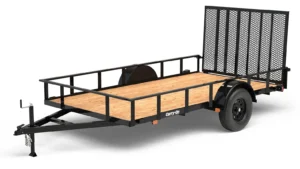
Single axle trailers are light, cheap to run and easy to move by hand. They suit loads up to roughly 3,500 lb (1,600 kg) and shorter decks. Tandem trailers carry more, track straighter, cope better if a tyre fails and feel calmer at speed. Once you go past about 14 ft or start carrying machines, two axles are usually worth it. Our 5×10 utility trailer is a good single axle example; the 7×20 equipment trailer shows what a working tandem looks like. For most people working out how to choose a trailer, this is the easiest decision of the lot.
Step 6: Choose the materials
Painted steel is the cheapest and easiest to repair. Galvanized steel costs a little more and resists rust far better, which matters if the trailer lives outside or you drive on salted roads. Aluminium is light, doesn’t rust and holds its value, but costs more up front. For a trailer you’ll keep for ten years, the extra spent on galvanized or aluminum usually comes back when you sell. When you think about how to choose a trailer for the long term, materials matter more than most people expect.
Step 7: Look at the details that make daily life easier
- Loading: a ramp gate, stand-up ramps or a tilt deck. Lifting heavy ramps gets old fast.
- Brakes: needed above certain weights in most places, and worth having on heavier trailers anyway.
- Tie-downs: enough anchor points in the right places.
- Lights: LED lights last longer and draw less power.
- Spare wheel: cheap insurance on any trip longer than a few miles.
These small things are often what separates a trailer you enjoy using from one you put up with. They are an underrated part of how to choose a trailer.
New or used?
Any guide on how to choose a trailer should mention used ones. A used trailer can be excellent value. The frame and body barely wear if they’ve been looked after, while the parts that do wear (tyres, bearings, brakes, lights, deck boards) are cheap to replace. Check the frame for rust and cracks, the floor for soft spots and the tyres for age. Our used trailers are described honestly, and we’ll send more photos on request.
Common mistakes when buying a trailer
We see the same few mistakes again and again. Buying too small to save a little money. Ignoring the tow vehicle’s payload. Forgetting where the trailer will be stored. Choosing a cheap trailer with no brakes for heavy loads. And not thinking about how you’ll load it. Knowing how to choose a trailer is mostly about avoiding those five.
Think about where you’ll tow
Roads matter. If most of your trips are short runs around town, a nimble single axle trailer is easier to live with. Long motorway journeys favour a tandem that sits steady at speed. Farm tracks and building sites call for good ground clearance and tough tyres. Winter driving on salted roads is a strong argument for galvanized steel or aluminum. Picture your typical trip and let that shape the choice as much as the load does.
Budget beyond the sticker price
Money is part of how to choose a trailer too, and the trailer price is only part of the cost. Add delivery, registration where it applies, a spare wheel, a coupler lock and decent straps or chains. If your vehicle needs a tow bar, wiring or a brake controller fitted, include that too. Running costs are low but not zero: tyres every few years, bearing grease, the odd bulb. Knowing the full figure up front avoids surprises and often makes the case for a better-built trailer that costs less to keep.
Licences, rules and paperwork
Rules differ from country to country and sometimes by region. Some places limit how heavy a trailer you can tow on a standard car licence. Many require trailers to be registered and plated, and most ask for brakes above a set weight. Check the rules where you live before you buy, so the trailer is legal to use the day it arrives. We supply the documents you need from our side, including the VIN and build details.
Examples from our range
Here is how to choose a trailer in practice, using a few typical customers. A homeowner with a garden and a small car usually ends up with a 5×8 utility trailer. A landscaper with two mowers often picks a 7×16 enclosed trailer or a tilt deck such as the 7×20 tilt trailer. A contractor with a mini digger needs something like the heavy duty equipment trailer. A rider with three horses and a half-ton pickup might go for the 3 horse trailer.

Before you tow it home
Whatever you buy, practise with it empty before the first real job. Find a quiet car park, try a few turns and some reversing, and get a feel for how much wider you need to take corners. Our trailer towing tips cover the rest, from setting up the hitch to braking with a load.
How to choose a trailer: quick checklist
Save this on your phone. It is how to choose a trailer in seven lines.
- List the heaviest and longest things you’ll carry regularly.
- Check your vehicle’s towing limit and payload.
- Pick the trailer type that matches the load.
- Choose a size with a little room to spare, and check your parking space.
- Decide on one or two axles.
- Pick steel, galvanized or aluminum.
- Check loading, brakes, tie-downs, lights and spare wheel.
Questions people ask us
What’s the first step in how to choose a trailer?
Write down what you’ll carry most often, then check what your vehicle can legally and safely tow.
Is a bigger trailer always better?
No. A trailer that’s too big costs more, weighs more and is harder to park. Choose the size your regular loads need, plus a little.
Do I need brakes on my trailer?
It depends on the loaded weight and your local rules. Heavier trailers almost always need them.
Can you help me choose?
Yes. Tell us what you carry and what you tow with, and we’ll suggest one or two trailers that fit.
Talk to us
If you’re still unsure how to choose a trailer for your situation, contact us. We’ll ask a few questions and point you to the right one, even if it’s a cheaper model than you expected. You can also browse every trailer for sale in our shop.