
This trailer size guide boils down to one rule: measure the biggest thing you’ll carry, add a foot or two of length for straps and balance, check it fits between the wheels, and make sure the loaded weight suits both the trailer’s rating and your vehicle. For garden and household jobs that usually means a 5×8 or 5×10. For a ride-on mower or quad, a 6×12 or 6×14. For landscaping crews, a 7×14 to 7×18 tandem. For skid steers and mini diggers, a 7×16 to 7×22 equipment or tilt trailer. For cars, 18 to 24 ft. For pallets and wide machines, a 102 in deckover. If you’re between two sizes, the larger one is usually the better buy.
The rest of this trailer size guide explains how trailer sizes are measured, walks you through sizing step by step, and gives a size chart for more than twenty common loads, matched to trailers we actually sell. Where a fact comes from an official source or a manufacturer we link to it; where it’s our own advice from selling trailers, we say so.
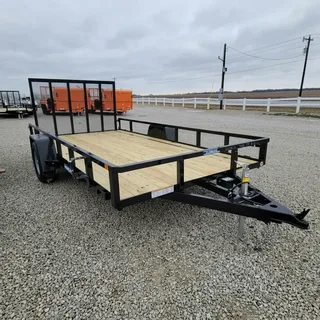
Trailer size guide basics: how sizes are described
Every trailer size guide starts with the naming. A trailer listed as “6×12” has a deck about 6 ft wide and 12 ft long. The first number is the width, the second is the length. Some makers give the width in inches instead, which is why you’ll see sizes like 77×14 or 82×20; 77 in is about 6.4 ft and 82 in is about 6.8 ft. Deckover trailers are often described as “102 in”, meaning the full 8.5 ft width.
A few things every buyer should know before using any trailer size guide:
- Deck size isn’t overall size. The tongue, fenders and lights add length and width. A 6×12 trailer is much longer than 12 ft from coupler to tail lights.
- Width between the fenders matters. On most flatbeds and utility trailers, the fenders sit beside the deck, so the usable width is the deck width. On deckovers, the deck sits over the wheels and uses the full width.
- Dovetails count. A trailer sold as “20+5” has a 20 ft flat deck plus a 5 ft sloping dovetail at the back.
- Enclosed trailers have interior height and door sizes. The box size is only part of the story; the door opening decides what goes in.
Trailer size guide step 1: measure your longest load
Measure the longest item you’ll carry regularly, with any attachment fitted: a mower with its deck, a skid steer with its bucket, a car bumper to bumper. Then add about 1 to 2 ft (30 to 60 cm). That extra space lets you place the weight slightly ahead of the axle, leaves room for straps, and stops anything hanging off the back. This is our rule of thumb rather than an official figure, but it’s the one we use when helping customers in this trailer size guide.
Trailer size guide step 2: measure the width
Measure the widest point of your load: wheel to wheel, track to track, or the widest part of the bucket. Compare it with the trailer’s usable deck width, leaving a few inches each side so you’re not driving on the edge of the deck. Most 5 and 6 ft wide trailers suit mowers, quads and garden machines. Most compact machines need a 7 ft deck. Cars usually need about 7 ft between the fenders or a car hauler. Pallets and wide machines often need a deckover.
Legal width limits
There are legal limits on how wide a trailer can be. In the UK, GOV.UK says the maximum trailer width for any towing vehicle is 2.55 metres (GOV.UK: towing weight and width limits). In the US, the Federal Highway Administration explains that the federal width limit for commercial motor vehicles on the National Network is 102 inches, or about 2.6 metres (FHWA: federal size regulations FAQ). Other countries have their own limits, so check yours, but you’ll notice that the widest trailers in our range, the 102 in deckovers, are built right to that common limit.
If you already know you want an open deck, our flatbed trailer guide compares utility, equipment, tilt and deckover types side by side.
Trailer size guide step 3: check the height
Many people skip this step of the trailer size guide. Height matters for enclosed trailers, horse trailers and tall loads. For enclosed trailers, measure your tallest item and compare it with the interior height and the door opening. In our range, enclosed trailers come with 78 in (1.98 m), 84 in (2.13 m) or 90 in (2.29 m) of inside height. For open trailers, think about overall height on the road: a tall machine on a deckover can be too high for low bridges.
Trailer size guide step 4: work out the weight
Size and capacity go together, and this is the step of the trailer size guide that keeps you safe. A big deck with a low rating is no use for heavy machines, and a small trailer can be overloaded easily with soil or stone. Find the trailer’s GVWR, subtract its empty weight to get the payload, and make sure your heaviest load fits inside it with a margin. Then check the tow side: Ford’s official 2026 Super Duty towing guide, for example, says tongue load for conventional towing should be 10% of the total loaded trailer weight, so your vehicle’s payload has to carry that too.
Trailer size guide step 5: check your tow vehicle and parking
Look up your vehicle’s towing limit. GOV.UK notes the towing weight is usually listed in the handbook or specification sheet, and on the VIN plate under the bonnet or inside the driver’s door (GOV.UK). The loaded trailer must sit comfortably under it. Length rules can apply too: GOV.UK says vehicles with a maximum authorised mass of 3,500 kg or less cannot tow a trailer longer than 7 metres. Finally, measure where the trailer will live. A trailer that won’t fit in your driveway is the wrong size, however good it is.
Trailer size chart: which size for which load?
This is the heart of the trailer size guide. The suggested sizes are our general advice from selling trailers, based on typical dimensions; always check your own load against the trailer’s actual deck, door and weight figures.
| Load | Suggested size | Trailers to look at |
|---|---|---|
| Garden waste, tip runs | 5×8 or 5×10 | 5×8 utility trailer, 5×10 utility trailer |
| Push mower and tools | 5×8 | 5×8 aluminum trailer |
| Small ride-on mower | 5×10 or 6×12 | 5×10 aluminum trailer, 6×12 aluminum trailer |
| Zero-turn mower plus push mower | 6×14 or 7×14 | 6×14 tilt trailer, 7×14 utility trailer |
| Landscaping crew kit | 7×16 to 7×18 tandem | 7×16 aluminum trailer, 7×18 utility trailer |
| Compact garden tractor with loader | 6×12 rated 7,000 lb, or 7×16 | 7000 lb tilt trailer, 7×16 equipment trailer |
| One quad bike (ATV) | 5×10 or 6×12 | lightweight utility trailer |
| Two quads or a side-by-side | 7×14 to 7×16 | aluminum utility trailer |
| One or two motorbikes | 5×8 to 6×12, or enclosed 6×12 | 6×12 enclosed cargo trailer |
| Two snowmobiles | 7×19 to 7×21 enclosed | used snowmobile trailer, aluminum snowmobile trailer |
| Three or four snowmobiles | 7×25 enclosed | 7×25 snowmobile trailer |
| Tools for one trade | 6×12 enclosed | 6×12 enclosed cargo trailer |
| Trade tools plus stock or a workbench | 7×14 to 7×16 enclosed | 7×14 enclosed trailer, 7×16 enclosed trailer |
| Small flat move | 6×12 enclosed | 6×12 enclosed cargo trailer |
| Family house move | 7×14 to 8.5×24 enclosed | 7×14 cargo trailer, 24 ft enclosed trailer |
| Skid steer | 7×16 to 7×20, heavy rating | heavy duty equipment trailer, 7×20 tilt trailer |
| Mini excavator (3 to 5 t) | 7×20 to 8×24, heavy rating | 7×22 tilt trailer, 8×24 tilt trailer |
| Car | 18 to 20 ft car hauler or 8.5×20 enclosed | car hauler trailer, enclosed car trailer |
| Pallets of materials | 20 ft or longer deckover | 20 ft deckover trailer |
| Gravel, soil, rubble | 5×10 to 7×16 dump | 5×10 dump trailer, 16 ft dump trailer |
| Two horses | 2 horse trailer | 2 horse trailer |
| Three horses | 3 horse slant or straight load | 3 horse trailer, 3 horse slant load trailer |
| Four to six horses with living space | Gooseneck with living quarters | 4 horse living quarters trailer, 6 horse trailer |
If your load falls between two rows of this trailer size guide, go for the larger size. In our experience, people who come back to trade up almost always say the same thing: they bought one size too small.
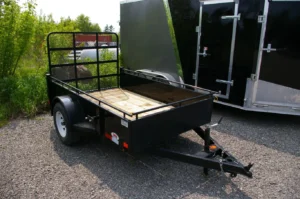
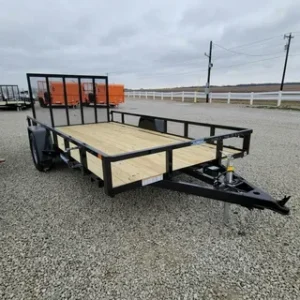
Trailer size guide example: a skid steer
Real numbers make this trailer size guide easier to use. Take a compact skid steer like the Bobcat S70. Bobcat’s official S70 specifications list an operating weight of 2,892 lb, an overall width of 35.5 in, a length without attachment of 75.6 in and a height of 71.4 in.
Here’s how we’d size a trailer for it. This is our own worked example:
- Length: about 6.3 ft without a bucket. With a bucket on the front, allow a couple more feet. Add 1 to 2 ft for positioning and straps, and a 10 to 12 ft deck is the bare minimum.
- Width: 35.5 in fits easily on a 6 ft (72 in) deck.
- Weight: 2,892 lb for the machine, plus a bucket or other attachment and fuel. Add the trailer’s own weight and you’re well past what a typical 3,000 lb single axle utility trailer can take.
- Result: a trailer rated for the machine plus attachments with a good margin, such as the 7000 lb tilt trailer for this small machine alone, or a 7×16 tandem like the 7×16 equipment trailer if you’ll also carry attachments and tools.
Bigger skid steers and compact track loaders weigh much more, often several times as much, so check your own machine’s operating weight and step up to heavier-rated trailers like the heavy duty equipment trailer (15,400 lb) accordingly.
Trailer size guide example: pallets
Pallet sizes are standardised. The international standard ISO 6780, “General-purpose flat pallets for through transit of goods”, lists plan dimensions including 1200 x 800 mm, 1200 x 1000 mm, 1219 x 1016 mm (the common 48 x 40 in size) and 1140 x 1140 mm (ISO 6780:1988).
Our own arithmetic from those sizes:
- On a 6 ft (about 1,830 mm) wide deck, you can fit one 1219 x 1016 mm pallet across with room to spare, but not two side by side.
- On a 7 ft (about 2,130 mm) deck, two 1016 mm sides fit side by side (2,032 mm), with about 100 mm to spare, so loading is tight but possible.
- On a 102 in (about 2,590 mm) deckover, two pallets sit side by side comfortably, and you can forklift them on from either side.
So if you move pallets regularly, a deckover like the 20 ft deckover trailer or deckover trailer is the easiest choice. Remember that a pallet of blocks or stone can be very heavy, so check the weight against the trailer’s rating as well as the space.
Trailer size guide example: sheet materials
Builders often carry sheets of plywood, plasterboard or OSB, which are commonly sold in 4 x 8 ft sheets. A 5 ft wide trailer takes them flat, and a deck of 8 ft or longer keeps them fully supported. A 5×10 like the 5×10 utility trailer handles a stack of sheets with room for tools at the front. Strap them down well, because flat sheets catch the wind.
Trailer size guide by size: open trailers
5×8 trailers
The smallest size in this trailer size guide and often a first trailer. Good for garden waste, a push mower, tip runs, firewood and small furniture. Light enough for many small cars to tow and for one person to move by hand. Too short for most ride-on mowers and too small for machines. See the 5×8 utility trailer (steel, 2,990 lb GVWR) and 5×8 aluminum trailer (2,996 lb).
5×10 trailers
Two extra feet make a real difference: room for a small ride-on mower, longer timber, 4×8 sheets with tools in front, or a quad bike. Still a single axle and easy to store. Our 5×10 utility trailer is rated at 3,500 lb; the 5×10 aluminum trailer and lightweight utility trailer are lighter, rust-free options.
6×12 trailers
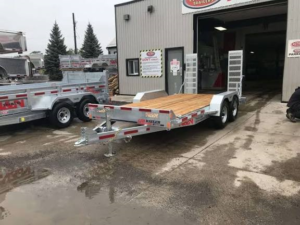
A popular all-rounder in any trailer size guide. Wide enough for most ride-on mowers and quads, long enough for a machine plus some tools. As an open trailer, see the 6×12 aluminum trailer or single axle aluminum trailer. As a tilt deck, the 6×12 tilt trailer (5,000 lb), gravity tilt trailer and the heavier 7000 lb tilt trailer remove ramps altogether.
6×14 trailers
A little longer for a mower plus a trimmer rack, or a longer machine. The 6×14 tilt trailer is a single axle gravity tilt rated at 5,000 lb.
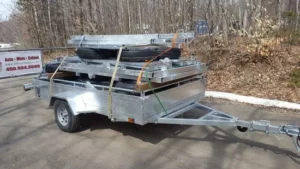
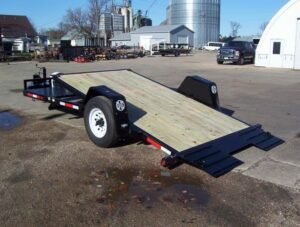
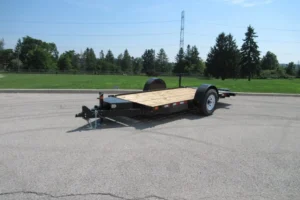
7×14 trailers
The step into tandem axles and 7 ft width, and the size this trailer size guide recommends most for working crews. This is the classic landscaper’s size: a zero-turn and push mower, trimmers, fuel and a pallet of slabs now and then. See the steel 7×14 utility trailer (7,000 lb) and the aluminum utility trailer (7,010 lb).
7×16 and 7×18 trailers
Room for two machines, longer loads or a compact tractor with implements. The 7×16 aluminum trailer and 80×16 utility trailer are light tandems; the 7×18 utility trailer carries 9,900 lb. For machines, the 7×16 equipment trailer, heavy duty equipment trailer and galvanized equipment trailer (7×18) are built for the job.
7×20 and 7×22 trailers
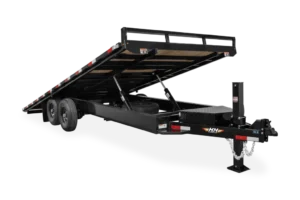
The skid steer and mini excavator sizes, with room for a machine plus an attachment. See the 7×20 equipment trailer, 7×20 aluminum trailer, 7×20 tilt trailer and 7×22 tilt trailer, plus the hydraulic 22 ft power tilt trailer.
8 ft wide and longer: 8×24 to 8×26
For wider machines, two machines at once or mid-size equipment. The 8×24 tilt trailer, the tri axle tilt trailer and the 8×26 26 ft tilt trailer cover this end.
Deckovers: 102 in wide, 20 to 35 ft
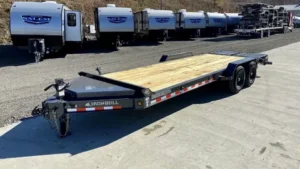
Full-width decks for pallets, wide machines and long loads. Sizes in our range run from the 20 ft deckover trailer to the 102 inch deckover trailer (20+5 ft) and the 30 ft deckover trailer (30+5 ft). See all equipment trailers and tilt and load trailers.
Trailer size guide for enclosed trailers
With an enclosed trailer, think in three dimensions. The floor size tells you how much fits; the interior height tells you whether you can stand up and stack tall items; the door opening decides what can get in at all.
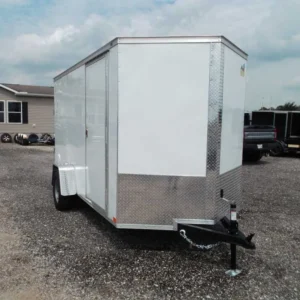
- 6×12 enclosed: a one-person trade, a small flat move or a couple of motorbikes. Our 6×12 enclosed cargo trailer has 78 in of headroom; the aluminum cargo trailer is a lighter 6×10.
- 7×14 enclosed: the trades favourite, with room for shelving down both walls. See the 7×14 enclosed trailer, 7×14 cargo trailer and ramp door cargo trailer, all with 84 in inside.
- 7×16 enclosed: two machines, or tools plus a workbench. The 7×16 enclosed trailer has a ramp door.
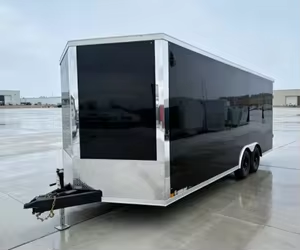
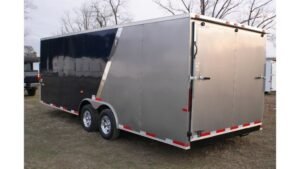
- 8.5×20 enclosed: cars, side-by-sides and big moves. The 20 ft enclosed trailer gives 90 in of headroom; the enclosed car trailer is built around vehicles.
- 8.5×24 enclosed: the most floor space, for full house moves, race setups or events. See the 24 ft enclosed trailer.
Browse all enclosed trailers.
Trailer size guide for horse trailers
Horse trailers are sized around the horse, not the cargo, so this part of the trailer size guide works differently. The University of Maryland Extension fact sheet Selecting a Horse Trailer advises that a trailer should be at least ten inches taller than the horse’s head at normal resting height, that a trailer about seven to eight feet tall and six to eight feet wide inside suits the average horse, and that you should allow at least three inches of space on each side of the horse. It also notes that draft horses need a larger than average trailer.
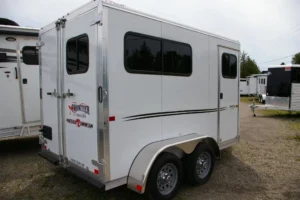
In our range, the 3 horse trailer has 84 in (7 ft) of headroom, while the 3 horse slant load trailer and straight load horse trailer have 90 in (7.5 ft), which suits taller horses. For more horses or living space, see the 4 horse living quarters trailer and 6 horse trailer. Browse all horse trailers.
Sizing for quads and side-by-sides, with real machine dimensions, is covered in our ATV trailer guide.
Trailer size guide for cars
Measure the car’s length bumper to bumper and its width across the wheels, not the mirrors. Most cars fit on an 18 to 20 ft car hauler with room to strap the wheels and stand the car slightly forward of the axles. Long trucks and big SUVs may need 20 ft or more. The width between the fenders is the limit on a flatbed hauler, so check it against your car’s track width. Our car hauler trailer and galvanized car hauler are open options; for an enclosed car trailer, the 8.5 ft wide boxes like the enclosed car trailer, 20 ft enclosed trailer and 24 ft enclosed trailer give room between the wheel wells. In this trailer size guide, cars are the load where the weight check matters most: always compare the car’s weight with the trailer’s payload.
Trailer size guide for dump trailers
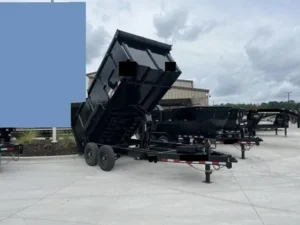
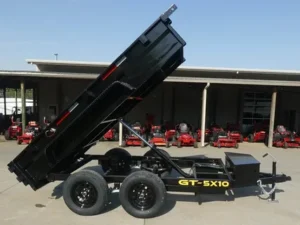
With a dump trailer, weight runs out long before space does. Soil, gravel and rubble are heavy, so a dump box that looks half full can already be at its limit. Size a dump trailer by the weight of your usual load and how many trips you’re happy to make, then check the box length suits your site access. Small sites and gardens suit the 5×10 dump trailer; general contracting suits the 7×14 dump trailer or 83×14 dump trailer; bigger jobs suit the 16 ft dump trailer. See all dump trailers.
Trailer size guide for snowmobiles, ATVs and bikes
Measure each machine’s length and width, then add space between them and in front for gear. Two average snowmobiles usually fit in a 7×19 to 7×21 enclosed sled trailer, three or four in a 7×25, though long-track mountain sleds take more room. A single quad fits on a 5×10 or 6×12; two quads side by side usually need a 7 ft wide deck. Motorbikes are narrow, so one or two fit on a small trailer, but an enclosed 6×12 keeps them and your gear dry. Ask us to check the fit with your machines’ sizes.
Trailer size guide for moving house
House moves are easier to size by rooms than by measurements. As a rough guide from our experience: a 6×12 enclosed trailer suits a small flat or one or two rooms, a 7×14 or 7×16 enclosed suits a two to three bedroom home in more than one trip, and an 8.5×20 or 8.5×24 enclosed suits larger homes. Tall items like wardrobes and fridges need the interior height: 78 in on our 6×12, 84 in on most 7 ft boxes, and 90 in on the 20 ft box. An enclosed trailer keeps everything dry and lets you leave it loaded overnight.
Trailer size guide for farms
Farms usually need more than one size. A 5×10 or 6×12 handles fencing, feed and small jobs; a 7×16 to 7×20 tandem moves compact tractors and implements; a deckover takes bales and pallets; and a dump trailer handles soil and gravel. If you only buy one, a 7×16 or 7×18 tandem is the most flexible size for most smallholdings, in our view.
How to measure a trailer before you buy
- Measure the usable deck length, excluding the tongue and any dovetail.
- Measure the width between the fenders or side rails, at the narrowest point.
- Measure the overall length from coupler to tail lights, for parking and legal limits.
- Measure the overall width, including fenders and lights.
- For enclosed trailers, measure the interior height and the door opening height and width.
- Read the GVWR on the plate and ask for the empty weight.
Write these down next to your load’s measurements, and this trailer size guide becomes a simple comparison. For any trailer we sell, we’ll give you these figures on request.
Size and worldwide delivery
We deliver trailers to customers in many countries, and size affects delivery. Long trailers, tall enclosed boxes and 102 in deckovers can need special transport or a larger container. Ask for a delivery quote on the exact trailer you’re considering so you know the full cost.
Trailer size guide in practice: three example buyers
The buyers below are made-up examples, not real customers. They show how the steps in this trailer size guide work together.
A homeowner with a ride-on mower
She has a ride-on mower about 4 ft wide and 6 ft long, plus garden waste runs and the odd trip to the tip. The width rules out a 4 ft deck, and the length plus a ramp angle points to 10 ft. A 5×10 or 6×10 single axle trailer covers it, parks on a driveway and tows behind a family car. Applying this trailer size guide, she doesn’t need a tandem axle, and a bigger trailer would just be harder to store.
A landscaper with a compact loader
He runs a small crew with a compact loader near 3,000 lb, a walk-behind mower and hand tools. The machine’s weight plus attachments already passes what most single axle trailers carry, so the trailer size guide points him to a 7×16 or 7×18 tandem with a ramp gate. Checking his truck’s towing rating and tongue weight confirms the choice. He leaves a few feet spare for a second mower as the business grows.
A family moving across the country
They have a three bedroom home, tall wardrobes and a fridge. Height and weather matter more than deck length here, so the trailer size guide sends them to an enclosed box: a 7×16 tandem with 84 in of interior height, or an 8.5×20 for fewer trips. They check that their SUV can tow the loaded weight before they buy.
Trailer size guide for storage and parking
Before you choose a size, measure where the trailer will live. Overall length includes the tongue, often 3 to 4 ft beyond the deck, so a 6×12 trailer can be around 16 ft long overall. Check your driveway, gate width, garage door height and any local rules about parking trailers on the street or in front of a house. Many buyers stand a small trailer on its end to save space, which only works with light single axle models built for it. A trailer size guide that skips storage leaves you with a trailer you can’t park at home.
Trailer size guide for overhang and long loads
Pipes, timber and ladders are often longer than the deck. Rules on how far a load can stick out behind the trailer, and when it needs a flag or light, vary by country and state, so check your local road rules before you plan on overhang. A trailer with a front rack, or a slightly longer deck, often solves the problem better. This trailer size guide treats overhang as a last resort, not a plan.
Should you size up for the future?
Most of our buyers who regret their choice went too small, not too big. If your work or hobby is growing, size up by one step: 6×12 instead of 5×10, or 7×16 instead of 7×14. The cost difference is usually small next to the price of selling and buying again. The exception is when parking, tow vehicle or road rules cap the size, which is why this trailer size guide checks those first.
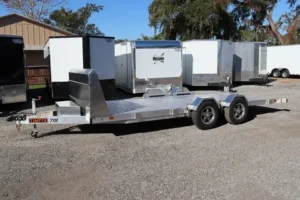
Trailer size guide: when to ask us
If your load is unusual, such as a machine with a wide bucket, a boat, a food cart or mixed loads that change by season, send us the measurements and weights. We’ll compare them with the deck, height and GVWR of the trailers we have for sale and suggest two or three sizes that fit. Using this trailer size guide first means you can ask sharper questions, and we can answer faster. There’s no charge for sizing advice, and you’re under no obligation to buy.
Too big or too small: what the trailer size guide can’t decide for you
Every trailer size guide has to deal with the same trade-off. A trailer that’s too small is a daily frustration: two trips instead of one, loads hanging off the back, and the temptation to overload. A trailer that’s too big costs more, weighs more, uses more fuel, is harder to park and may push your vehicle to its limit. Our honest view, from what customers tell us, is that slightly too big is easier to live with than slightly too small, as long as your vehicle can tow it and you have somewhere to keep it.
Think about next year, not just today
If your loads are growing, a landscaping business adding a second mower, a hobby farm adding a tractor, a family adding a second quad, size for where you’ll be in a year or two. It’s usually cheaper to buy the right size once than to sell and buy again.
Size versus weight
A common mistake in using any trailer size guide is choosing on deck size alone. Two 7×16 trailers can look identical and have very different ratings. In our range, for example, the 7×16 equipment trailer is rated at 7,700 lb, while the heavy duty equipment trailer, also 7×16, is rated at 15,400 lb. Same footprint, double the capacity. Similarly, our 7×14 enclosed boxes come at 7,055 lb and 10,141 lb. Always match the GVWR to your heaviest load, then pick the length and width.
Single or tandem axle?
Size and axles go together. In our range, most trailers up to about 6×14 are single axle, and most from 7×14 up are tandem. Tandems carry more, track straighter and are safer if a tyre fails; singles are lighter, cheaper and easier to move by hand. Our tandem axle trailer guide explains the choice in full.
Open or enclosed at a given size?
The same trailer size guide numbers work for both, but an enclosed trailer of the same deck size weighs more, costs more and limits tall loads to the door height. Our enclosed vs open trailer comparison goes through the pros and cons, and our aluminum vs steel trailer guide covers the material choice.
Common sizing mistakes
- Measuring without the attachment. A machine with its bucket on is longer, and often wider.
- Ignoring the fenders. Usable width is between the fenders, not the overall width.
- Forgetting the tongue. Overall length is much more than deck length; measure your parking space against the whole trailer.
- Choosing on size, not rating. A big deck with a low GVWR is no good for heavy loads.
- Forgetting the door. On enclosed trailers, the door opening limits what goes in.
- Buying for today only. If your work is growing, size up.
- Forgetting the tow vehicle. The loaded trailer must sit within your vehicle’s towing limit and payload.
Trailer size guide for businesses
In a business trailer size guide, the right size is the one that does a full day’s work in one trip. Count what you carry on your busiest day, not your average one. Landscapers often find a 7×16 or 7×18 tandem is the sweet spot; trades often settle on a 7×14 or 7×16 enclosed box; contractors usually need a 7×20 or bigger equipment or tilt trailer. Getting the size right saves fuel, time and wear every single day.
Buying used? Check the real size
Used trailers are sometimes listed with rounded or guessed sizes. Measure the deck, the width between the fenders, and for enclosed trailers the interior height and door opening yourself, and check the GVWR on the plate. Our used trailers are listed with the sizes and ratings we can confirm; ask us if anything isn’t listed.
Trailer size guide: quick decision table
| If your main load is… | Start with |
|---|---|
| Light garden and household jobs | 5×8 or 5×10 single axle |
| One machine up to a ride-on mower or quad | 6×12 or a tilt deck |
| A crew’s worth of kit | 7×14 to 7×18 tandem |
| Tools and stock that must stay dry | 6×12 to 7×16 enclosed |
| A skid steer or mini excavator | 7×16 to 7×22 heavy-rated equipment or tilt |
| A car | 18 to 20 ft car hauler or 8.5×20 enclosed |
| Pallets or wide machines | 102 in deckover |
| Horses | Sized by number of horses and their height |
Trailer size guide: questions people ask
What size trailer do I need?
Measure your longest and widest regular load, add about 1 to 2 ft of length, check it fits between the fenders, and make sure the loaded weight is within the trailer’s GVWR and your vehicle’s towing limit.
What do trailer sizes like 6×12 mean?
Width by length of the deck, in feet: a 6×12 has a deck about 6 ft wide and 12 ft long. Sizes like 77×14 give the width in inches.
What is the most popular trailer size?
For households, 5×8 to 6×12. For landscapers and trades, 7×14 to 7×16. That’s what we see most often, not a published statistic.
How wide can a trailer be?
It depends on where you live. GOV.UK gives 2.55 m as the maximum trailer width in the UK, and the US federal limit for commercial vehicles on the National Network is 102 inches.
What size trailer for a skid steer?
Usually 7×16 to 7×20 with a high enough rating for the machine plus attachments. A small machine like the Bobcat S70, listed at 2,892 lb, can go on a smaller heavy-rated trailer.
How tall should a horse trailer be?
The University of Maryland Extension advises at least ten inches taller than the horse’s head at normal resting height, which is about 7 to 8 ft for an average horse.
Should I buy bigger than I need?
Usually a little bigger, if your vehicle can tow it and you have room to park it. Most people who trade up say they bought too small.
Find the right size in our range
We stock trailers from 5×8 to 35 ft deckovers, and we deliver worldwide. Browse our utility trailers, lawn and garden trailers, enclosed trailers, equipment trailers, tilt and load trailers, dump trailers, snowmobile trailers and horse trailers, or see everything in the shop. Not sure which size? Contact us with your load’s dimensions and weight and your tow vehicle, and we’ll suggest the right trailer. For more help, read how to choose a trailer.
Sources and References
- GOV.UK: Towing with a car, towing weight and width limits (2.55 m width, 7 m length, finding towing weight)
- US Federal Highway Administration: federal size regulations FAQ (102 inch width limit)
- ISO 6780:1988, General-purpose flat pallets for through transit of goods, principal dimensions
- Bobcat: S70 skid-steer loader specifications
- University of Maryland Extension: Selecting a Horse Trailer (FS-948)
- Ford: 2026 Super Duty Pickup Towing Guide (tongue load guidance)