The enclosed vs open trailer choice comes down to protection versus flexibility. An enclosed trailer keeps your cargo dry, out of sight and locked up, and it can double as mobile storage or a workshop, but it costs more, weighs more and catches more wind. An open trailer is cheaper, lighter, easier to tow and can carry tall, wide or awkward loads that would never fit through a door, but everything on it is exposed to weather and theft. If you carry tools, stock or anything valuable or weather-sensitive, an enclosed trailer usually pays for itself. If you carry machines, building materials, garden waste or bulky items, an open trailer is usually the better buy.
That’s the short answer. Below we go through the enclosed vs open trailer decision properly: cost, weight, wind, loading, security, upkeep and which type suits which kind of work. We sell both, so we have no reason to push one over the other. Prices and specs come from our own listings; official facts are linked to their sources; and anything that’s our opinion is marked as such.
Enclosed vs open trailer: the quick comparison
| Open trailer | Enclosed trailer | |
|---|---|---|
| Purchase price | Lower | Higher, often much higher |
| Empty weight | Lighter | Heavier (walls, roof, doors) |
| Weather protection | None without a tarp | Full |
| Security | Low: cargo visible and reachable | High: cargo hidden and locked |
| Tall or wide loads | Easy | Limited by door and interior size |
| Loading | From any side, forklift-friendly | Through the rear (and side) doors |
| Wind and fuel | Less affected | More drag, more affected by side winds |
| Doubles as storage | No | Yes, often |
| Upkeep | Deck, frame, running gear | Plus roof, seals, doors and hinges |
The table is a summary of general trailer knowledge and our experience. Each row is explained below.
What counts as an open or an enclosed trailer?
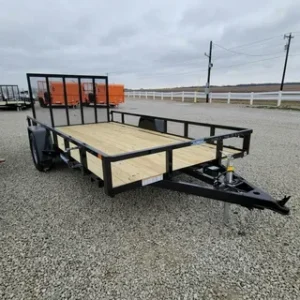
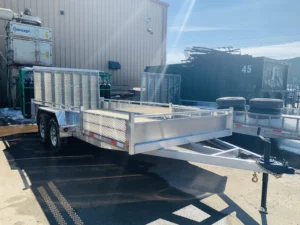
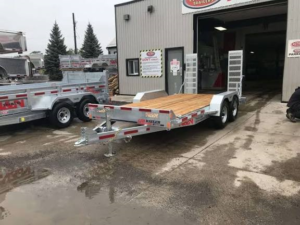
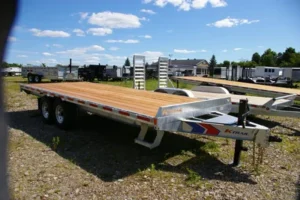
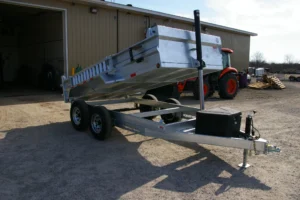
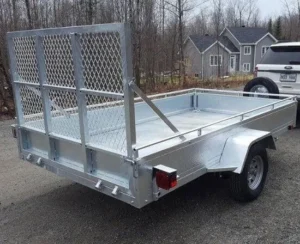
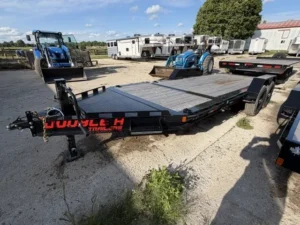
An open trailer has a deck and, at most, low sides or rails. That covers utility trailers, flatbeds, equipment trailers, deckovers, car haulers, tilt trailers and dump trailers. Our utility trailers, equipment trailers and tilt and load trailers are all open.
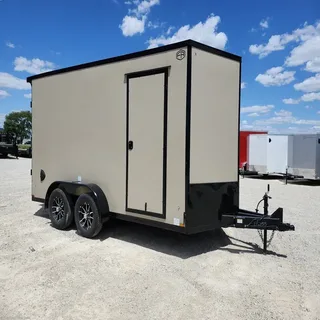
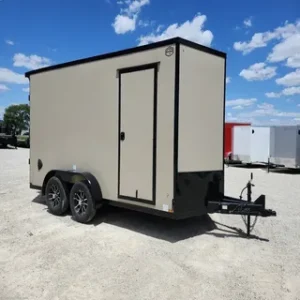
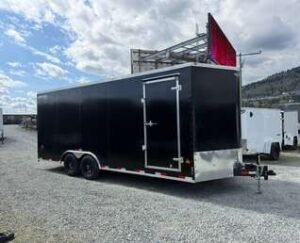
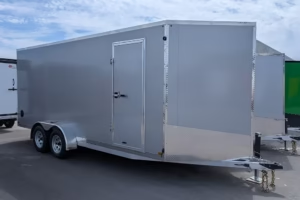
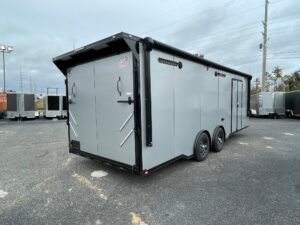
An enclosed trailer has walls, a roof and lockable doors, usually barn doors or a fold-down ramp at the back and often a side door. Cargo trailers, enclosed car trailers and enclosed snowmobile trailers all fall here. See our enclosed cargo trailers and snowmobile trailers. Horse trailers are a special kind of enclosed trailer built around animals rather than cargo.
When people weigh up an enclosed vs open trailer, they’re usually choosing between a utility or equipment trailer on one side and a cargo box on the other, so that’s the comparison this guide focuses on.
Enclosed vs open trailer: protection from weather
This is the first reason most people buy enclosed. Rain, snow, dust and road spray never touch your cargo. That matters for tools that rust, electronics, paper stock, furniture, mattresses, paint, adhesives and anything that would be ruined by one wet drive.
On an open trailer you can use a good tarp, but tarps flap, leak at the edges, tear in strong wind and need strapping down properly every time. They’re fine for garden waste or building materials that don’t mind getting a bit wet; they’re a poor substitute for walls and a roof if your load is valuable.
The enclosed vs open trailer decision often settles itself right here: if you’d lose money every time your load got wet, go enclosed.
Once you have picked open or enclosed, our trailer size guide helps you choose the right length, width and interior height.
Enclosed vs open trailer security and theft
An open trailer shows everything to everyone. A pallet of tools, a mower or a quad bike on an open deck is easy to see and quick to take. An enclosed trailer hides the load and puts a locked door between it and anyone tempted. In our experience that’s the second big reason people choose enclosed, especially tradespeople who leave trailers on job sites or outside their homes overnight.
A few practical tips for either type:
- Fit a coupler lock whenever the trailer is unhitched.
- Use a wheel clamp if the trailer is stored somewhere public.
- On enclosed trailers, use a good padlock or a disc lock on the door hasps rather than the cheap lock it came with.
- Park with the doors against a wall where you can.
- Record the VIN and take photos of the trailer and any distinctive marks.
No trailer is theft-proof, but an enclosed one makes your cargo a much harder target.
Enclosed vs open trailer price: how much more is enclosed?
Enclosed trailers cost more because there’s simply more trailer: walls, a roof, doors, seals, lights inside and often a ramp door with springs. To put real numbers on it, we compared similar-size open and enclosed trailers from our own current listings. Prices change, so treat these percentages as a guide rather than a quote:
| Size | Open trailer | Enclosed trailer | Enclosed costs about |
|---|---|---|---|
| 7×14, tandem, about 7,000 lb GVWR | 7×14 utility trailer (steel) | 7×14 enclosed trailer (steel) | 109% more |
| 6×12, single axle, about 3,000 lb GVWR | 6×12 aluminum trailer | 6×12 enclosed cargo trailer (steel) | 35% more |
| 7×16, tandem | 7×16 aluminum trailer, 7,010 lb | 7×16 enclosed trailer, 10,141 lb | 134% more (62% more per lb of GVWR) |
The cleanest comparison is the first row: two steel 7×14 tandems with almost identical ratings, where the enclosed one costs about twice as much in our listings. The other two pairs differ in material or rating, so they’re less exact. Still, the pattern is clear: in our range, an enclosed trailer typically costs somewhere between about a third more and more than double the price of a similar open trailer.
Whether that’s worth it depends on what the walls and roof save you. If they protect a few thousand in tools from theft or weather once, the enclosed trailer has paid for itself. If you mostly carry gravel and garden waste, they save you nothing.
Enclosed vs open trailer weight and towing
Walls, a roof and doors add weight. An enclosed trailer weighs noticeably more empty than an open trailer of the same deck size and rating, which leaves less payload and makes your vehicle work harder. Before buying either, check the GVWR, ask for the empty weight, and subtract one from the other to get your real payload. We’ll give you the empty weight of any trailer we sell.
Wind resistance and fuel
An enclosed trailer is a big flat box pushing air. The US Department of Energy’s fuel economy tips say a roof-top cargo box alone can reduce fuel economy by 2% to 17%. An enclosed trailer isn’t a roof box, and the figure doesn’t apply directly, but it shows how much a box shape can cost in fuel. Expect an enclosed trailer to use noticeably more fuel than an open one, especially at motorway speeds. Our estimate, not a measured figure.
Side winds
Tall boxes also feel crosswinds. The UK Highway Code, in rule 232 on driving in windy weather, says high-sided vehicles are the most affected by windy weather, and warns that strong gusts can blow vehicles off course, especially on exposed roads or when passing bridges or gaps in hedges. A tall enclosed trailer turns your rig into something much closer to a high-sided vehicle. Slow down on exposed roads and bridges, and leave more room. Open trailers, especially empty ones, are far less affected.

Loading an enclosed vs open trailer
This is where open trailers shine. You can load an open trailer from either side, from the back, from above with a crane or forklift, and you can carry things taller or wider than the trailer itself. Pallets go on with a forklift in seconds. Long timber hangs over the back. A ride-on mower drives up the ramp gate.
An enclosed trailer loads only through its doors. That’s fine for boxes, furniture, tools and wheeled machines that fit through the opening, but it rules out tall items, pallets loaded by forklift from the side, and anything wider than the door. Before you buy, measure:
- Door opening width and height, not just the interior.
- Interior height. Our enclosed trailers range from 78 in (1.98 m) on the 6×12 enclosed cargo trailer and aluminum cargo trailer, through 84 in (2.13 m) on most 7 ft and 8.5 ft boxes, to 90 in (2.29 m) on the 20 ft enclosed trailer.
- Your tallest item, with a little extra for loading at an angle.
Barn doors vs ramp door
If you go enclosed, the rear door matters. Barn doors swing open to the sides, suit boxes and dock loading, and have fewer moving parts. A ramp door folds down so wheeled machines roll straight in. Compare the barn-door 7×14 cargo trailer with the ramp door cargo trailer of the same size.
What fits: flexibility of loads
On flexibility, the enclosed vs open trailer comparison clearly favours open. Open trailers carry the widest range of loads: building materials, machines, cars, hay, firewood, garden waste, furniture, scrap, kayaks, anything. Enclosed trailers carry what fits inside, but carry it better: protected, organised and locked.
One way to look at the enclosed vs open trailer choice is this: an open trailer is a tool for moving things, an enclosed trailer is a room on wheels. If you need a room, enclosed. If you need to move awkward things, open.
Securing the load: enclosed vs open trailer
Walls don’t hold a load in place, whichever side of the enclosed vs open trailer choice you land on. In a hard stop, an unstrapped toolbox will hit the front wall of an enclosed trailer just as hard as it would fly off an open one. The UK Driver and Vehicle Standards Agency says plainly in its load securing guidance that you cannot rely on the weight of a load alone to keep it in place once the vehicle is moving. So whichever you choose, you still strap everything down.
The difference is what happens if you get it wrong. On an enclosed trailer, a loose item damages your cargo and the inside of the trailer. On an open trailer, it can end up on the road. A study by the AAA Foundation for Traffic Safety found road debris was a factor in more than 200,000 police-reported crashes in the US between 2011 and 2014, with about two-thirds involving items falling from vehicles. That’s why open loads of loose material should always be covered as well as strapped. Our guide to securing a load covers tie-downs for both types.
Enclosed vs open trailer visibility, mirrors and size
An enclosed trailer blocks your view straight back, and many are wider than the tow vehicle. GOV.UK advises fitting suitable towing mirrors if your trailer is wider than the rear of your car (GOV.UK: trailer and towing equipment), and many other countries have similar rules. With an open trailer you can often see over or through the load. With an enclosed trailer you rely completely on your mirrors, so extended towing mirrors are worth having.
Height matters too. A tall enclosed box can be too high for low bridges, multi-storey car parks, drive-throughs and some fuel station canopies. Write the overall height on a note on your dashboard.
Enclosed vs open trailer storage and parking
Storage is an underrated part of the enclosed vs open trailer decision. An open trailer can often be stood on its end or tucked under a carport. An enclosed trailer needs a proper parking spot and, because of its height, usually won’t fit in a standard garage. On the plus side, an enclosed trailer is its own shed: plenty of owners use one as lockable storage for tools, equipment or seasonal kit, and some never fully unload it. That’s an advantage an open trailer simply doesn’t have.
Enclosed vs open trailer upkeep
Both types need the same core care: tyres, bearings, brakes, lights, coupler and frame. Our trailer maintenance checklist covers it all. The extras by type:
| Extra upkeep | Open trailer | Enclosed trailer |
|---|---|---|
| Deck | Exposed to weather; check boards and seal wood | Protected, but watch for leaks and spills |
| Roof and seams | None | Reseal when sealant cracks |
| Doors and seals | Gate hinges only | Hinges, locks, rubber seals, ramp springs |
| Condensation | None | Use roof vents to keep it down |
| Rust | Whole trailer exposed | Frame and underside exposed, interior protected |
In short, an enclosed trailer has a few more things to look after, but your cargo has far fewer things to worry about.
How long does each type last?
There’s no official lifespan for either type; it depends on use, storage and care. In our experience, the frame and running gear of an enclosed vs open trailer age in much the same way, and both can give many years of work if tyres, bearings and brakes are kept up. The difference is where the weak spots are. On an open trailer, the deck and the whole frame face the weather every day, so wood decks and painted steel need regular attention. On an enclosed trailer, the deck is protected but the roof seams, door seals and floor become the parts to watch, because a slow leak can rot a floor from the inside without anyone noticing. Keep the roof sealed and the floor dry, and an enclosed trailer can outlast an open one used in the same conditions.
Enclosed vs open trailer resale value
In our experience both types sell well if they’ve been looked after. Enclosed trailers hold their value strongly with tradespeople and small businesses, because there’s steady demand for lockable boxes. Open utility trailers are always in demand because they’re cheap and useful. What hurts resale on either is rust, rotten floors and leaks. Material plays a part too; see our aluminum vs steel trailer guide.
Enclosed vs open trailer for a business
If you run a trade or a mobile business, an enclosed trailer offers things an open one can’t:
- A mobile workshop: fit shelving, a workbench and lighting, and the trailer becomes your workspace on site.
- Overnight security: leave tools locked on site instead of loading and unloading every day.
- Advertising: the flat sides are perfect for your logo and phone number. A signwritten trailer is a billboard that follows you around.
- Professional look: customers notice tidy, organised kit.
For a business, that often tips the enclosed vs open trailer decision even when the price is higher. Look at the 7×14 enclosed trailer, 7×14 cargo trailer or 7×16 enclosed trailer.
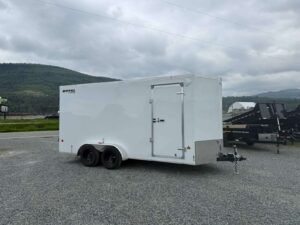
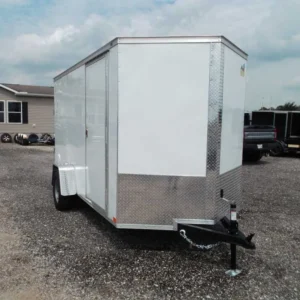
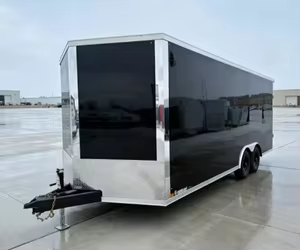
Enclosed vs open trailer: which one for your kind of work?
Enclosed vs open trailer for garden jobs and homeowners
For garden waste, compost, soil, tip runs and the odd piece of furniture, an open trailer is the obvious choice. It’s cheaper, lighter, tows behind a small car and is easy to tip out. The 5×8 utility trailer, 5×10 utility trailer and 5×8 aluminum trailer are our most popular. Add a tarp or mesh sides for loose material. See our lawn and garden trailers.
Enclosed vs open trailer for landscapers
Most landscapers start open: a 7×14 or 7×16 with a ramp gate carries mowers, blowers and materials, and it’s easy to load from the side. The 7×14 utility trailer, 7×16 aluminum trailer and 7×20 tilt trailer are typical. Once the kit gets expensive, many switch to an enclosed trailer with a ramp door, like the ramp door cargo trailer or 7×16 enclosed trailer, so mowers stay locked up overnight. If theft is a worry where you work, enclosed wins this one.
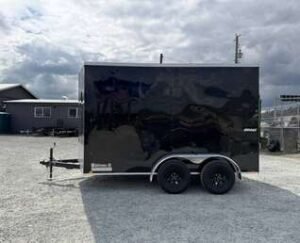
Enclosed vs open trailer for moving house
For furniture, boxes, mattresses and electrical goods, enclosed is far better. Everything stays dry and clean, you can stack higher against the walls, and you can leave a half-loaded trailer outside overnight without worrying. The 6×12 enclosed cargo trailer suits a small flat; the 7×14 enclosed trailer or 24 ft enclosed trailer handles a full house. An open trailer works for a move in dry weather if you tarp and strap carefully, but it’s more stressful.
Enclosed vs open trailer for trades
Plumbers, electricians, carpenters and tilers usually go enclosed, for the security and the mobile workshop. A trade that carries mostly long or heavy materials, like timber, pipe or steel, may prefer open. Some trades run both: an enclosed box for tools and an open trailer for materials.
Enclosed vs open trailer for cars
An open car hauler is cheaper, lighter and easier to tow, and fine for moving everyday cars, project cars and local transfers; see the car hauler trailer or galvanized car hauler. An enclosed car trailer keeps stone chips, weather and prying eyes off a valuable or classic car, and gives you somewhere to keep tools and spares at a track day; see the enclosed car trailer.
Enclosed vs open trailer for motorbikes and ATVs
One bike or quad on a short local trip is fine on a small open trailer. For two machines, longer trips, or riding gear you’d rather keep dry, an enclosed trailer with a ramp door is better. The ramp door cargo trailer is a popular size.
Enclosed vs open trailer for snowmobiles
Open sled decks exist and are cheap, but sleds arrive covered in salt and slush. Enclosed snowmobile trailers keep machines clean and give riders a dry place to change at the trailhead. All the sled trailers we stock are enclosed aluminum: the aluminum snowmobile trailer, 7×25 snowmobile trailer and used snowmobile trailer.
Enclosed vs open trailer for machines and equipment
For skid steers, mini excavators and tractors, open wins easily. Machines are heavy, often tall, and don’t mind rain, so walls just add weight and cost. Look at the 7×20 equipment trailer, heavy duty equipment trailer, 20 ft deckover trailer or a tilt deck like the power tilt trailer.
Enclosed vs open trailer for events and market traders
Vendors, mobile caterers, sound and lighting crews and exhibitors nearly always choose enclosed. Stock and equipment stay protected and organised, and the trailer can serve as a lockable store on site. The 20 ft enclosed trailer, with 90 in of headroom, suits staging and tall equipment.
Enclosed vs open trailer for farms
Farms usually need open trailers for bales, fencing, feed, livestock equipment and machines, and an open deck is easy to load with a loader or forklift. A small enclosed trailer can still be handy for tools, vet supplies or markets. Dump trailers like the galvanized dump trailer are another open option many farms use.
Enclosed vs open trailer for racing and hobbies
Track-day drivers, kart racers, cyclists and hobby car builders usually prefer enclosed: the car or kit stays clean, tools and spares travel organised, and the trailer becomes a paddock base with shade and shelter. Club racers on a budget often start with an open car hauler and upgrade later. If you travel far to events, the enclosed vs open trailer decision usually ends up enclosed.
Size guide: enclosed vs open trailer sizes for common jobs
| Job | Open option | Enclosed option |
|---|---|---|
| Garden waste and tip runs | 5×8 or 5×10 utility | Rarely needed |
| One ride-on mower | 6×12 or tilt deck | 6×12 with ramp |
| Landscaping crew kit | 7×14 to 7×18 tandem | 7×14 or 7×16 with ramp |
| One-person trade | Usually not ideal | 6×12 single axle |
| Small flat move | 6×12 with tarp | 6×12 or 7×14 |
| Full house move | Not recommended | 7×14 to 8.5×24 |
| Car | Car hauler | 8.5×20 or 8.5×24 |
| Skid steer or digger | Equipment or tilt trailer | Not practical |
The table is our general guidance from selling trailers; your exact loads decide the final size.

Can’t decide? The in-between options
If the enclosed vs open trailer choice is still a toss-up, there are a few ways to get some of both:
- Open trailer plus a good tarp and straps: cheap weather protection for occasional wet loads.
- Open trailer with tall mesh sides: keeps bulky loose loads in, though not dry.
- Enclosed trailer with a ramp door: you can still roll wheeled machines in, so you lose less flexibility.
- Two trailers: plenty of businesses run a small enclosed box for tools and an open trailer for materials and machines.
Real enclosed vs open trailer pairs from our range
Specs make the enclosed vs open trailer comparison concrete. These pairs come from our current listings:
- 7×14 tandems: the open 7×14 utility trailer is steel, rated at 7,000 lb. The 7×14 enclosed trailer is steel, rated at 7,055 lb, with barn doors and 84 in of headroom. Same footprint and almost the same rating; the enclosed box adds walls, a roof and locking doors for about twice the price in our listings.
- Heavier 7×14 boxes: if you need more capacity in an enclosed box, the 7×14 cargo trailer (barn doors) and ramp door cargo trailer are both rated at 10,141 lb.
- Small single axles: the open 6×12 aluminum trailer and the 6×12 enclosed cargo trailer are both rated at about 3,000 lb. The enclosed one has 78 in of headroom and barn doors.
- Big enclosed boxes: for cars, events or full house moves, the 20 ft enclosed trailer (90 in inside, 10,141 lb) and 24 ft enclosed trailer have no real open equivalent; the open alternative is a car hauler or deckover.
What your tow vehicle needs
An enclosed vs open trailer of the same deck size can need quite different tow vehicles. The enclosed one weighs more empty, catches more wind and is often taller and wider. Check that your vehicle’s towing limit comfortably covers the loaded trailer, that the hitch and ball are rated for it, and that you can see down both sides; GOV.UK advises suitable towing mirrors when the trailer is wider than your car (GOV.UK). GOV.UK also says a trailer must have a working brake system if it weighs over 750 kg loaded, and many other countries set similar thresholds, so heavier enclosed boxes almost always come with brakes.
Running costs over the years
Beyond the purchase price, an enclosed trailer usually costs a little more each year: more fuel per trip, roof and seal upkeep, and sometimes higher insurance because the trailer is worth more. An open trailer costs less to run but may cost you in other ways: tarps and straps that wear out, cargo damaged by weather, and the risk of theft. When you compare an enclosed vs open trailer over five or ten years, think about what each would have saved or cost you on your real loads. That’s our reasoning, not a published study.
Three typical buyers
These are made-up examples to show how the choice usually goes.
A gardener with a small car
Loads: green waste, compost bags, a push mower. Nothing valuable, nothing that minds rain. An open 5×8 utility trailer is cheaper, lighter and easier to tow and tip. Enclosed would be wasted money.
An electrician working from home
Loads: tools, cable drums, ladders, stock. Leaves the trailer outside overnight. An enclosed 6×12 enclosed cargo trailer or 7×14 enclosed trailer keeps everything locked and dry and doubles as a workshop. Ladders can ride on a roof rack or inside if the length allows.
A contractor with a mini digger
Loads: a 3.5 tonne excavator and buckets. Machines don’t mind rain and need side access for chaining. An open heavy duty equipment trailer or 7×20 tilt trailer is the right tool.
Common mistakes
- Buying enclosed for loads that don’t fit. Measure the door opening and interior height against your tallest item first.
- Buying open for valuable kit. One theft or one soaked load can cost more than the price difference.
- Forgetting the extra weight. An enclosed box can push a small tow vehicle over its limit.
- Ignoring wind. Tall boxes need slower speeds on exposed roads.
- Skipping the straps inside. Walls aren’t tie-downs.
Making the most of an enclosed trailer
If you go enclosed, a few simple additions make it far more useful. E-track rails on the walls give you tie-down points anywhere. Shelving screwed into the wall studs keeps tools organised. LED interior lights help on early starts. A roof vent cuts heat and condensation. A side door saves climbing over the load. Keep heavy items low and over the axles, and don’t drill the roof.
Making the most of an open trailer
An open trailer gets more practical with a ramp gate for wheeled machines, a set of mesh sides for bulky loose loads, a fitted tarp or cargo net, and stake pockets for extra tie points. A tilt deck, like the gravity tilt trailer, removes ramps altogether. With those, an open trailer covers a huge range of jobs.
An enclosed vs open trailer scorecard
Tick each statement that’s true for you:
- My cargo would be damaged or lost value if it got wet.
- I’ll leave the trailer loaded overnight or on job sites.
- I want a mobile workshop or lockable storage.
- I’d like to advertise my business on the trailer.
- My loads fit through a door: boxes, tools, furniture, small machines.
- My tow vehicle can handle the extra weight comfortably.
Four or more ticks: an enclosed trailer is probably worth it. Two or three: think about what you carry most often. Zero or one: an open trailer will likely serve you better and save you money. This is our rule of thumb, not a formula.
Enclosed vs open trailer myths
“Enclosed trailers keep loads in place”
They keep loads in, not still. Everything inside still needs strapping.
“Open trailers are only for rubbish”
Open trailers carry machines, cars, materials and some of the heaviest loads on the road. Many professionals prefer them.
“Enclosed trailers are impossible to tow”
They feel the wind more and use more fuel, but with the right vehicle, correct loading and sensible speed they tow perfectly well. Our trailer towing tips help.
“A tarp is as good as walls”
For a short dry trip, maybe. For rain, wind, theft and daily use, no.
Buying used: enclosed vs open trailer checks
- Used open trailer: check the deck boards, frame rust, gate hinges and tyres.
- Used enclosed trailer: check everything above, plus the roof seams and corners for leaks, water stains inside, soft spots in the floor, door hinges and locks, ramp springs and the condition of the rubber seals.
An enclosed trailer that has leaked for years can have a rotten floor under a clean-looking interior, so press on the floor all over. Our current used stock includes the used cargo trailer (enclosed) and used deckover trailer (open). See all used trailers.
Questions to ask before buying
- What’s the GVWR and the empty weight?
- For enclosed: what are the interior height and the door opening size?
- Barn doors or ramp? Is there a side door?
- What tie-down points does it have: E-track, D-rings, stake pockets?
- What’s the overall height and width?
- Does it have brakes, and what type?
We’ll answer these for any trailer we sell, and they’ll usually settle the enclosed vs open trailer question for your situation.
Delivery worldwide
We deliver both open and enclosed trailers to customers in many countries. Enclosed trailers take more space in transport because of their height, so ask for a delivery quote on each option you’re considering. That way you compare the full delivered cost of an enclosed vs open trailer, not just the sticker price.
Our recommendation
Choose enclosed if you carry valuable, weather-sensitive or theft-prone cargo, leave the trailer loaded, or want a mobile workshop or lockable store. Choose open if you carry machines, materials, garden waste or anything tall, wide or awkward, want the lowest price and weight, or tow with a smaller vehicle. That’s our honest view of the enclosed vs open trailer decision, based on what we sell and what customers tell us; your own loads should make the final call.
Enclosed vs open trailer: questions people ask
Is an enclosed or open trailer better?
Neither is better for everyone. Enclosed protects and secures cargo; open is cheaper, lighter and carries awkward loads.
How much more does an enclosed trailer cost?
In our current listings, a 7×14 steel enclosed trailer costs about twice as much as a 7×14 steel open utility trailer with a similar rating. Other pairs range from about 35% more upwards.
Does an enclosed trailer use more fuel?
Yes, because of the extra weight and the box shape pushing air. How much depends on size, speed and your vehicle.
Are enclosed trailers harder to tow in wind?
Yes. The UK Highway Code notes high-sided vehicles are most affected by windy weather, and a tall enclosed trailer behaves similarly. Slow down on exposed roads.
Do I still need to strap loads in an enclosed trailer?
Yes. Walls don’t stop a load sliding in a hard stop.
Can an enclosed trailer carry a ride-on mower?
Yes, if the door opening and interior fit it. A ramp door makes it easy.
Which holds its value better?
Both sell well when looked after. Enclosed trailers are in steady demand with trades; open utility trailers are always in demand because they’re useful and affordable.
Shop open and enclosed trailers
Whichever way you go, we have trailers for sale on both sides of the enclosed vs open trailer question, and we deliver worldwide. Browse our enclosed cargo trailers, open utility trailers, equipment trailers and tilt and load trailers, or see everything in the shop. Not sure? Contact us with what you carry and what you tow with, and we’ll recommend a trailer. You might also like our guides on the tandem axle trailer vs single axle question and how to choose a trailer.
Sources and References
- GOV.UK: The Highway Code, driving in adverse weather conditions (rule 232, windy weather)
- US Department of Energy, FuelEconomy.gov: Driving more efficiently (roof-top cargo box and fuel economy)
- GOV.UK: Towing with a car, trailer and towing equipment (towing mirrors)
- GOV.UK DVSA: Securing loads on HGVs and goods vehicles, load securing basics
- AAA Foundation for Traffic Safety: Prevalence of Motor Vehicle Crashes Involving Road Debris, 2011 to 2014