
Securing a load on a trailer comes down to one idea: the load must not be able to move in any direction, not forwards when you brake, not sideways on a bend, not backwards when you pull away and not upwards over a bump. In practice that means placing the weight correctly, using enough straps or chains with a high enough rating, and checking them again once you’re on the road. A widely used benchmark from US cargo rules is that the combined working load limit of your tie-downs should be at least half the weight of what you’re carrying.
That’s the short answer. The rest of this guide explains the numbers behind it, how many tie-downs you actually need, which equipment suits which job, and how securing a load differs on an open utility trailer, an enclosed box, an equipment deck, a car hauler, a dump trailer and a horse trailer. We sell all of those trailers, so a lot of what follows comes from the questions customers ask us after they’ve bought one. Where a fact comes from a regulation or a published study, we link to it so you can check it yourself.

Why securing a load matters more than people think
Loose loads aren’t just a risk to your cargo. They’re a risk to everyone behind you. A study by the AAA Foundation for Traffic Safety found that road debris was a factor in more than 200,000 police-reported crashes in the US between 2011 and 2014, causing about 39,000 injuries and around 500 deaths. About two-thirds of those debris crashes involved items falling from vehicles, which the researchers linked to poor maintenance and unsecured loads.
Those are US figures, but the physics is the same on every road in the world. A sheet of plywood, a gas can or a wheelbarrow that leaves a trailer at speed becomes a missile. And a load that shifts without falling off is dangerous too, because it changes how the trailer handles just when you need it to behave.
Securing a load properly also protects your own money. A machine that slides into the front of a trailer can damage the trailer, the machine and the tow vehicle in one go. A mower that tips over on a corner can crack its deck. Ten minutes with the right straps is cheaper than any of that.
The forces your load has to survive
Most people underestimate how hard a load pushes when a vehicle brakes or turns. Two official sources put numbers on it, and they’re worth knowing because they explain why “it’s heavy, it won’t move” is wrong.
- The UK’s Driver and Vehicle Standards Agency, in its load securing code of practice, says a securing system should be able to withstand the entire weight of the load in the forward direction and half the weight of the load to the sides and to the rear. It also says plainly that you cannot rely on the weight of a load alone to keep it in place once the vehicle is moving.
- The US Federal Motor Carrier Safety Administration cargo securement rules (49 CFR Part 393, Subpart I) design securement systems around 0.8 g deceleration in the forward direction, 0.5 g acceleration rearward and 0.5 g sideways, based on breaking strength.
In plain terms: in a hard stop, your load tries to slide forward with a force close to its own weight. A 1,000 kg mower wants to keep going with something like 800 to 1,000 kg of push. Friction from rubber tyres on a wet wooden deck won’t hold that. Straps or chains will, if there are enough of them and they’re rated for it.
Strictly speaking, these rules are written for commercial vehicles in their own countries. A private owner with a small garden trailer may not be legally bound by them. But they’re the best published guide to what actually works, and we’d treat them as the standard to aim for when securing a load on any trailer.
Know your numbers before securing a load: WLL, breaking strength and lashing capacity
Every strap, chain and binder has ratings on its label or tag. Understanding them is the single most useful thing you can learn about securing a load.
Working load limit (WLL)
The working load limit is the maximum load the strap or chain should carry in normal use. This is the number to work with. It’s always much lower than the breaking strength, because it includes a safety margin.
Breaking strength
Breaking strength is the force at which the strap or chain actually fails. It’s often printed in big numbers on cheap straps because it looks impressive. Don’t use it to plan your tie-downs.
Lashing capacity (LC)
In Europe and the UK, straps are labelled with a lashing capacity in decanewtons (daN). The DVSA guidance on securing equipment describes LC as the maximum force the lashing can safely withstand without damage when pulled in a straight line. Roughly, 1 daN is about 1 kg of force, so a strap marked LC 500 daN is good for about 500 kg in a straight pull.
The “half the weight” rule
Under the US rules, the aggregate working load limit of all the tie-downs used to secure an item must be at least one-half times the weight of that item (49 CFR 393.106). So for a 2,000 lb (about 900 kg) machine, the WLLs of your tie-downs should add up to at least 1,000 lb (about 450 kg). That’s a minimum, not a target. We always suggest going well over it.
A practical point the regulations don’t spell out: your strap is only as strong as what it’s hooked to. An anchor point, D-ring or stake pocket on the trailer has its own rating, and so do the hooks on the strap. Use the lowest number in the chain.
How many tie-downs do you need when securing a load?
This is the question we get asked most about securing a load. The US rules give a clear minimum for items that aren’t blocked against forward movement by a headboard, bulkhead or other cargo (49 CFR 393.110):
| Length of the item | Weight | Minimum tie-downs |
|---|---|---|
| 5 ft (1.52 m) or less | 1,100 lb (500 kg) or less | 1 |
| 5 ft (1.52 m) or less | Over 1,100 lb (500 kg) | 2 |
| Over 5 ft and up to 10 ft (3.04 m) | Any weight | 2 |
| Over 10 ft (3.04 m) | Any weight | 2, plus 1 for every extra 10 ft or part of it |
Heavy machinery has its own rule. Under 49 CFR 393.130, crawler-track or wheeled equipment must be restrained against movement forwards, backwards, sideways and upwards using a minimum of four tie-downs, and accessory equipment such as buckets and blades must be completely lowered and secured.
Worked examples
These are our own illustrations using the rules above, not official calculations:
- A ride-on mower, about 5.5 ft long and 450 lb: longer than 5 ft, so at least two tie-downs. Their combined WLL must be at least 225 lb. In practice we’d use four light ratchet straps, one at each corner, because a mower can rock and walk sideways.
- A bundle of 16 ft timber, 600 lb: over 10 ft, so two tie-downs plus one more for the extra 6 ft: three in total. Combined WLL of at least 300 lb, and protect the strap where it crosses sharp edges.
- A 3.5 tonne mini excavator: heavy machinery, so at least four tie-downs, one per corner, with a combined WLL of at least 1,750 kg. Chains and binders are the sensible choice here, and the bucket goes down flat on the deck.
When securing a load made up of several items, apply the rule to each one, not just to the load as a whole.
Choosing equipment for securing a load
Ratchet straps
For most people, securing a load starts with ratchet straps. They are the everyday tool for securing a load on small and medium trailers. They’re quick, they tension well and they’re easy to release. Buy straps with a clear WLL or LC label, and pick the right width for the job: narrow straps for garden loads, wider heavy-duty straps for machines and pallets.
Cam buckle straps
Cam straps are tightened by hand, so you can’t over-tension them. That makes them good for fragile items like furniture, boxes or a canoe, but not for heavy loads.
Chains and binders
For heavy machines and steel, chains with ratchet or lever binders are the standard. The DVSA points out in its guidance on securing equipment that chains are only as strong as the weakest component in the system, and that straps and chains shouldn’t be mixed in the same lashing. Use matching hooks and binders with a known rating.
Wheel nets and axle straps
For cars, the right way is to strap the wheels or the axle, not the bodywork or suspension arms. Wheel nets go over the tyre; axle straps loop round a solid part of the axle. That way the car can settle on its suspension without the straps going slack.
Nets and tarps
Cargo nets and tarps stop loose material like garden waste, mulch, sand and scrap from blowing out. A tarp on its own doesn’t hold a heavy load in place, but it’s essential for anything that can blow or fall.
Edge protectors and friction mats
Edge protectors stop straps being cut on sharp corners; the DVSA recommends sleeves or protectors over corners and sharp or abrasive edges. Anti-slip friction mats under a load help a lot, but the same guidance says a high-friction surface can be very effective as part of a system and must not be used by itself.
Anchor points on the trailer
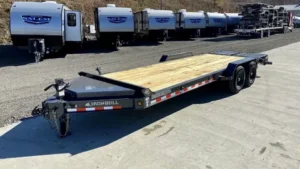
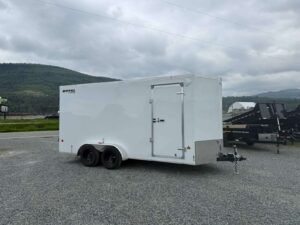
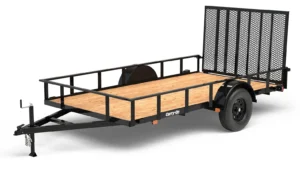
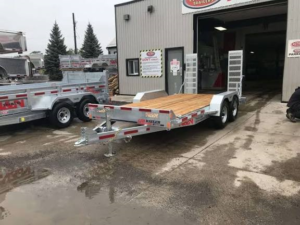
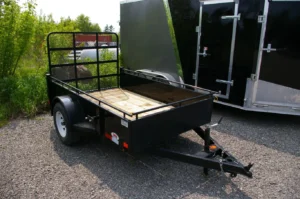
Before you buy straps, look at where they’ll hook on. Open trailers usually have stake pockets, D-rings or rub rails. Enclosed trailers often have E-track or D-rings in the floor and walls. Equipment trailers have heavy D-rings and chain points. Our 7×20 equipment trailer, 7×14 cargo trailer and 5×10 utility trailer show the three main styles.
Two ways of securing a load: direct and tie-down lashing
Direct lashing
Direct lashing means one end of the strap or chain is attached to the load and the other to the trailer, as the DVSA describes it. This is the method for machines, vehicles and anything with its own tie points. Each lashing works against movement in a particular direction, so angle them outwards and forwards or backwards to cover every direction.
Tie-down (friction) lashing
Tie-down lashing goes over the top of the load from one side of the trailer to the other, pressing it down onto the deck so friction holds it. It works for boxes, stacked material and pallets. The DVSA notes that if the angle between the strap and the deck is less than 30 degrees, the lashing will not be effective, so tall loads secure better this way than low, flat ones.
Blocking and bracing
Pushing a load hard up against the front of the trailer, a headboard or other cargo stops it moving forward without relying only on straps. That’s why it pays to load heavy items against the front wall of an enclosed trailer. You still need straps to stop it bouncing or sliding sideways.
Securing a load: what the numbers look like in practice
Rules are easier to follow when you can see them applied. The table below uses the “half the weight” benchmark from the US rules and shows how quickly a sensible setup goes well past the minimum. The strap and chain ratings here are examples to show the arithmetic, not product recommendations; always use the rating printed on your own equipment.
| Load | Approx. weight | Minimum combined WLL (half the weight) | Example setup | Combined WLL of example |
|---|---|---|---|---|
| Push mower and tools | 60 kg | 30 kg | 2 straps rated 150 kg each | 300 kg |
| Ride-on mower | 200 kg | 100 kg | 4 straps rated 250 kg each | 1,000 kg |
| Quad bike (ATV) | 300 kg | 150 kg | 4 straps rated 400 kg each | 1,600 kg |
| Small car | 1,200 kg | 600 kg | 4 wheel straps rated 1,000 kg each | 4,000 kg |
| Mini excavator | 3,500 kg | 1,750 kg | 4 chains rated 2,000 kg each | 8,000 kg |
Notice that the example setups all land several times above the minimum. That’s deliberate. Straps lose strength with age and wear, angles reduce how much of a strap’s rating actually resists movement, and anchor points may be weaker than the strap. Building in a big margin is the simplest way of securing a load you don’t have to worry about.
Two more points worth knowing. First, a strap pulled at an angle only resists part of the load in any one direction, which is why four angled straps work better than two straight ones. Second, the tie-down count from the length table still applies even when the WLL sum is comfortably met: a long item with one very strong strap can still pivot around it.
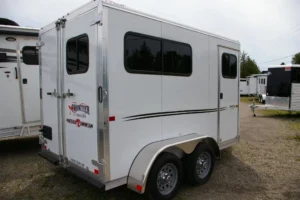
Some of the trailers customers most often ask us about securing a load on:
Where you put the weight matters as much as how you strap it
Securing a load starts before the first strap goes on, and it starts with weight. If the weight is in the wrong place, the trailer will tow badly no matter how tight the straps are.
- Forward of the axle: for a standard ball hitch, the Manitoba Public Insurance trailer safety guide says tongue weight should be about 10 to 15 percent of the loaded trailer weight. Put the heaviest items just ahead of the axle to get there.
- Low and central: the DVSA advises putting the load near the vehicle’s centre line, keeping its centre of gravity as low as possible and spreading it to give an even weight distribution over the floor (load securing basics).
- Within the ratings: stay under the trailer’s GVWR and your vehicle’s towing and payload limits.
A tail-heavy trailer sways. A trailer loaded to one side pulls and wears tyres unevenly. Get the weight right first, then strap it.
Securing a load on an open utility trailer
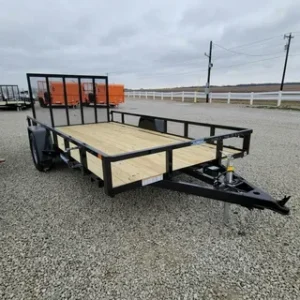
Open trailers like the 5×8 utility trailer, 6×12 aluminum trailer or 7×14 utility trailer carry the widest mix of loads, and they’re where most loose-load problems happen. Securing a load on an open trailer depends on what it is.
Securing a load of garden waste, mulch, soil or sand
- Don’t pile above the sides. Anything above the rail can blow off.
- Cover it with a tarp or cargo net and strap the cover down at several points so it can’t flap loose.
- Remember that wet soil and sand are far heavier than they look. Load by weight, not by how full the trailer looks.
Securing a load of timber, pipes and long items
- Bundle long pieces together with straps first, then strap the bundle to the trailer.
- Use the tie-down count from the table above: a 16 ft bundle needs at least three tie-downs under the US rules.
- Use edge protectors where straps cross sharp edges.
- Mark any overhang with a flag; local rules on overhang length and marking vary, so check yours.
Securing a load of furniture and boxes
- Load heavy items (fridges, washing machines, wardrobes) first, against the front, standing upright where the maker says they should travel upright.
- Fill gaps with soft items so nothing can slide.
- Use cam straps on fragile pieces so you don’t crush them, and cover everything with a tarp if rain is possible.
Securing a load like a mower or garden machine
- Drive the machine on, put it in gear or set the parking brake, and lower any cutting deck.
- Strap from each corner of the machine’s frame to a separate anchor point, angled outwards.
- Don’t strap over the seat or plastic panels; find solid frame points.
For regular garden work, a light trailer with a ramp gate or a tilt deck makes loading much easier. See our utility trailers and lawn and garden trailers.
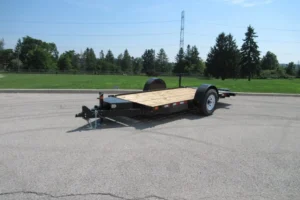
Securing a load in an enclosed trailer
People assume walls do the job. They don’t. In a hard stop, an unstrapped toolbox or generator will hit the front wall with real force, and anything stacked will topple. Securing a load in an enclosed trailer still means strapping.
- Use the E-track or D-rings. Most enclosed trailers have them on the floor or walls. E-track lets you place straps wherever the load sits.
- Load against the front wall. Heavy items go forward and low, which blocks forward movement and puts weight where it should be.
- Load bars and shoring beams. These lock across the trailer between the walls and stop rows of boxes sliding back.
- Shelving and bins. If you carry tools every day, secure shelves to the wall studs and keep small items in lidded bins.
- Machines inside a box. Treat a mower or motorbike in an enclosed trailer exactly as you would on an open deck: four corners, separate anchor points.
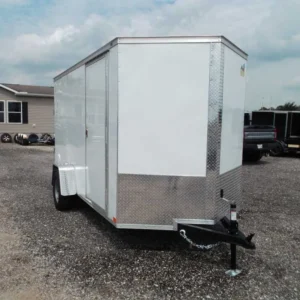
Our 7×14 enclosed trailer, ramp door cargo trailer and 20 ft enclosed trailer all have tie-down points; ask us about the layout of any model. Browse all enclosed trailers.
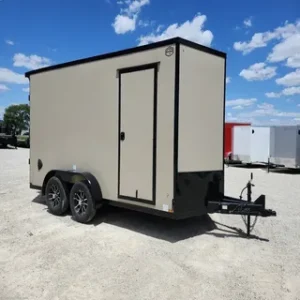
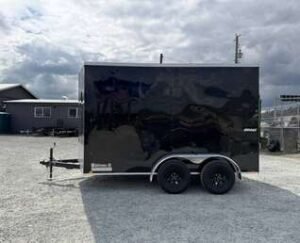
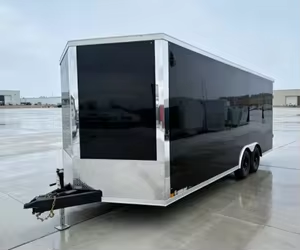
Securing a load of heavy equipment
Machines are where securing a load matters most, because the weights are high and the consequences of getting it wrong are serious. Following the US heavy equipment rule (49 CFR 393.130) is a good benchmark even where it doesn’t legally apply:
- Position the machine so its weight sits slightly ahead of the trailer axles.
- Lower everything. Buckets, blades, booms and forks go flat on the deck.
- Set the brakes and put the machine in gear or park, and remove the key.
- Use at least four tie-downs, one at each corner, attached to the machine’s tie-down points, never to hydraulic lines or thin brackets.
- Angle each chain outwards and forwards or backwards, so the four together resist movement in every direction.
- Check the ratings. The combined WLL of the chains must be at least half the machine’s weight, and in practice much more.
- Secure attachments separately. A spare bucket or breaker on the deck needs its own tie-downs.
Equipment trailers built for this work have heavy D-rings and chain points in the right places. See the heavy duty equipment trailer, 20 ft deckover trailer and 102 inch deckover trailer, or all equipment trailers.
Securing a load on a tilt trailer
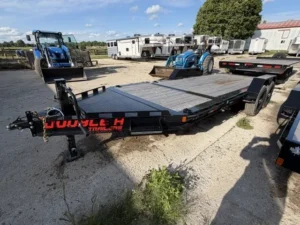
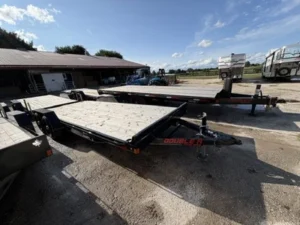
Tilt trailers make loading safer because there are no ramps, but the load still needs the same tie-downs as any equipment deck. One extra step: lock the tilt before you strap down, so the deck can’t move under the load. Strap to the deck’s own anchor points, not to the frame beneath the pivot. The 7×20 tilt trailer, power tilt trailer and 26 ft tilt trailer are typical. Browse all tilt and load trailers.
Securing a car on a car hauler
- Load the car nose forward in most cases, so the engine weight helps tongue weight.
- Put it in gear or park with the handbrake on.
- Strap the wheels with wheel nets or use axle straps around a solid part of the axle. Avoid strapping to suspension arms, because the car bounces and the straps go slack.
- Use four tie-downs, one per corner.
- Check that nothing loose inside the car can fly around.
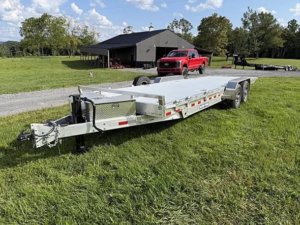
See the car hauler trailer, galvanized car hauler and enclosed car trailer.
Securing a load in a dump trailer
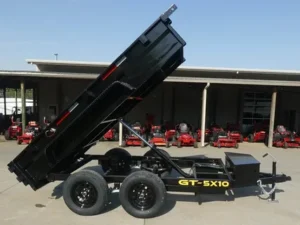
Dump trailers carry loose, heavy material, so securing a load here mostly means not overfilling and covering it. Keep material below the top of the sides, use a tarp (many dump trailers have a roll tarp kit), and close and latch the rear gate before you drive. Don’t carry machines in a dump box unless it’s designed for that. Look at the 5×10 dump trailer, 83×14 dump trailer or all dump trailers.
Securing snowmobiles, ATVs and motorbikes
- Strap each machine front and rear to separate anchor points, so it can’t roll or slide.
- For motorbikes, use a wheel chock at the front and soft loops on the handlebars or lower triple clamp, pulling down and slightly outwards.
- For snowmobiles, strap the ski area and the rear bumper, and use ski guides if your trailer has them.
- Keep fuel cans upright and strapped.
See the aluminum snowmobile trailer and 7×25 snowmobile trailer.
Securing a load of pallets
Pallets of blocks, bags or boxes are common on deckovers and larger utility trailers. Securing a load of pallets works best with tie-down lashings over the top, at least two per pallet, with corner protectors so the strap doesn’t crush the packaging or cut on the edge. A friction mat under each pallet helps a lot. Shrink-wrapped pallets can still shift inside the wrap, so strap across the load itself, not just the wrapping. A deckover like the 20 ft deckover trailer lets you forklift pallets on from either side and use the stake pockets along the edge.
Securing a load when moving house
Moving day is when a lot of people tow for the first time, with a full trailer of mixed items. Securing a load of furniture is mostly about packing: heavy, solid items first and forward, then lighter items on top and towards the back, with soft things like mattresses and cushions filling the gaps so nothing can slide. Strap each layer as you go rather than one strap over everything at the end. An enclosed trailer such as the 6×12 enclosed cargo trailer keeps rain off, but the load inside still needs straps.
Securing a load in wind, rain and winter
Bad weather doesn’t change the rules, it just punishes mistakes faster. Wind gets under tarps and loose sheets, so use more tie points and fold the tarp’s leading edge under so air can’t catch it. Rain makes decks and loads slippery, which reduces friction and makes tie-down lashings less effective, so add direct lashings or friction mats. In winter, straps can freeze stiff and ice can build up under loads; check tension at every stop, because a strap that was tight at -10 °C may slacken as the load settles. Securing a load in poor conditions takes a few more minutes, and those minutes are well spent.
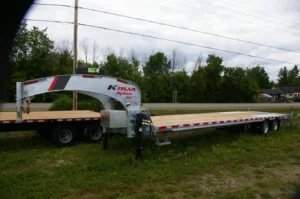
Securing a load on a flatbed or deckover
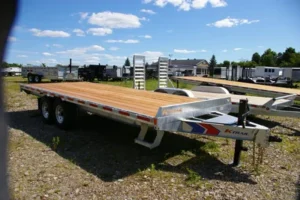
Flatbeds and deckovers have no sides, so nothing stops a load except your straps and chains. Use the stake pockets and rub rails for tie-down points, protect straps where they cross the deck edge, and treat every item as if it could slide straight off the side, because it can. Long loads need tie-downs along their whole length, following the length rule above. Our 30 ft deckover trailer and used deckover trailer are built for this kind of work.
A small kit for securing a load
Keep a bag or box in the trailer or tow vehicle with the basics, so you’re never improvising with rope:
- Four to eight ratchet straps with clear WLL labels, sized for your usual loads
- Two or four cam straps for fragile items
- Chains and binders if you carry machines
- A tarp and a cargo net, plus bungee hooks or short straps for the cover
- Edge protectors and a couple of friction mats
- Wheel chocks
- Gloves and a knife for cutting old cable ties
With that kit in place, securing a load becomes a quick routine instead of a hunt for something to tie it with.
What about horse trailers?
Horses aren’t cargo, and securing a load of live animals is a different skill. The trailer’s dividers, breast bars and butt bars do the restraining, and horses are tied with quick-release knots or breakaway ties so they can be freed quickly in an emergency. What does apply from this guide is everything else on board: hay nets, saddles, water containers and tack boxes should be strapped or stowed so they can’t fall onto a horse. See our horse trailers, such as the 3 horse trailer.
Securing a load isn’t finished until you check it on the road
Straps settle and loads shift slightly once the trailer starts moving. Our habit, and a common one among people who tow for a living, is to stop after the first few miles and check every strap and chain again, then check at every break on a long trip. Look for straps that have gone slack, hooks that have moved and anything that has shifted on the deck.
If the load has moved, find somewhere safe to stop, fix it before carrying on, and look again at why it moved. Usually it’s too few tie-downs, the wrong angle, or a strap that wasn’t really tight.
If you’re new to towing, our trailer towing tips cover the driving side, from braking distances to handling sway.
Inspecting the straps and chains you use for securing a load
Securing a load is only as good as the equipment you use. Worn straps fail without warning.
- Regular checks: the DVSA securing equipment guidance says operators should check all straps at least every six months and record the condition, and must replace any straps that are significantly damaged. It also advises inspecting straps involved in a load shift even if the damage looks minor.
- Working order: the US rules require tie-downs to be in proper working order with no damaged or weakened components (49 CFR 393.104).
- What to look for: cuts, fraying, burns, stiff or faded webbing, broken stitching, bent hooks, seized or cracked ratchets, and stretched or nicked chain links.
- Labels: if the label with the rating is missing or unreadable, you no longer know what the strap is good for. Replace it.
- Storage: keep straps dry and out of sunlight when you’re not using them; UV and damp break down webbing over time.
Common mistakes when securing a load
- Relying on weight. As the DVSA puts it, you cannot rely on the weight of a load alone to keep it in place.
- Too few straps. One strap over a long load lets it pivot and slide.
- Planning with breaking strength. Use the working load limit, not the big number on the packaging.
- Weak anchor points. A strong strap on a thin bracket is a weak system.
- Strapping to suspension or bodywork. On cars and machines, use wheels, axles and proper tie-down points.
- Flat angles. A tie-down lashing below about 30 degrees does very little.
- Overloading. No amount of strapping makes an overweight trailer safe.
- Never checking again. Straps loosen. Look again after a few miles.
- Loose covers. A flapping tarp tears free and becomes debris itself.
Securing a load: quick reference
| Load | Main method | Minimum we’d use |
|---|---|---|
| Garden waste, mulch, soil | Keep below sides, tarp or net | Cover strapped at 4+ points |
| Timber and pipes | Bundle, then tie-down lashing | Per length rule, edge protectors |
| Furniture and boxes | Block against front, cam straps | Every item restrained |
| Mower or garden tractor | Direct lashing at corners | 4 ratchet straps |
| Skid steer or mini digger | Direct lashing with chains | 4 chains and binders, bucket down |
| Car | Wheel nets or axle straps | 4 tie-downs |
| Motorbike or ATV | Chock plus front and rear straps | 4 straps |
| Pallets | Tie-down lashing, friction mat | 2+ per pallet |
The “minimum we’d use” column is our practical advice, not a legal requirement. Where a regulation applies to you, follow it.
Local rules on securing a load
Rules vary by country and region. Many places have laws against driving with an unsecured or uncovered load, with fines for loose material and items falling from vehicles. Commercial operators often have detailed codes, like the US FMCSA cargo securement rules and the UK DVSA load securing guidance. Check what applies where you tow. Following the principles in this guide will put you well on the right side of most of them.
Securing a load: step-by-step checklist
- Check the trailer: tyres, lights, coupler and anchor points.
- Weigh or estimate the load and make sure it’s within the trailer and vehicle ratings.
- Place heavy items low, central and just ahead of the axle.
- Block items against the front or each other where you can.
- Choose straps or chains with a combined WLL of at least half the load weight, and more for safety.
- Use enough tie-downs for the length and type of each item.
- Angle direct lashings to cover every direction.
- Protect straps from sharp edges.
- Cover loose material with a tarp or net.
- Stop after a few miles and check everything again.
Securing a load: questions people ask
How do you secure a load on a trailer?
Place the weight low, central and slightly forward of the axle, then restrain it with straps or chains so it can’t move forwards, backwards, sideways or up. Use enough tie-downs, with a combined working load limit of at least half the load’s weight, and check them again after a few miles.
How many straps do I need to secure a load?
Under US cargo rules, one tie-down for items 5 ft or shorter and 1,100 lb or lighter, two for items up to 10 ft, and one more for every extra 10 ft. Heavy machinery needs at least four.
What does working load limit mean?
It’s the maximum load a strap or chain should carry in normal use. It’s lower than the breaking strength and is the number to plan with.
Is the weight of the load enough to hold it?
No. The UK DVSA says you cannot rely on a load’s weight alone to keep it in place once the vehicle is moving.
Should I use straps or chains?
Straps for most light and medium loads; chains and binders for heavy machines and steel. Don’t mix them in the same lashing.
How long does securing a load take?
Once you have the right straps and a routine, securing a load on a small trailer takes five to ten minutes, and a machine on an equipment trailer perhaps fifteen. Securing a load properly is always quicker than dealing with one that has moved.
Do I need to cover my load?
Anything that can blow or fall out, such as garden waste, soil, sand or scrap, should be covered with a tarp or net. Many places require it by law.
The right trailer makes securing a load easier
Good anchor points, a solid deck and the right size for your loads make every job quicker and safer. If you’re still choosing, our guides on how to choose a trailer and the types of trailers will help, and our trailer maintenance checklist covers keeping anchor points, decks and tie-down rails in good order. Browse every trailer in the shop, or contact us and tell us what you carry. We’ll point you to a trailer with the tie-down points you need, and we deliver worldwide.
Sources and References
- US eCFR: 49 CFR Part 393, Subpart I, Protection Against Shifting and Falling Cargo (FMCSA cargo securement rules)
- GOV.UK DVSA: Securing loads on HGVs and goods vehicles, section 2, load securing basics
- GOV.UK DVSA: Securing loads on HGVs and goods vehicles, section 4, ways to secure a load
- GOV.UK DVSA: Load securing, vehicle operator guidance (overview)
- AAA Foundation for Traffic Safety: Prevalence of Motor Vehicle Crashes Involving Road Debris, United States, 2011 to 2014
- Manitoba Public Insurance: Trailer Safety guide