
The best ATV trailer for most people is a 5×8 or 5×10 open trailer with a ramp gate for one quad, a 7×14 to 7×16 tandem for two quads nose to tail or a mid-size UTV, and a 7 ft wide trailer of 14 ft or more for a full-size sport UTV. Measure your machine’s width first, because that’s what rules trailers in or out. A typical utility quad is under 4 ft wide and fits almost any trailer, but a 72 in sport side-by-side needs a deck at least 77 in, and ideally 82 in or more, between the rails. If you want it kept dry and locked up, go for an enclosed trailer with a rear ramp door. We sell all of these, new and used, and deliver worldwide.
This guide shows how to size an ATV trailer using real machine dimensions from Honda and Can-Am, compares open, tilt and enclosed options, and explains weight, ramps, tie-downs and the costs of each upgrade, using trailers we actually sell. Where a figure comes from a manufacturer or official body we link to it; where it’s our own advice from selling trailers, we say so.
What is an ATV trailer?
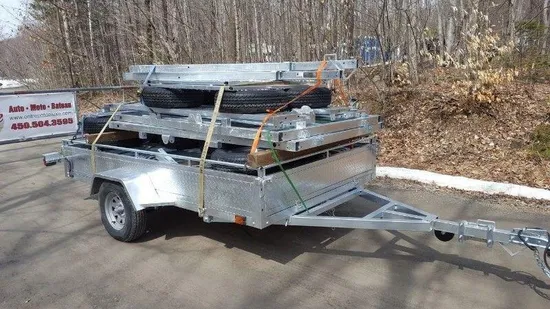
An ATV trailer is any trailer you use to carry quads or side-by-sides (UTVs). There’s no special design that makes a trailer an “ATV trailer”. It’s about the right deck size, a ramp that suits the machine, and enough tie-down points to hold it. Most buyers use an open utility trailer with a ramp gate. Others prefer a tilt trailer so there’s no ramp to lift, or an enclosed trailer that doubles as a locked garage on the road.
Some makers build side-loading ATV trailers that take two quads across the trailer from the side. We don’t currently stock that type; the trailers in this guide load from the back, which is the more common layout and suits UTVs as well as quads.
ATV trailer size: the quick answer
| What you carry | ATV trailer size we’d suggest | From our range |
|---|---|---|
| One utility ATV | 5×8 or 5×10 single axle, ramp gate | 5×8 steel, 5×8 aluminum, 5×10 steel |
| One ATV plus gear or a trailer-mounted sprayer | 5×10 or 6×12 | 5×10 aluminum, 6×12 aluminum |
| Two ATVs, nose to tail | 7×14 or 7×16 tandem | 7×14 steel, 7×16 aluminum |
| Compact UTV (about 50 in wide) | 5×10 to 6×12 | 5×10 steel 3,500 lb, 6×12 aluminum |
| Full-size utility UTV (about 64 in wide) | 77×12 to 7×14 | 77×12, 7×14 aluminum tandem |
| Sport UTV (about 72 in wide) | 82×16 to 7×18 | 80×16 aluminum, 82×18, 7×18 steel |
| ATV or UTV, kept dry and locked | 6×10 to 7×16 enclosed with ramp door | 6×10 enclosed, 7×14 enclosed, 7×16 enclosed |
The sections below show where those sizes come from, so you can check them against your own machine.
Measure your machine first
Before you look at any ATV trailer, find three figures for your quad or UTV: overall length, overall width and weight. They’re in the owner’s manual and on the maker’s website. Here are some real examples from current manufacturer spec pages:
| Machine | Length | Width | Height | Weight |
|---|---|---|---|---|
| Honda FourTrax Rancher 4×4 (2026) | 82.8 in | 47.4 in | 46.2 in | 615 lb curb |
| Honda Pioneer 520 (2026) | 105.0 in | 50.0 in | 71.2 in | 1,060 lb curb |
| Honda Pioneer 1000 Deluxe (2026) | 119.1 in | 64.0 in | 80.0 in | 1,781 lb curb |
| Can-Am Maverick X3 RS | 132 in | 72.4 in | 68.5 in | 1,728 lb est. dry |
Sources: Honda FourTrax Rancher 4×4 specs, Honda Pioneer 520 specs, Honda Pioneer 1000 Deluxe specs and Can-Am Maverick X3 specs. Honda’s curb weights include fluids and a full tank; Can-Am’s figure is an estimated dry weight, so a fuelled machine weighs more.
The spread is huge. The widest machine here is more than 50% wider than the quad, and the heaviest weighs nearly three times as much. That’s why “ATV trailer” covers everything from a small 5×8 to a 7×18 tandem.
Width decides the trailer type
On most open trailers the deck sits between the wheels, so the usable width is the gap between the fenders or rails. That gap is roughly 60 in on a 5 ft trailer, 72 in on a 6 ft, 77 to 82 in on the mid-size models, and 84 in on a 7 ft deck. Exact figures vary with the build, so ask us for the inside width of any trailer you’re looking at. Allow a few inches each side so you can steer on without scraping and get to the straps.
- Rancher-type quad (47.4 in): fits a 5 ft deck with about 6 in spare each side.
- Pioneer 520 (50 in): fits a 5 ft deck with about 5 in each side, a 6 ft deck with room to spare.
- Pioneer 1000 (64 in): too wide for a 5 ft deck, fits a 6 ft deck with about 4 in each side, better on 77 in or wider.
- Maverick X3 RS (72.4 in): won’t fit a 6 ft deck at all; on a 77 in deck it leaves just over 2 in each side, so an 82 in or 7 ft deck is the sensible minimum.
Length: add room for straps and balance
Add at least a foot to your machine’s length. You need space to strap it and to set it slightly forward of the axles so the tongue carries its share. On that basis the Rancher (about 6.9 ft) suits an 8 ft deck, the Pioneer 520 (about 8.75 ft) a 10 ft deck, the Pioneer 1000 (about 9.9 ft) a 12 ft deck, and the Maverick X3 (11 ft) a 14 ft deck or longer. Leave more if you’ll carry fuel cans, coolers or a second machine.
ATV trailer or pickup bed?
Plenty of owners start by loading a quad into a pickup bed with a pair of ramps. It works, but it has limits. A quad like the Rancher is 47.4 in wide, which leaves little room between many pickups’ wheel arches, and its 615 lb sits high up, so the truck feels it in corners. Loading into a bed means a steep climb up long ramps, often the most nervous part of the day. And the bed is then full, with nowhere for gear or a second machine. UTVs are far too big for a pickup bed.
An ATV trailer keeps the load low, takes a gentler ramp angle, leaves the truck bed free, and can be towed by SUVs and vans that have no bed at all. You can also leave the machine on the trailer between rides, ready to go. For anyone riding more than a few times a year, or owning more than one machine, a trailer is usually the better long-term buy, in our view.
Types of ATV trailer we sell
Open utility trailers with a ramp gate
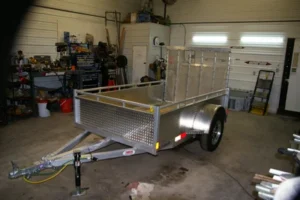
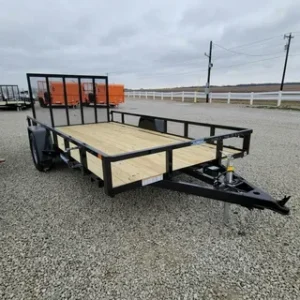
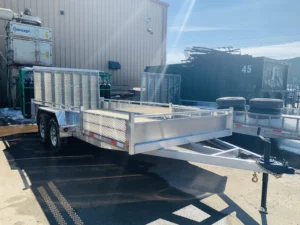
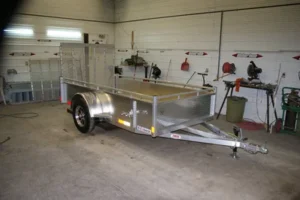
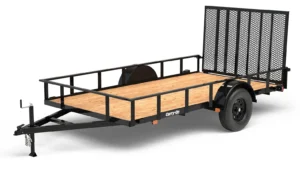
This is the classic ATV trailer: a low open deck, mesh or rail sides, and a fold-down gate that doubles as the ramp. It’s light, cheap, easy to tow and easy to see over. It suits anyone who rides locally, stores the machine at home and doesn’t need it covered on the road. Steel versions cost the least; aluminum ones are lighter and don’t rust.
Single axle examples: the 5×8 steel utility trailer (2,990 lb GVWR), the 5×10 steel utility trailer (3,500 lb GVWR), the 5×10 aluminum utility trailer and the 6×12 aluminum utility trailer (2,996 lb GVWR). Tandem examples: the 7×14 steel tandem (7,000 lb GVWR), the 7×16 aluminum tandem and the 7×20 aluminum tandem (7,010 lb GVWR). Browse all utility trailers and lawn and garden trailers, many of which make good ATV trailers too.
Tilt trailers
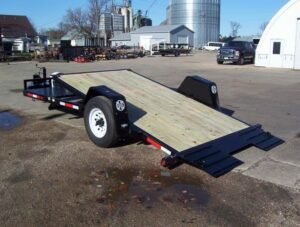
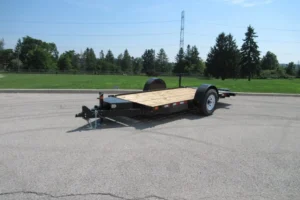
On a tilt trailer the deck tips down to the ground, so there’s no ramp gate to lift or to catch the wind. The loading angle is gentle, which helps with lowered sport machines and with nervous riders. Our 6×12 manual tilt trailer and 6×12 gravity tilt trailer both take a quad or a compact UTV, and the 6×14 gravity tilt trailer gives extra length for gear. For bigger side-by-sides, the 7×20 tilt and load trailer is a heavier option. More detail in our tilt trailer buying guide, or browse tilt and load trailers.
Enclosed trailers with a ramp door
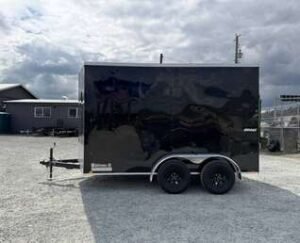
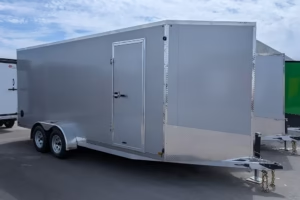
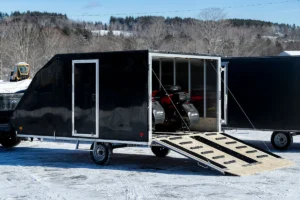
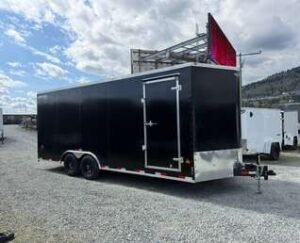
An enclosed ATV trailer keeps the machine out of rain, road grit and sight, and you can leave it loaded overnight at a campsite or hotel. The rear door folds down as a ramp. Inside, you have walls to fit hooks, racks and a fuel can holder. The downsides are weight, wind and price. Check the interior height against your machine: the Pioneer 1000’s 80 in height fits under an 84 in roof, but the door opening is often lower than the interior, so ask us for that figure before you buy.
Examples: the 6×10 aluminum enclosed trailer with ramp (78 in interior), the 7×14 enclosed trailer with ramp (84 in), the 7×16 enclosed trailer with ramp (84 in) and the 8.5×20 enclosed trailer for two side-by-sides. Our snowmobile trailers, like the 7×21 aluminum snowmobile trailer with 84 in interior height, also carry ATVs all year. See all enclosed trailers, and our enclosed vs open trailer comparison.
Larger flatbeds for fleets
Outfitters, farms and rental businesses moving several machines at once often use an equipment trailer or a deckover. A deckover’s 102 in deck takes two quads side by side with no fenders in the way. Our flatbed trailer guide covers those.
How many ATVs fit on an ATV trailer?
Using the Rancher’s 82.8 in by 47.4 in as a typical utility quad, here’s how the numbers work out on floor space alone:
- One quad: 5×8 (60 x 96 in). About 13 in of spare length.
- Two quads nose to tail: 165.6 in, or 13.8 ft, plus straps. A 7×14 is tight; a 7×16 gives room to work.
- Two quads side by side: 94.8 in of width, which no between-the-wheels trailer offers. That needs a 102 in deckover, which leaves about 3.5 in each side, or a side-loading design.
- Three quads nose to tail: 248 in, or about 20.7 ft. That’s more than a 7×20 deck, so three full-size quads usually means a longer trailer or a mix of side-by-side and nose-to-tail on a deckover.
- Four quads: two rows of two on a 102 in deckover use about 14 ft of deck.
Smaller youth quads change the sums, and machines with racks, winches or wider tyres need more room, so measure your own.
Weight: GVWR, payload and your ATVs
Every ATV trailer has a GVWR, the most it may weigh fully loaded including the trailer itself. Ford’s towing guide defines GVWR for vehicles in the same way, as “the maximum allowable weight of the fully-loaded vehicle” (Ford 2026 RV and Trailer Towing Guide). What you can actually carry is the payload:
Payload = GVWR − empty trailer weight
A single quad is light. At 615 lb, the Rancher is well inside what a 2,990 lb GVWR trailer allows even after the trailer’s own weight. Two quads plus fuel and gear come to around 1,400 lb, still fine on most single axle trailers on paper, but a tandem rides better and leaves margin. UTVs are another story. A Pioneer 1000 at 1,781 lb plus tools in the bed can use most of a small single axle trailer’s payload, so for full-size side-by-sides we’d suggest a tandem axle trailer of around 7,000 lb GVWR. We’ll give you the empty weight of any ATV trailer we sell so you can do the sum.
Single axle or tandem?
For one quad, a single axle is lighter, cheaper and easier to push around by hand. For two quads or any full-size UTV, a tandem is steadier, shares the weight across four tyres, and keeps you rolling if one tyre goes flat. Our tandem axle trailer guide explains the trade-offs.
Tongue weight and your tow vehicle
Your vehicle has to handle the trailer and the weight pressing down on the hitch. Ford says that for conventional trailers over 2,000 lb, “tongue load is 10% of loaded trailer weight” (Ford). Other makers quote ranges up to about 15%, so check your own handbook. In Great Britain, GOV.UK points drivers to the vehicle handbook or VIN plate for the towing limit (GOV.UK towing weight and width limits).
A worked example: a 7×14 enclosed trailer carrying a Pioneer 1000 could weigh around 4,000 lb or more loaded, depending on the trailer’s own weight. At 10% that’s roughly 400 lb on the hitch. Plenty of SUVs and pickups can do that, but many small cars can’t. If you’re close to your vehicle’s limit, an aluminum open ATV trailer is the lighter route.
Ramps and loading an ATV trailer
Loading is where most ATV trailer accidents happen, so the ramp matters as much as the deck. A few things to look at:
- Ramp length. A longer ramp gives a gentler angle. Short, steep ramps make machines with low ground clearance scrape and make it easier to lose traction.
- Ramp surface. Mesh or expanded metal gives grip in wet and mud. Smooth steel gets slippery.
- Ramp springs or assist. A big ramp gate can be heavy to lift. Spring-assisted gates make that easier.
- Tilt instead of ramps. No ramp to lift at all, and the gentlest angle.
- Enclosed ramp door. Usually strong enough for a full-size UTV, but check the door’s rating against your machine.
When loading, hitch the trailer to the vehicle first so it can’t tip, line up straight, use low gear and keep a steady speed. Don’t stand behind or beside the ramp while someone rides up. Many riders prefer to winch or walk a quad on rather than ride it, especially on a steep ramp. Read your machine’s owner’s manual for the maker’s own loading advice.
Tie-downs: holding your ATV on the trailer
Count the tie-down points on any ATV trailer before you buy. You want solid D-rings or stake pockets near each corner of where the machine will sit, so you can strap it from four directions. Strap to the frame or to points the maker recommends, not to plastic or to racks that might bend. Compressing the suspension a little with the straps helps stop the machine bouncing loose.
In the US, the FMCSA cargo securement rules for commercial vehicles are a useful benchmark even for private towing. They say the total working load limit of the tie-downs “must be at least one-half the weight of the article” (FMCSA cargo securement rules). For a 1,781 lb UTV, that means straps with a combined working load limit of at least about 890 lb, counted the way the rules describe. The rules apply to commercial vehicles in interstate commerce and other countries have their own, but the principle holds anywhere. Our guide to securing a load on a trailer goes into straps, ratchets and angles.
Steel, galvanized or aluminum?
A painted steel ATV trailer costs the least and is easy to repair. An aluminum ATV trailer is lighter, which helps if your tow vehicle is small, and it doesn’t rust. Galvanized steel sits in between: heavier than aluminum but with a zinc coating that resists rust much better than paint. The American Galvanizers Association estimates coating life from thickness and climate, and points out that “time to first maintenance” isn’t the same as total service life (American Galvanizers Association). If you ride on beaches, salted winter roads or wash mud off the deck every weekend, rust resistance is worth paying for. Our aluminum vs steel trailer article compares them in detail.
Features worth having on an ATV trailer
- Plenty of tie-down points, placed where your machine sits.
- Mesh or rail sides to stop gear sliding off.
- A spare wheel and a way to carry it.
- LED lights, which last longer and cope better with water when you launch near rivers or wash the trailer.
- A wheel chock or front stop to line the machine up the same way each time.
- Brakes on heavier trailers. Many countries and states require them above a certain loaded weight, so check your local rules.
- A jockey wheel so you can move the trailer by hand.
What each upgrade costs in our range
Prices change, so here are the differences between trailers we sell today as percentages. They show the relative cost of each choice better than a price tag would.
- Aluminum vs steel, 5×8: our 5×8 aluminum costs about 71% more than our 5×8 steel.
- Aluminum vs steel, 5×10: our 5×10 aluminum costs about 62% more than our 5×10 steel with the 3,500 lb GVWR.
- Aluminum vs steel, 7×14 tandem: about 86% more for aluminum.
- Open vs enclosed, 6 ft: our 6×12 enclosed trailer with barn doors costs about 35% more than our 6×12 aluminum open trailer.
- Open vs enclosed, 7×14: our 7×14 enclosed with barn doors (7,055 lb GVWR) costs about twice our 7×14 steel open tandem, and the 7×14 enclosed with a ramp door (10,141 lb GVWR) nearly three times as much.
- Tilt vs open, 6×12: our 6×12 manual tilt trailer is priced the same as our 2027 6×12 aluminum open trailer.
- Used vs new enclosed: our used 2022 7×19 aluminum snowmobile trailer costs about 27% less than the new 7×21.
Our take: if you ride locally and store the machine indoors, a steel open ATV trailer is hard to beat on value. If you tow long distances, camp with the machine or store the trailer outside, the extra for enclosed or aluminum earns its keep.
Buying a used ATV trailer
A used trailer can save real money, and open ATV trailers are easy to inspect. Look at the frame for cracks and heavy rust, especially at the hitch and the axle mounts. Check the deck for soft spots, the ramp hinges for wear, the tyres for age cracks, and the lights and wiring. Make sure the VIN or serial plate and the GVWR label are there. Our used trailers include enclosed options like the 2022 7×19 aluminum snowmobile trailer and the 2023 8.5×16 cargo trailer, both of which carry ATVs and UTVs. For a full checklist, see our used trailer buying guide.

ATV trailers for farms, hunters and businesses
Not everyone buys an ATV trailer for weekend trail riding. On farms and ranches, a quad or UTV is a working machine, and the trailer moves it between fields, along with fencing gear, sprayers and feed. A 7×16 tandem with a ramp gate carries the machine plus a pallet of posts, and steel is fine because it’s easy to weld and repair.
Hunters and anglers often want an enclosed trailer, because it hides expensive kit at the trailhead and gives somewhere dry to change and store gear. A 6×10 or 7×14 enclosed with a ramp door suits one machine; an 8.5×20 takes two UTVs or a UTV plus a quad.
Rental companies, guided tour operators and dealers need to move several machines at once and load them quickly, many times a week. For them, a longer tandem, a tilt deck or a 102 in deckover saves time. For the heaviest fleet work, see our equipment trailers.
Three example buyers
These buyers are made up. They show how the steps in this guide fit together.
A trail rider with one quad
She rides a utility quad about the size of the Rancher, tows with a small SUV, and keeps the trailer in a garage. Width and weight are easy: a 5×8 open ATV trailer with a mesh ramp gate takes the machine with room for a fuel can. Because her SUV has a modest towing limit, she picks the aluminum 5×8 to save weight.
A farmer with a full-size UTV
He runs a 64 in wide utility side-by-side with tools in the bed, so the loaded machine is close to 2,000 lb. The width rules out a 5 ft deck and the weight argues against a small single axle. A 7×14 steel tandem at 7,000 lb GVWR fits the machine with space for a few fence posts, and the steel frame is easy to repair on the farm.
A couple with two sport UTVs
They own two 72 in wide sport side-by-sides and travel to riding areas a few hours away, staying overnight. Two machines that wide need either a very long open trailer or a full-width enclosed one. An 8.5×20 or 8.5×24 enclosed trailer with a ramp door takes both, keeps them secure in hotel car parks, and gives room for gear. They check that their pickup can tow the loaded weight before ordering.
Storing and looking after your ATV trailer
Measure where the trailer will live before you buy. The overall length includes the tongue, usually several feet beyond the deck, and enclosed trailers need height clearance under carports and garage doors. Wash off mud and salt after rides, grease the hubs and ramp hinges, and check tyre pressures and lights before every trip. Keep the deck clear of standing water, especially on wooden floors. Our trailer maintenance checklist covers it all in more detail.
Common mistakes when buying an ATV trailer
- Not measuring the machine’s width. Sport UTVs especially are wider than people think.
- Buying for today’s quad only. If a UTV or a second machine might come later, size up now.
- Forgetting the empty trailer weight. Payload is GVWR minus the trailer, not GVWR.
- Ignoring tongue weight. Check your vehicle can take it.
- Too few tie-down points. Four solid anchors around the machine is the minimum.
- A steep, smooth ramp. It’s the riskiest part of using any ATV trailer.
- Enclosed with a low door. Check the door opening height, not just the roof height.
Choosing an ATV trailer step by step
- Write down your machine’s length, width, height and weight from the maker’s specs.
- Add a few inches of width each side and at least a foot of length.
- Decide open, tilt or enclosed based on how far you travel and where you store it.
- Add the weight of fuel, gear and any second machine, and pick a GVWR that leaves margin after the trailer’s own weight.
- Check your vehicle’s towing limit and tongue weight limit.
- Look at the ramp or tilt, tie-down points, lights and brakes.
- Choose steel, galvanized or aluminum for your climate and budget.
For the same process applied to every kind of trailer, read how to choose a trailer, and for more sizes, our trailer size guide.
Rules on size, lights and registration
Trailer rules differ a lot between countries and states, so check the ones where you live and where you’ll ride. In Great Britain, for example, GOV.UK sets a maximum trailer width of 2.55 m for towing with a car, and a maximum length of 7 m for a trailer towed by a vehicle weighing up to 3,500 kg (GOV.UK). In the US, the federal width limit for commercial vehicles on the National Network is 102 in (Federal Highway Administration). Every ATV trailer in this guide is well within those widths except the full-width deckovers, which sit at the US limit.
Beyond size, most places require working brake lights, indicators and tail lights, a number plate or registration on the trailer, and sometimes safety chains or a breakaway cable. Brakes are usually required above a certain loaded weight. If you’re not sure, tell us where you’ll tow and we’ll point out anything to check on the trailer you’re considering.
Carrying gear as well as the machine
Riders rarely carry just the quad. Helmets, fuel, tools, a cooler, a spare tyre and sometimes a tent all need a place. On an open trailer, a front rack or toolbox on the tongue keeps that kit out of the way of the machine. On an enclosed trailer, the walls take hooks and shelves, which is one of the biggest reasons people choose enclosed. Either way, add that gear to your weight sums and keep heavy items low and near the axles.
Youth quads and smaller machines
Youth ATVs and small utility machines are shorter and narrower than the Rancher, so two often fit side by side on a 6 ft or 7 ft deck where two full-size quads won’t. Measure them together, including handlebars and mirrors, before you assume. A 6×12 is often enough for two small quads, which costs less to buy and tow than a 7×16. Leave room for growth, though: kids move up to bigger machines quickly.
Towing an ATV trailer: driving tips
A loaded ATV trailer changes how your vehicle drives. Leave more space to stop, take corners wider, and slow down in crosswinds, especially with an enclosed trailer, which catches more wind than an open one. Check the straps after the first few miles and at every stop. On dirt roads to riding areas, take it slow over ruts and potholes, which bounce the machine against its straps. If the trailer starts to sway, ease off the accelerator rather than braking hard. More on this in our trailer towing tips.
Open or enclosed: which suits your riding?
If you ride close to home, store the machine in a garage and want the lowest cost and weight, an open ATV trailer is the practical choice. If you travel long distances, stay overnight away from home, ride in wet or dusty places, or want somewhere to keep gear permanently packed, an enclosed one is worth the extra. Plenty of riders start with open and move to enclosed as their trips get longer. If you think that’s likely, buying enclosed first saves the cost of a second trailer later.
Questions to ask before you order
Whoever you buy from, these questions save surprises when the trailer arrives:
- What is the inside width between the fenders or rails, measured at the narrowest point?
- What is the empty weight, and so what is the real payload?
- How long is the ramp or gate, and what is it rated to carry?
- How many tie-down points are there, and where exactly are they?
- For enclosed trailers, what are the door opening height and width, and the width between the wheel wells inside?
- What size coupler does it have, and does it need a brake controller?
- What lights, chains or breakaway system does it have, and do they suit the rules in my country?
- Is there a spare wheel, and what size are the tyres?
- What does delivery to my address cost, and how long does it take?
We’ll answer all of these for any trailer in our range. Having the answers in writing also makes it easy to compare two or three options side by side, which is the quickest way to land on the right one for your machine and your budget.
Why buy your ATV trailer from us
We sell open, tilt and enclosed trailers side by side, so we can match the ATV trailer to your machine rather than steering you to one type. Every listing shows the deck size, axle setup and GVWR, and we’ll send the empty weight, inside width, interior and door heights, ramp type and coupler size of any trailer you’re considering. Send us your machine’s model and your tow vehicle, and we’ll check the fit and the weights with you before you order. We stock used trailers too, which can be a cheaper way into an enclosed ATV trailer. We deliver to many countries and can quote delivery along with the trailer, so you know the full cost up front. Advice is free and there’s no obligation to buy.
Worldwide delivery
Open ATV trailers are compact and simple to ship; enclosed ones are bulkier and sometimes need special transport. Tell us your country when you ask for a quote, so we can check that the trailer’s width, lights and brakes suit local rules where you’ll tow it.
ATV trailer FAQ
What size trailer do I need for one ATV?
A 5×8 is enough for most utility quads, which are usually under 4 ft wide and about 7 ft long. A 5×10 gives room for gear.
What size trailer do I need for two ATVs?
Two full-size quads nose to tail need about 14 ft plus strapping room, so a 7×14 is tight and a 7×16 is comfortable. Side by side needs a 102 in deck.
What size trailer do I need for a UTV?
It depends on width. A compact 50 in UTV fits a 5×10. A 64 in utility UTV needs a 6 ft deck at least, and a 72 in sport UTV needs an 82 in or 7 ft deck, usually 14 to 18 ft long.
Can I put an ATV in an enclosed cargo trailer?
Yes, if it has a ramp door and the door opening and interior are tall and wide enough. Most quads are under 4 ft tall; tall UTVs need checking.
Is a single axle ATV trailer enough?
For one or two quads, usually yes. For a full-size UTV, we’d suggest a tandem.
Do I need brakes on my ATV trailer?
That depends on the loaded weight and the rules where you live. Light single axle trailers often don’t need them; heavier trailers usually do.
Steel or aluminum ATV trailer?
Steel is cheaper and easy to repair. Aluminum is lighter and won’t rust, and in our range costs roughly 60 to 85% more depending on size.
Shop ATV trailers
We stock trailers that suit every quad and side-by-side, from 5×8 open trailers to 8.5×24 enclosed models, new and used, with delivery worldwide. Browse utility trailers, lawn and garden trailers, tilt and load trailers, enclosed trailers, snowmobile trailers and used trailers, or see everything in the shop. Not sure which ATV trailer fits your machine? Contact us with the model and your tow vehicle. For more reading, see types of trailers, trailer towing tips and our utility trailer buying guide.
Sources and References
- Honda: 2026 FourTrax Rancher 4×4 specifications
- Honda: 2026 Pioneer 520 specifications
- Honda: 2026 Pioneer 1000 Deluxe specifications
- Can-Am: Maverick X3 specifications
- Ford: 2026 RV and Trailer Towing Guide (GVWR and tongue load)
- FMCSA: Cargo securement rules
- GOV.UK: Towing with a car, weight and width limits
- American Galvanizers Association: Estimating the life of hot-dip galvanized coatings