

A used trailer can save you a lot of money, but only if you check it properly before you pay. Inspect six things on any used trailer: the frame and welds, the axles and suspension, the tires and their date codes, the bearings and brakes, the deck or floor, and the paperwork, including a VIN that matches the title. Then compare the price with a new trailer of the same size and rating, because a used trailer isn’t always the cheaper option.
This guide walks through that inspection step by step. It explains how to tell a fair price from an overpriced one, using our own new and used listings as real examples, and lists the used trailers we have for sale right now: cargo, snowmobile, deckover, gooseneck tilt and horse trailers. We sell and deliver worldwide. Specs and prices come from our own listings. Outside facts link to their source, and where something is our opinion, we say so.
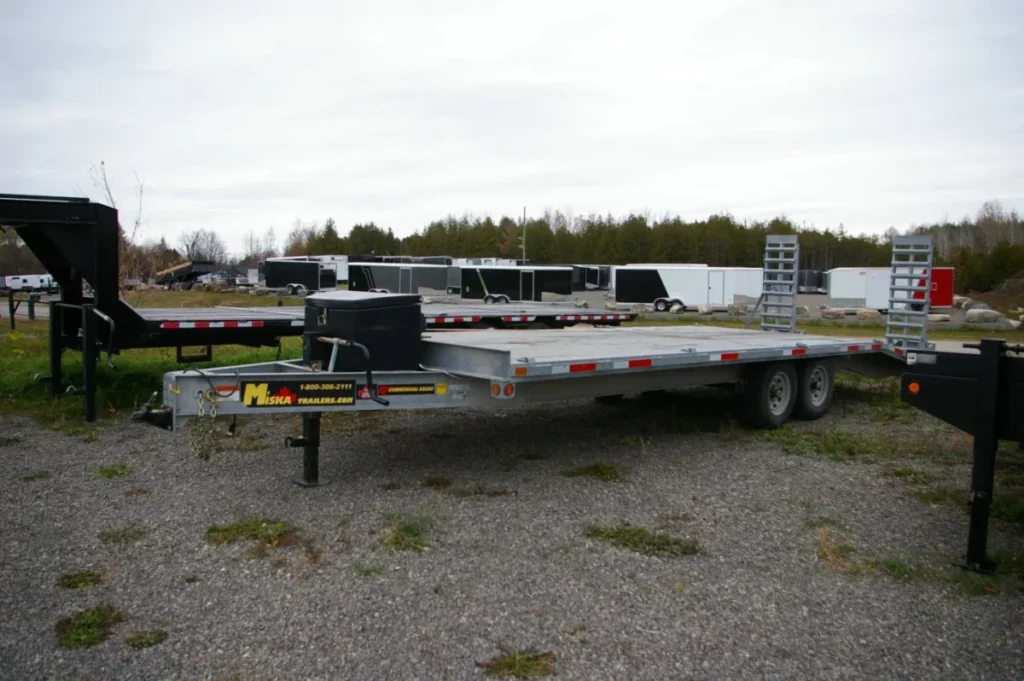
Used trailers we have for sale right now
| Used trailer | Year | Size | Key specs | Price |
|---|---|---|---|---|
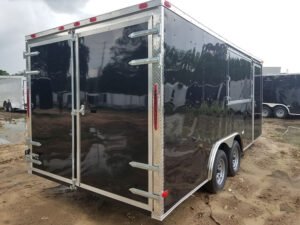
| Used cargo trailer | 2023 | 8.5 x 16 ft | Enclosed, tandem, 2-5/16 in coupler, charcoal | $5,100 |
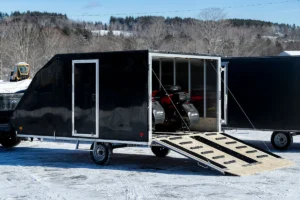
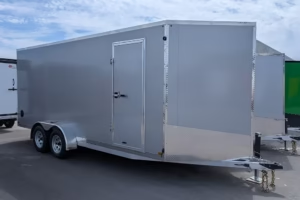
| Used snowmobile trailer | 2022 | 7 x 19 ft | Aluminum, tandem, ramp door, 7,000 lb GVWR | $7,200 |
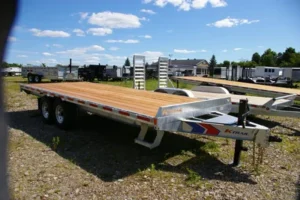
| Used deckover trailer | 2021 | 102 in x 25 ft | Galvanized, tandem, 14,000 lb GVWR | $7,900 |
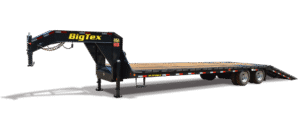
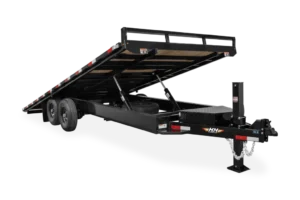
| Used gooseneck tilt trailer | 2024 | 8.5 x 25 ft | Tilt and load, gooseneck, tandem, black | $8,300 |
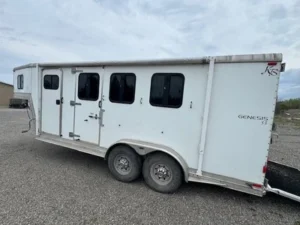
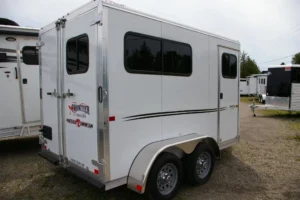
| Used 3 horse gooseneck | 2006 | 3 horses | Gooseneck, dressing room | $13,999 |
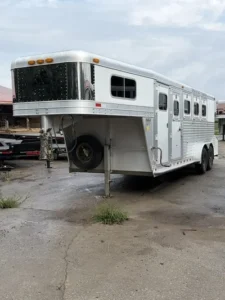
| Used 4 horse gooseneck | 2004 | 4 horses | Gooseneck | $16,500 |
Prices are in US dollars and correct when this was written. Browse the full used trailers category for current stock. We’ll send extra photos, condition notes and a video walk-around of any used trailer on request.
Is a used trailer worth it?
A trailer is a simple machine. There’s no engine or gearbox, so a well-kept used trailer can do the same job as a new one for years. The parts that wear, such as tires, bearings, brake parts, lights and deck boards, are usually cheap and easy to replace. The parts that are expensive or impossible to fix properly are the frame, the axles and, on enclosed and horse trailers, the floor and roof.
So the question isn’t really new or used. It’s whether this particular used trailer has a sound frame, straight axles and a clean history, at a price that leaves room for the wear items you’ll probably need to replace.
When a used trailer makes sense
- You need a bigger or more specialised trailer than your budget allows new.
- You’ll use it a few times a year, so long-term wear matters less.
- You’re comfortable spending a little on tires, bearings or lights.
- The trailer is a recent model with plenty of life left, like our 2024 gooseneck tilt or 2023 cargo trailer.
When new is the better buy
- A new trailer of the size you need costs about the same as a used one.
- You’ll use it every day for business and want a warranty where offered.
- You need specific options, such as a certain height, door type or brakes.
- The used trailer needs a floor, axle or frame repair.
Used vs new: real prices from our own listings
Here’s where most buying guides stop being useful. They tell you used is cheaper without showing you. These are real comparisons from our current stock. They aren’t identical trailers, so read the notes.
| Used trailer | Used price | Closest new model | New price | Notes |
|---|---|---|---|---|
| 2022 7×19 aluminum snowmobile | $7,200 | 2026 7×21 aluminum snowmobile | $9,900 | New is 2 ft longer and rated 6,990 lb |
| 2024 8.5×25 gooseneck tilt | $8,300 | 2026 8×24 tandem tilt | $10,900 | New is bumper pull, 17,280 lb GVWR |
| 2006 3 horse gooseneck | $13,999 | 2027 3 horse slant load | $18,650 | New is bumper pull, aluminum |
| 2023 8.5×16 cargo | $5,100 | 2026 8.5×20 cargo, 90 in | $6,500 | New is 4 ft longer |
| 2021 102 in x 25 ft deckover | $7,900 | 2026 20 ft deckover | $6,200 | Used is 5 ft longer, same 14,000 lb rating |
Two things stand out. First, the savings on specialised trailers like snowmobile, tilt and horse models are substantial: $2,600 to $4,650 in these examples. Second, the used deckover costs more than a shorter new one. That’s fair, because you’re paying for 5 extra feet of deck and a galvanized finish, but it shows that a used trailer isn’t automatically cheaper. Compare like with like: size, rating, axle setup, hitch and finish.
Our view: a used trailer is a good deal when the saving covers a set of tires and a bearing service with money left over, and the frame and axles are sound.
Step 1: check the paperwork first
Do this before you drive anywhere to see the used trailer. If the paperwork isn’t right, nothing else matters.
- Find the VIN. On most trailers it’s on a plate or sticker on the tongue or the front of the frame. Under US federal rules, a vehicle identification number consists of 17 characters. Older or homemade trailers may have shorter numbers or none at all.
- Match the VIN on the trailer with the title or registration document, character for character.
- Check for recalls. NHTSA lets you search vehicles, tires and other equipment for safety recalls. Its VIN tool may not show recalls that have already been repaired, so ask the seller for records too.
- Check the weight plate. The manufacturer’s label usually shows the GVWR and axle ratings. If it’s missing or painted over, ask why.
- Ask about liens or loans on the trailer, and get a written bill of sale.
- Check you can register it where you live. Rules for trailers differ a lot between countries and states.
We supply the paperwork you need for registration with every used trailer we sell, and we’ll send the VIN in advance so you can run your own checks.
Step 2: the frame and welds
The frame is the backbone, and it’s the most important part of any used trailer inspection. Get underneath the used trailer with a torch.
- Tongue and coupler: look for cracks where the tongue meets the main frame, and where the coupler is bolted or welded on. These areas take every bump and every hard stop.
- Cross-members: check that none are bent, cracked or rusted through.
- Spring hangers: look for cracks around the brackets that hold the springs to the frame.
- Welds: fresh welds or heavy grinding marks mean a repair. Ask what happened.
- Rust: surface rust on steel is normal. Flaking, scaling or holes are not.
- Straightness: stand behind the trailer and sight along the frame. It should look straight, with no sag in the middle.
On aluminum trailers, look for cracks around welds instead of rust. On galvanized trailers like our used deckover, check for any patches where the zinc coating has worn through.

Step 3: axles, springs and wheels
- Tire wear pattern: uneven wear on one edge often means a bent axle or a misaligned spring hanger. That’s an expensive fix.
- Springs: look for broken or shifted leaves, worn shackles and bushings.
- Torsion axles: if the trailer sits noticeably lower on one side, the rubber inside may be worn.
- Axle rating: make sure the axle labels or the manufacturer’s plate match the GVWR you’re being sold.
- Wheels: check for cracks, bends and missing lug nuts.
Step 4: tires and their age
Trailer tires often age out before they wear out, because trailers sit for long periods. NHTSA explains that you can’t detect tire aging just by looking, and that some vehicle and tire makers recommend replacing tires that are six to 10 years old, regardless of tread. It also explains how to read the date code: the last four digits of the DOT Tire Identification Number show the week and year the tire was made. For example, a code ending in 0308 means the third week of 2008.
On a used trailer, check every tire including the spare, and on both sidewalls, because the code may only appear on one side. If the tires are old, budget for a new set. It’s usually one of the cheaper repairs, but don’t skip it. Also check that the tires are trailer-rated and that their load rating together covers the trailer’s GVWR.
Step 5: bearings and brakes
Bearings
Jack up each wheel in turn and spin it by hand. It should turn smoothly and quietly. Then grab it at the top and bottom and rock it. Any clunk or play means the bearings need adjusting or replacing. Ask when they were last greased. Bearing failure is one of the most common roadside problems with trailers, and a seized bearing can damage the axle spindle.
Brakes
- Electric brakes: connect the trailer to a vehicle with a brake controller and test them at low speed. Check the wiring to each wheel for damage.
- Surge brakes: check the actuator on the tongue for leaks and that it moves freely.
- Breakaway kit: pull the pin and check the brakes lock on. Check that the battery holds a charge.
- Drums and shoes: if you can, pull a drum and look at the shoe wear and the magnets.
Brakes matter for safety and, in many places, for the law. In Great Britain, GOV.UK says a trailer must have a working brake system if it weighs more than 750 kg loaded.
Step 6: the used trailer’s deck, floor and body
Open trailers
- Walk the whole deck. Soft, cracked or spongy boards need replacing.
- Check ramps, gates and dovetails for bends, cracks and working latches.
- Look at stake pockets and tie-down points for cracks.
Enclosed and cargo trailers
- Look for water stains on the ceiling and walls. Leaks are the most common problem on a used cargo trailer.
- Press on the floor everywhere, especially near the doors and in corners.
- Check roof seams, vents and door seals.
- Open and close every door and the ramp. Check the hinges, springs and latches.
Our cargo trailer guide covers what to look for in more detail.

Horse trailers
- Lift the mats. Urine and manure rot wood floors and corrode aluminum. This is the single most important check on a used horse trailer.
- Check dividers, latches, butt bars and windows for damage and sharp edges.
- Look at the ventilation: roof vents and windows should open and close.
- On living quarters trailers, check every appliance and look for water damage.
Our horse trailer guide and living quarters horse trailer guide go further.
Step 7: lights, wiring and hitch
- Connect the trailer and test every light: tail, brake, indicators, side markers and plate light.
- Look for chafed, taped or corroded wiring under the frame.
- Check the plug type matches your vehicle, or budget for an adapter.
- Check the coupler latches firmly onto a ball of the right size. Our used trailers list a 2-5/16 in coupler on several models.
- On goosenecks, check the coupler height adjustment and the safety chains.
- Check the jack winds up and down smoothly.
Step 8: a test tow
If you can, hitch the used trailer up and tow it a short distance. Listen for knocks and grinding. Check that it tracks straight behind the vehicle and doesn’t pull to one side. After a few miles, stop and carefully feel each hub. One much hotter than the others can mean a dragging brake or a tight bearing. If you’re buying from a distance, ask the seller for a video of the trailer being towed and of each wheel being spun.
What to look for by trailer type
The steps above apply to every used trailer. Each type also has its own weak spots.
Used utility and flatbed trailers
Check the rear gate hinges and springs, which take a beating. Look at the deck where wheels land, and at the stake pockets, which crack when overloaded. Heavy use with gravel or soil often shows up as bent cross-members. See our utility trailer and flatbed trailer guides.
Used dump trailers
Run the hydraulics up and down several times. Check for leaks at the cylinder and hoses, and see whether the bed holds its position when raised. Look at the hinge pins at the back and the floor of the bed for cracks and thin spots. Our dump trailer guide covers this in more depth.
Used equipment and tilt trailers
Machines are heavy and tracks are hard on decks. Look for cracked welds where the ramps or dovetail join the frame. On tilt trailers, check the pivot for play, and see whether the deck lock engages fully. On hydraulic tilts, check that the deck holds its angle without drifting down. Our tilt trailer and skid steer trailer guides go further.
Used enclosed and snowmobile trailers
Water is the enemy. Check the roof, the front nose seams and around every vent and light. On snowmobile trailers, look at the floor coating and the front and rear ramps, which see a lot of studded tracks and salt. Check that the ramp door spring assist still works.
Used horse trailers
The floor comes first, then the dividers, latches and ventilation. On older steel horse trailers, look closely for rust under the mats and along the lower walls where manure sits.
Questions to ask the seller
- How long have you owned it, and what did you use it for?
- When were the bearings last serviced?
- When were the tires replaced? Can I see the date codes?
- Has it ever been in an accident or had frame repairs?
- Has it been stored outside or under cover?
- Do the brakes and all lights work?
- Is the title or registration in your name, and is there any loan on it?
- Are there any known problems I should know about?
A seller who answers clearly and lets you look at everything is a good sign. When you buy a used trailer from us, we’ll answer every one of these in writing.
Red flags that should make you walk away
- No VIN, or a VIN that doesn’t match the paperwork.
- Cracked frame welds around the tongue or spring hangers.
- A bent axle, shown by badly uneven tire wear.
- A rotten floor in a horse trailer.
- Widespread water damage in an enclosed or living quarters trailer.
- A seller who won’t let you look underneath or test the lights and brakes.
- A price far below what similar trailers sell for, with no clear reason.
How to negotiate a fair price
This is practical advice from our side of the counter, not a formula.
- Know the new price of the closest equivalent. The comparison table above is a good start.
- Write down what it needs: tires, bearings, lights, deck boards. Each is a fair reason to ask for less.
- Be specific. “The tires are from 2017 and need replacing” is more convincing than “it looks a bit tired”.
- Consider timing. Out-of-season trailers often sell for less.
- Don’t haggle away the inspection. A small discount isn’t worth missing a cracked frame.
A quick used trailer inspection checklist
Take this with you, or send it to the seller with a request for photos.
- VIN found, legible and matching the paperwork
- Manufacturer’s weight plate present, showing GVWR
- Tongue, coupler and frame free of cracks
- Cross-members straight and solid
- Spring hangers and springs intact
- Even tire wear, no sign of a bent axle
- Tire date codes checked on every tire, including the spare
- Wheels spin smoothly with no play
- Brakes and breakaway kit tested
- Deck or floor solid, with mats lifted on horse trailers
- Roof, seams and doors dry and sealed on enclosed trailers
- All lights and wiring working
- Coupler fits your ball, jack works
- Short test tow with no noises or pulling
What to budget after buying a used trailer
We can’t give exact figures, because prices vary so much between countries. As a general plan, set aside money for:
- Tires, if they’re more than a few years old.
- A bearing service on every wheel.
- Brake parts, such as shoes, magnets or a breakaway battery.
- Lights and wiring, often a cheap upgrade to LEDs.
- Deck boards or floor repairs, where needed.
- Registration, insurance and any inspection required where you live.
Our view: if the trailer’s price plus these likely costs is still well below a comparable new trailer, it’s probably a good buy. If it isn’t, look at new.
Fixing up a used trailer: what you can do yourself
Many owners do the basic jobs at home. Others are best left to a trailer or welding shop. This split is our general view, and it depends on your skills and tools.
Usually fine to do yourself
- Replacing tires and wheels, if you have a suitable jack and torque wrench.
- Greasing or repacking bearings, once you’ve watched it done properly.
- Swapping lights for LEDs and replacing damaged wiring.
- Replacing deck boards on open trailers.
- Painting steel after wire-brushing surface rust.
- Fitting a new jack, coupler lock or spare tire mount.
Usually a job for a professional
- Frame welding, especially near the tongue or spring hangers.
- Straightening or replacing an axle.
- Brake rebuilds, if you’re not confident with electric brakes.
- Aluminum welding, which needs different equipment and skills.
- Roof replacement on enclosed trailers.
- Floor replacement on horse trailers, where safety is critical.
Three buyers, three choices
These are typical situations we hear about, with our suggestion for each. They’re recommendations, not rules.
The snowmobile rider on a budget
Two sleds, a few trips a winter, and a tight budget. The 2022 used 7×19 aluminum snowmobile trailer at $7,200 saves $2,700 on the new 7×21. Check the floor coating and ramp springs, and it should give years of service.
The contractor needing a big deck
Wide machines and pallets, used every week. The 2024 used gooseneck tilt trailer is nearly new and costs $2,600 less than our new 8×24 tilt. If a gooseneck doesn’t suit your truck, the used galvanized deckover is a bumper-pull alternative.
The rider buying a first horse trailer
Two or three horses, occasional shows. The 2006 used 3 horse gooseneck at $13,999 is a big saving on a new trailer. Budget for a floor check, new tires and a bearing service. If your truck can’t take a gooseneck, look at the new 2 horse bumper pull at $13,400.
Storing the trailer after you buy it
- Keep it under cover if you can, especially steel trailers and wood decks.
- Raise the tongue slightly so rain runs off.
- Cover the tires from sun, which ages rubber.
- Move it every few weeks to avoid flat spots on the tires.
- Use a coupler lock and wheel clamp. Trailers are easy to steal.
- Photograph the VIN and keep a copy of the paperwork somewhere safe.
Towing a used trailer safely
Once the used trailer is yours, treat the first trip as a shakedown. Load it lightly, keep the speed down, and stop after a few miles to check the hubs, tires and hitch. Then load properly.
GMC’s towing guide says a conventional trailer should put about 10 to 15 percent of its loaded weight on the hitch, and a gooseneck 15 to 30 percent, with roughly 60 percent of the load over the front half of the trailer. Too little weight on the hitch is the main cause of sway.
Secure every load. The AAA Foundation for Traffic Safety found that road debris was a factor in an average of 50,658 police-reported crashes a year in the US from 2011 to 2014, with about two-thirds involving items that fell from vehicles. Our guides to securing a load and trailer towing tips cover the details.

Our used trailers in detail
2023 used cargo trailer, 8.5 x 16 ft: $5,100
A wide enclosed trailer on tandem axles, with a 2-5/16 in coupler, in charcoal. At 8.5 ft wide, it’s roomy enough for a small car, motorcycles, a mobile workshop or moving gear. It’s a recent model, so there’s plenty of life left. See the used cargo trailer.
2022 used snowmobile trailer, 7 x 19 ft: $7,200
Aluminum, tandem axles, a rear ramp door and a 7,000 lb GVWR, in black and charcoal. Aluminum doesn’t rust like steel, which matters for a trailer that lives on salted winter roads. See the used snowmobile trailer, or read our snowmobile trailer guide.
2021 used deckover trailer, 102 in x 25 ft: $7,900
Galvanized, tandem axles, a 2-5/16 in coupler and a 14,000 lb GVWR. The deck sits over the wheels, so you get the full 102 in width (about 2.59 m) for wide machines, pallets and vehicles. See the used deckover trailer, or read our flatbed trailer guide. Note that 102 in is over the 2.55 m width limit in Great Britain.
2024 used gooseneck tilt trailer, 8.5 x 25 ft: $8,300
A tilt and load deck, gooseneck hitch with 2-5/16 in listed, tandem axles, black. The deck tips to the ground so machines drive straight on without ramps. At 2024, it’s nearly new. See the used gooseneck tilt trailer, or read our tilt trailer guide. Ask us for the GVWR.
2006 used 3 horse gooseneck trailer: $13,999
A gooseneck with a front dressing room. Older horse trailers can be excellent value, but the floor check under the mats is essential. Ask us for photos with the mats lifted. See the used 3 horse gooseneck.
2004 used 4 horse gooseneck trailer: $16,500
A four horse gooseneck. Ask us for the GVWR, layout and condition notes. See the used 4 horse gooseneck.
New trailers to compare against
If a used trailer doesn’t fit, these new models are the closest alternatives in our range:
- 2026 7×16 cargo trailer, ramp door: tandem, 84 in interior, 10,141 lb GVWR, $7,500.
- 2026 8.5×20 cargo trailer: tandem, rear ramp, 90 in interior, 10,141 lb GVWR, $6,500.
- 2026 7×21 aluminum snowmobile trailer: 84 in interior, 6,990 lb GVWR, $9,900.
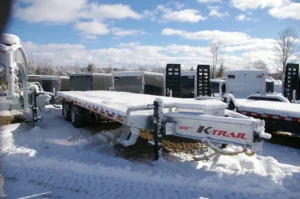
- 2026 20 ft deckover trailer: tandem, 14,000 lb GVWR, $6,200.
- 2025 102 in deckover: 20 ft plus 5 ft dovetail, tandem, 33,000 lb GVWR, $11,900.
- 2026 8×24 tilt trailer: tandem, 17,280 lb GVWR, $10,900.
- 2027 3 horse slant load trailer: bumper pull, aluminum, 84 in interior, 7,000 lb GVWR, $18,650.
- 2026 2 horse trailer: Colt Big Sky Series, bumper pull, aluminum, 7,000 lb GVWR, $13,400.
For smaller jobs, our new utility trailers start at $1,050, which is often less than you’d pay for a decent used one.
Buying a used trailer from a distance
Many of our customers buy a used trailer without seeing it in person, often from another country. That’s workable if you ask for the right things:
- Photos of every area in this checklist: under the frame, the tongue, the spring hangers, each tire’s date code, the deck or floor, the roof and the VIN plate.
- A video walk-around with the lights working and each wheel being spun.
- The VIN in writing, so you can check recalls and registration before paying.
- Service records, if any: bearing services, brake work, tire replacement.
- A delivered quote that includes transport to your address or nearest port.
- A clear list of what’s included, such as a spare tire, ramps or a jack.
We’ll provide all of that for any used trailer we sell.
Used trailer prices: what moves them up or down
From the listings we handle, these are the things that make the biggest difference to a used trailer’s price. This is our observation, not a market study.
- Age and condition: a 2023 or 2024 used trailer in good order holds its price far better than a trailer 20 years old.
- Construction: aluminum and galvanized trailers usually hold value better than painted steel, because they rust less.
- Type: specialised trailers, such as horse, tilt and gooseneck models, cost more new, so the saving on a used one is bigger in dollars.
- Rating: higher GVWR and brakes on both axles add value.
- Options: ramps, side doors, winches, living quarters and extra height all add value.
- Location and season: snowmobile trailers often sell for more in autumn, and horse trailers before the show season. Buying out of season can help.
Mistakes we see buyers make
These come from our own conversations with buyers, so treat them as experience rather than statistics.
- Not checking tire age on a used trailer, only tread depth.
- Skipping the look underneath. Most expensive problems are under the frame or the floor.
- Not lifting the mats in a horse trailer.
- Paying close to new price for a used trailer that needs work.
- Forgetting the paperwork, then finding the trailer can’t be registered.
- Buying the wrong hitch without checking the coupler size or gooseneck setup.
Worldwide delivery
We deliver new and used trailers to customers in many countries, and we’ll send photos and condition notes for any used trailer before you buy. Ask for a delivered quote on any model. Tell us where you’ll tow, and we’ll flag any width, brake or lighting points that matter there. We supply the paperwork you need for registration.
Used trailer FAQs
What should I check first on a used trailer?
The paperwork and VIN, then the frame and welds. If either is wrong, move on.
How old is too old for trailer tires?
NHTSA notes that some vehicle and tire makers recommend replacing tires six to 10 years old, regardless of tread. Read the date code on the sidewall.
How do I tell if a trailer axle is bent?
Look for uneven tire wear on one edge, and sight along the wheels from behind. A bent axle often makes the trailer pull to one side.
Is a used trailer always cheaper than new?
No. In our own stock, some new trailers cost less than longer or better-equipped used ones. Compare size, rating and finish.
Can I check a used trailer for recalls?
Yes. NHTSA has a recall search for vehicles and equipment. Ask the seller for repair records too.
Do your used trailers come with paperwork?
Yes. We supply the documents you need for registration, and we’ll send the VIN in advance.
Should I buy a used trailer without seeing it?
It can work if you get detailed photos of the frame, tires, deck and VIN, a video of the lights and wheels, and the VIN in writing to check before paying.
What’s the most expensive thing to fix on a used trailer?
Usually the frame, an axle, or the floor and roof on enclosed and horse trailers. Tires, bearings and lights are much cheaper.
Is aluminum better for a used trailer?
Aluminum doesn’t rust like steel, so a used aluminum trailer often ages better. Check the welds for cracks instead of looking for rust.
Do you ship used trailers outside the US?
Yes, we deliver worldwide. Ask for a delivered quote.
Find your used trailer
Tell us what you’ll carry, what you tow with, and your budget, and we’ll tell you whether a used trailer or a new one makes more sense. Browse our used trailers, enclosed trailers, equipment trailers and horse trailers, or see everything in the shop. For more background, read trailer maintenance, the trailer size guide and how to choose a trailer. Questions? Contact us.