
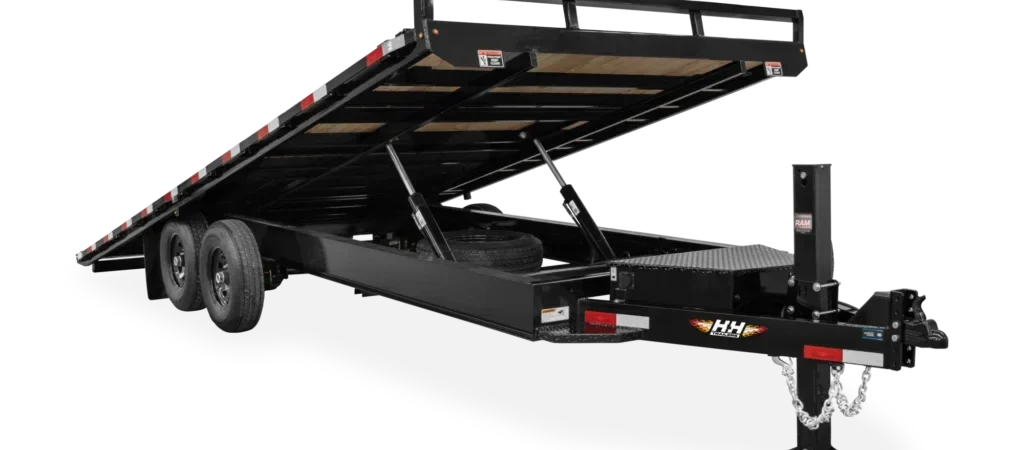
The right skid steer trailer is one whose rated capacity (GVWR) comfortably covers the trailer’s own weight, your machine, its attachments and whatever else rides along, with a deck wide and long enough to park the machine over the axles. As a rough guide: a small loader around 1,300 kg (2,800 lb) sits happily on a 6×12 tilt rated 7,000 lb. A mid-size machine in the 2,700 to 3,400 kg range (about 6,000 to 7,500 lb) needs a tandem axle trailer rated at least 10,000 lb, and most owners end up glad they went to 14,000 lb. Large skid steers and compact track loaders near or over 4,500 kg (10,000 lb) need 14,000 lb at minimum, and often a 17,000 lb tilt deck or a heavy deckover.
That’s the short version. The rest of this guide shows you how to work out the numbers for your own machine, how the loading styles compare, what tie-down rules say, and which skid steer trailer we’d point you to at each size. We sell every type mentioned here and ship worldwide, so the prices and specs are from our own listings. Manufacturer and legal facts are linked to their sources, and where something is our opinion we say so.
Skid steer trailer sizes at a glance
Here’s how we match machines to trailers. It’s a starting point, not a substitute for doing the sums in the next sections.
| Machine class | Typical operating weight | Skid steer trailer GVWR to look at | Examples from our stock |
|---|---|---|---|
| Small / walk-through-the-gate size | Around 1,300 kg (2,800 lb) | 7,000 to 7,700 lb | 6×12 gravity tilt 7K, 7×16 equipment 7,700 lb |
| Mid-size (the most common) | 2,700 to 3,400 kg (6,000 to 7,500 lb) | 10,000 lb minimum, 14,000 lb preferred | ETL718-10K, ETL718-14K, 7×16 equipment 15,400 lb |
| Large skid steer | 3,700 to 4,500 kg (8,300 to 9,900 lb) | 14,000 to 17,000 lb | 7×20 tilt 15,400 lb, 8×24 tilt 17,280 lb |
| Compact track loader or machine plus extra gear | 5,000 kg (11,000 lb) and up | 17,000 lb and up | 8×24 tri-axle 22,679 lb, 102 in deckover 33,000 lb |
The weight bands come from manufacturer spec sheets we cite below. The trailer pairings are our recommendation, and they assume you’ll sometimes carry an attachment or two as well.
Start with what your machine really weighs
Every skid steer trailer decision starts with one number: what the loaded machine actually weighs on the deck. Guessing here is where most people go wrong, because skid steers are far heavier than they look.
A few published figures show the spread:
- The Bobcat S70, one of the smallest skid steers sold, lists an operating weight of 1,268 kg (about 2,795 lb).
- The mid-size Bobcat S66 is listed at an operating weight of 3,271 kg on Bobcat’s European site, roughly 7,200 lb.
- Caterpillar lists its 262D3 skid steer at an operating weight of 3,763 kg (8,296 lb).
- At the top end, the Bobcat S86 skid steer weighs 9,728 lb and its tracked sibling, the T86 compact track loader, weighs 12,393 lb.
So “a skid steer” can mean anything from under 3,000 lb to over 12,000 lb. A skid steer trailer that’s perfect for one end of that range is dangerous at the other.
Operating weight vs shipping weight
Spec sheets often give two figures. Shipping weight is the bare machine, usually without the bucket, fuel or operator. Operating weight is closer to what you’ll haul, because it normally includes a standard bucket, full fluids and an allowance for the operator. Caterpillar’s note on the 262D3, for example, says its operating weight assumes a 75 kg operator, all fluids and a 68 in bucket. Use operating weight for sizing a skid steer trailer. If your machine has a cab with heat and air, a heavier bucket, counterweights or tracks over the tires, it’ll weigh more than the base figure.
Attachments, fuel cans and mud add up
Almost nobody hauls a bare loader. You’ll put forks, a grapple, an auger or a second bucket on the deck too, plus fuel cans, chains and a toolbox. Each attachment has its weight on its plate or in its manual, so look it up rather than guessing. And don’t laugh at mud: a machine coming off a wet site carries a surprising amount of it in the tracks, tires and belly pan. Our rule of thumb is to add everything you could realistically carry on a bad day and size the skid steer trailer for that.
GVWR, payload and why your skid steer trailer needs headroom
GVWR (gross vehicle weight rating) is the most the trailer may weigh in total, itself plus everything on it. On a skid steer trailer it’s on the VIN plate or sticker, and it’s usually limited by the axles, tires, frame or coupler, whichever is weakest. The number that matters to you is payload: how much you can actually load.
How to work out payload
Payload = GVWR minus the trailer’s empty weight. That’s it. A trailer with a 14,000 lb GVWR that weighs 3,000 lb empty can carry 11,000 lb. The catch is that heavy-duty trailers are heavy. Thicker decks, bigger frames, tilt cylinders and dovetails all eat into payload. When you compare one skid steer trailer with another, compare payloads, not GVWRs. Our listings show the GVWR; ask us for the empty weight of any model and we’ll give it to you before you buy.
A worked example
Take the Bobcat S66 at about 7,200 lb. For the sake of the example, say the trailer weighs 2,600 lb empty (that figure is illustrative, not a spec for any model).
- On a 10,000 lb GVWR trailer: payload is 7,400 lb. Load the S66 and you’ve got about 200 lb left. No forks, no spare bucket, nothing.
- On a 14,000 lb GVWR trailer: payload is 11,400 lb. Load the S66 and you still have about 4,200 lb spare for attachments and gear.
This is why we push most mid-size owners toward the 14K class. A trailer run at its limit every day wears its bearings, tires and springs faster, brakes harder, and leaves no margin for the day you throw a pallet of pavers on behind the machine. Spending a little more on the skid steer trailer up front is cheaper than replacing axles in three years. That’s our view from what we see come back for repair, not a law of physics, but it’s held true often enough.
Don’t overload the tow vehicle either
The trailer’s rating is only half the picture. Your truck has a towing capacity, a maximum tongue (hitch) weight, a gross combined weight rating and rear axle rating, all in its owner’s manual. The loaded skid steer trailer must fit inside every one of them. A pickup that “tows 14,000 lb” on paper may hit its payload limit first once the tongue weight, crew and tools are in the bed.
Deck width and length
Weight decides whether a skid steer trailer is safe. Size decides whether the machine fits and sits in the right spot.
Width: between the fenders or over the wheels
On a standard equipment or tilt trailer the deck sits between the wheels, so the usable width is the distance between the fenders. A trailer sold as 7 ft wide has a little less than 84 in between fenders once you allow for the fender brackets, so ask for the exact measurement. Measure your machine across the tires or tracks and across the bucket. Small machines like the S70 are only about 3 ft wide, but mid-size and large skid steers are often 66 to 74 in across with the bucket on. Leave room so the tires aren’t rubbing the fenders and you can get chains and binders on.
A deckover puts the deck above the wheels, giving you the full 8 ft or 102 in. That’s the answer if you run wide buckets, a wide snow pusher or tracks that won’t sit comfortably between fenders.
Length: room to put the weight in the right place
A skid steer with a bucket on is usually somewhere around 11 to 13 ft long. You could squeeze that onto a 14 ft deck, but you’d have no choice about where it sits, and position matters more than people think. You want the machine’s weight slightly ahead of the axles so the hitch carries the right share. A 16 to 18 ft deck gives you that room for one mid-size machine. Go to 20 to 24 ft if you carry attachments on the deck, a second small machine, or pallets behind the loader.
Loading styles: ramps, gravity tilt, power tilt and deckover
How a skid steer trailer loads changes your day more than any other feature. Here’s how the four main styles compare.
| Style | How it loads | Good for | Watch out for |
|---|---|---|---|
| Equipment trailer with ramps | Fold-down or slide-out ramps at the rear | Lowest price, simple, nothing to break | Steeper approach, ramps are heavy to lift |
| Gravity tilt | Deck tips when the machine passes the balance point, often slowed by a hydraulic damper | No ramps to lift, gentle angle, no power needed | Machine must drive past the pivot to tilt it back |
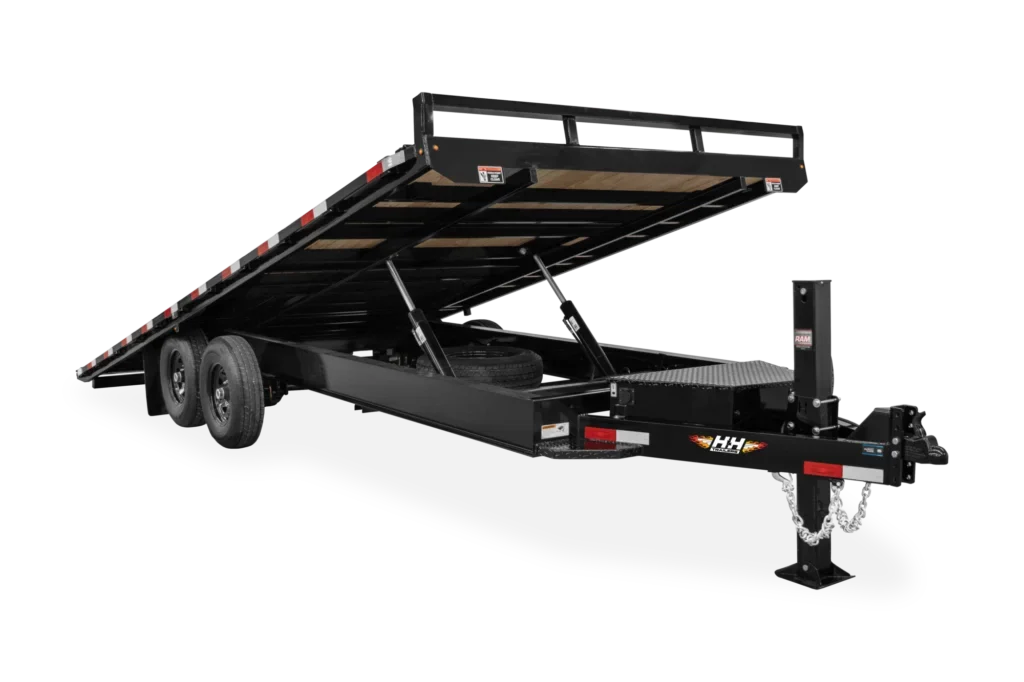
| Hydraulic power tilt | A pump tilts the deck on demand | Easiest loading, controlled angle, low-clearance machines | More cost, a power unit and battery to look after |
| Deckover | Ramps or a dovetail at the rear, deck over the wheels | Wide machines and loads, long decks | Higher deck height, so steeper ramps and a higher center of gravity |
Equipment trailer with ramps
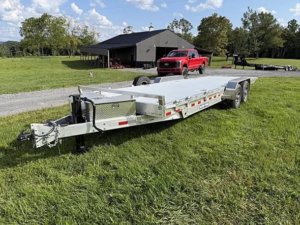
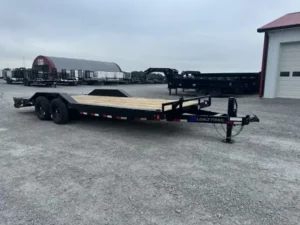
The classic skid steer trailer, and still the best seller. A flat steel deck between the wheels, stake pockets or D-rings along the sides, and two ramps at the back. It’s the cheapest way to haul a loader and there’s very little to go wrong. The downsides are the ramp angle (fine for most skid steers, awkward for some low attachments) and lifting heavy ramps several times a day. If you move the machine once a week, it’s hard to beat. Our 7×20 equipment trailer and 7×16 heavy duty equipment trailer are this type.
Gravity tilt
The whole deck pivots. With the trailer parked, the rear of the deck rests on the ground. You drive on, and once the machine’s weight passes the pivot point, the deck settles level. Most gravity tilts have a hydraulic cylinder that slows the movement so it doesn’t slam. No ramps to lift and a low, gentle angle make this kind of skid steer trailer popular with landscapers who load several times a day. See our gravity tilt trailer range for small machines.
Hydraulic power tilt
Same idea, but a pump raises and lowers the deck at the push of a button, so you choose when it tilts. That gives you control on uneven ground and lets you load machines or attachments that can’t make it over a ramp lip. It’s the most comfortable skid steer trailer to use every day. The ETL718-14K power tilt trailer and 22 ft power tilt trailer are our most popular picks for mid-size loaders.
Deckover
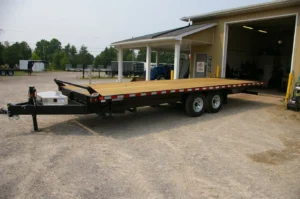
A deckover skid steer trailer trades a higher deck for full width. They shine for long or wide loads, a loader plus a mini excavator, or contractors who also haul pallets and materials. Some, like our deckover tilt trailer, combine the full-width deck with a hydraulic tilt so you don’t need tall ramps. If you choose a deckover with ramps, check the approach angle for your machine.
Can a dump trailer double as a skid steer trailer?
Often, yes, and it’s a popular combination for landscapers: haul the machine to the job, then haul the spoil away. A tandem dump like our 7×14 dump trailer rated 15,400 lb has the capacity for a mid-size loader. Check three things first: that the inside width between the box walls clears your machine with room for your hands, that the trailer has tie-down points inside the box, and that the ramps are rated for the machine. A dump box also puts the machine higher, so the load sits a little less stable than on a low deck.
Axles, tires and brakes
Almost every skid steer trailer worth buying runs on two axles, and the heaviest on three. Tandem axles share the load, carry on if one tire goes flat, and track more steadily on the highway. Our guide to tandem axle vs single axle trailers covers that trade-off in depth.
Look at the axle ratings and add them up. Two 7,000 lb axles make a 14,000 lb trailer; two 5,200 lb axles make around 10,400 lb. Tires need a load rating that matches or beats the axle, and the right load range for the weight. Under-rated tires are one of the most common reasons a skid steer trailer fails on the road.
Brakes on a skid steer trailer are not optional at these weights. Electric brakes on every axle, driven by a brake controller in the tow vehicle, are the norm on a bumper pull skid steer trailer. A breakaway kit applies the trailer brakes if it ever comes loose. Ask whether a trailer has brakes on one axle or all of them; on a heavy trailer you want all of them.
Hitch, tongue weight and the tow vehicle
The coupler on a heavy skid steer trailer is usually a 2-5/16 in ball or an adjustable pintle ring. Match the ball, hitch receiver and ball mount ratings to the loaded trailer weight. Safety chains should be crossed under the coupler and rated for the trailer.
Tongue weight is where loading position comes in. GMC’s towing guide says a conventional ball-hitch trailer should put about 10 to 15 percent of the loaded trailer weight on the tongue, with around 60 percent of the load over the front half of the trailer. On a 12,000 lb loaded skid steer trailer, that’s 1,200 to 1,800 lb on your hitch. Too little and the skid steer trailer can sway; too much and the truck’s rear sags and its steering goes light. Park the loader slightly ahead of the axles, bucket forward, and check by eye that truck and trailer sit level.
Bumper pull or gooseneck?
Most skid steer trailers are bumper pull because they suit a wide range of trucks. Goosenecks put the hitch over the truck’s rear axle and carry more of the weight there; the same GMC guide puts gooseneck and fifth wheel tongue weight at 15 to 30 percent. A gooseneck tows more steadily with heavy, long loads and turns tighter, but it ties you to a truck with a bed hitch. For one mid-size machine, bumper pull is usually the practical choice. For a compact track loader plus attachments every day, a gooseneck starts to make sense. We have a used gooseneck tilt trailer in stock if you want to try one without paying new prices.
Our trailer towing tips cover driving with a heavy trailer behind you, from braking distances to backing up.
How to tie down a skid steer on a trailer
A loader that shifts on a trailer can roll it, break it loose from the truck or go through the back of the cab in a hard stop. Securing it properly is part of choosing the trailer, because the trailer needs anchor points where you need them.
In the US, federal cargo securement rules give a clear benchmark. For wheeled or tracked machines weighing 10,000 lb or more, 49 CFR 393.130 requires at least four tiedowns restraining the machine forward, rearward, sideways and vertically, attached as close as practicable to the front and rear of the machine or to its designated tie-down points.
n
The same rule says accessory equipment such as a bucket or arm must be fully lowered and secured. Lighter machines can be secured under that section or the general cargo rules, and the general rules set the minimum strength: under 49 CFR 393.106(d), the combined working load limit of the tiedowns must be at least half the weight of the cargo, and a tiedown running from the trailer straight to the cargo only counts for half its own rating.
These rules apply to commercial vehicles in the US, but the logic is sound for any skid steer trailer anywhere. In practice:
- Use the machine’s tie-down points, usually marked with a symbol, never the lift arms or cylinders.
- Four chains or straps, one at each corner, pulling outward and away from the machine so each one resists more than one direction.
- Lower the bucket or attachment flat on the deck, and chain it if it can move.
- Check the working load limit stamped on chains and binders. For a 7,200 lb machine with four direct tiedowns, the four ratings added together need to reach at least 7,200 lb, so each chain and binder should be rated 1,800 lb or more. More is better.
- Stop after the first few miles and re-tighten. Things settle.
So when you look at a skid steer trailer, count the anchor points. You want D-rings or stake pockets near each corner of where your machine will sit, plus extra for attachments. Our full guide to securing a load on a trailer goes through chains, binders and straps.
Towing rules differ from country to country
We sell to buyers in many countries, and the rules for a heavy skid steer trailer change at every border. A few examples of what to check:
- Licence limits. In Great Britain, GOV.UK says you can tow a trailer up to 3,500 kg maximum authorised mass on a car licence, subject to your own entitlement and the tow vehicle’s limits. A 14,000 lb (6,350 kg) trailer is far beyond that and needs heavier vehicle licensing. Many other countries have similar bands.
- Brakes. GOV.UK also says a trailer over 750 kg loaded must have a working brake system. Even the smallest loader plus trailer clears that.
- Width. The same page sets a 2.55 m maximum trailer width. A 102 in deckover is 2.59 m wide, which is over that limit. If you’re outside North America, tell us where you’ll tow and we’ll suggest a width that suits local law.
- Registration and plates. Some countries require heavy trailers to be registered and inspected. Check with your local road authority before you buy.
We don’t give legal advice, so treat this as a list of questions to ask locally, not answers.
Skid steer trailers we sell, by machine size
Here’s where each skid steer trailer in our range fits. Prices are in US dollars and correct when this was written; click through for current pricing and photos.
For small skid steers (around 1,300 kg / 2,800 lb)
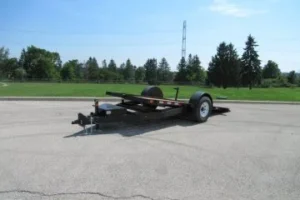
- Single axle gravity tilt TL612-7K: 6 x 12 ft deck, gravity tilt, 7,000 lb GVWR, $2,950. Our pick for the smallest loaders.
- 7×16 equipment trailer: tandem axle, steel, 7,700 lb GVWR, $3,900. More deck for attachments, and two axles.
- 7×18 galvanized equipment trailer: tandem axle, hot-dip galvanized, 7,560 lb GVWR, $4,100. Good if you work near salt or keep the trailer outside.
- 6×14 gravity tilt TL614-5K and 6×12 manual tilt: 5,000 lb GVWR. These suit ride-on mowers and the very lightest machines only; check the trailer’s empty weight against your loader before choosing one.
For mid-size skid steers (2,700 to 3,400 kg / 6,000 to 7,500 lb)
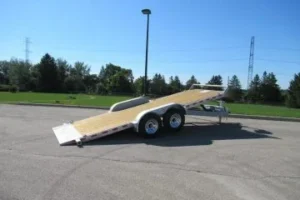
- Hydraulic power tilt ETL718-10K: 7 x 18 ft, power tilt, 10,000 lb GVWR, $6,900. Works for the lighter end of this class with little else on the deck.
- 7×20 equipment trailer: tandem, steel, 10,000 lb GVWR, $4,200. Budget option with ramps; same caution on payload.
- Hydraulic power tilt ETL718-14K: 7 x 18 ft, 14,000 lb GVWR, $7,500. The one we’d choose for a typical mid-size machine plus attachments.
- 7×16 heavy duty equipment trailer: tandem, steel, 15,400 lb GVWR, $5,100. Lots of capacity for the money if you’re happy with ramps.
- 80×20 galvanized tilt and load trailer: 14,000 lb GVWR, $7,500. Rust protection plus a tilt deck.
- 7×22 tilt and load trailer: tandem, steel, 15,119 lb GVWR, $6,800. Long deck for machine plus pallets.
For large skid steers (3,700 to 4,500 kg / 8,300 to 9,900 lb)
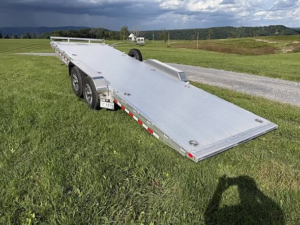
- Hydraulic power tilt ETL722-14K: 7 x 22 ft, 14,000 lb GVWR, $7,600.
- 7×20 tilt and load trailer: tandem, steel, 15,400 lb GVWR, $7,800.
- 8×20 deckover trailer: tandem, steel, 15,400 lb GVWR, $4,200. Full-width deck at a low price; check the ramp angle for your machine.
- 20 ft deckover trailer: tandem, 14,000 lb GVWR, $6,200.
- Deckover power tilt ETL822-14K: 8 x 22 ft, 14,000 lb GVWR, $9,600 (also listed as our hydraulic deckover trailer at $9,500).
For compact track loaders and heavy combined loads
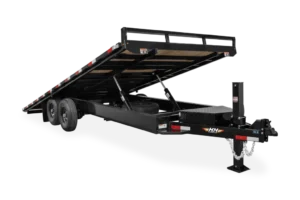
- 8×24 tilt and load trailer: tandem, steel, 17,280 lb GVWR, $10,900.
- 8×24 tri-axle tilt trailer: electric brakes, 22,679 lb GVWR, $11,900. For a tracked loader plus a full set of attachments.
- 26 ft deckover power tilt ETL826-14K: 8 x 26 ft, 14,000 lb GVWR, $11,250. Length for two smaller machines.
- 102 in deckover trailer: 20 ft plus 5 ft dovetail, 33,000 lb GVWR, $11,900.
- 30 ft deckover trailer: 102 in wide, galvanized, 35,250 lb GVWR, $17,900.
Used options
A used skid steer trailer can be a smart buy if the frame is straight and the axles are sound. Right now we have a used 102×25 galvanized deckover rated 14,000 lb at $7,900 and the used gooseneck tilt mentioned above at $8,300. See all used trailers.
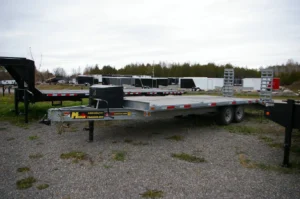
Three common setups and the skid steer trailer we’d match to each
Numbers are easier to apply when you can picture the job. These are typical buyer situations we hear about, with our suggestion for each. They’re examples, not promises about your own machine, so run your own weights through the payload sum above.
The weekend landowner with a small loader
One small machine around 1,300 kg, used on a few properties, towed by a mid-size pickup or SUV. The priority here is low weight and easy loading. A single axle gravity tilt rated 7,000 lb is the obvious skid steer trailer for this person: no ramps to lift, light enough for a modest tow vehicle, and enough payload for the machine plus a bucket and forks. If the same trailer also has to carry a ride-on mower or firewood, a 7×16 tandem gives more deck and a second axle for stability.
The landscaper moving a mid-size machine every day
A machine around 3,000 to 3,300 kg, loaded and unloaded three or four times a day, often with forks or a grapple on the deck as well. Here time and wear matter more than the purchase price. We’d point this buyer to a 14,000 lb hydraulic power tilt skid steer trailer such as the ETL718-14K. The power tilt saves lifting ramps dozens of times a week, and the 14K rating leaves room for attachments and a pallet of plants or stone. If the budget is tight, the 15,400 lb 7×16 equipment trailer with ramps carries the same weight for less money.
The contractor with a track loader and a mini excavator
A compact track loader over 5,000 kg, sometimes paired with a small excavator, towed by a heavy-duty truck. This buyer needs deck length, width and capacity all at once. A long tilt deck rated 17,000 lb or more, or the tri-axle 8×24, makes sense here, and if the truck has a bed hitch, a gooseneck deserves a serious look. A 102 in deckover is another option in countries where that width is legal on the road.
New or used skid steer trailer: what to inspect
A good used skid steer trailer can save a lot of money, because these trailers are built heavy and last for years when looked after. The risk is buying one that was run overloaded for most of its life. Before you pay for any used trailer, ours or anyone else’s, check these points in person or ask for photos:
- Frame and tongue. Look along the main rails for bends, sags or cracked welds, especially around the axle hangers and where the tongue meets the frame.
- Deck. On wood decks, push a screwdriver into the boards near the anchor points; soft wood means replacement soon. On steel decks, look for cracks and deep rust under the paint.
- Axles and springs. Uneven tire wear can mean a bent axle. Flat or cracked springs mean the trailer has been overloaded or just has a lot of miles.
- Brakes and wiring. Test the brakes with a controller and check every light. Corroded plugs and patched wiring are common on older equipment trailers.
- Tilt system. On a tilt deck, look for leaking cylinder seals, worn pivot pins and a pump that struggles. On ramps, check the hinges and the welds where the ramp meets the deck.
- VIN plate. Make sure it’s present and readable, so you know the real GVWR and can register the trailer where that’s needed.
We check our own used stock before listing it and will send extra photos on request. A new skid steer trailer costs more, but you get the full rated life, current lighting and a clean history, which matters if you plan to keep it for ten years or more.
Steel, galvanized or aluminum?
Most heavy skid steer trailers are steel, and the same goes for most of ours, because it’s strong, cheap and easy to repair. Painted steel needs touch-ups where chains and tracks scrape the paint off. Hot-dip galvanized steel costs a little more but resists rust far better, which matters if you work in coastal areas, use road salt in winter or leave the trailer outside. Aluminum is lighter, which means more payload for the same GVWR, but it costs more and is less common at these weights. Our aluminum vs steel trailer guide compares them in detail.
n
For a skid steer trailer, steel or galvanized steel is the usual choice, and the deck surface matters more than you’d think: steel tread plate or a wood deck both work; just keep wood decks sealed and check for rot near anchor points.
Skid steer trailer buying checklist
Take this list to any seller, including us:
- What’s the GVWR, and what does the trailer weigh empty? (So you know the payload.)
- What are the axle ratings and tire load ratings?
- Brakes on every axle? Electric or hydraulic? Breakaway kit fitted?
- Exact width between the fenders, or deck width on a deckover?
- Deck length, and the length from the front of the deck to the axle centers?
- Ramps, gravity tilt or power tilt? Ramp length and rating?
- How many tie-down points, where are they, and what are they rated for?
- Coupler type and size, and safety chain rating?
- Paint, powder coat or galvanized?
- Lights, wiring plug type and whether it suits your truck and country?
We’ll answer every one of these for any skid steer trailer we sell. If a seller can’t tell you the empty weight, be wary.
Mistakes we see people make
These come from our own conversations with buyers, so treat them as experience rather than statistics.
- Buying on GVWR alone. Two trailers both rated 10,000 lb can differ by over a thousand pounds in payload.
- Forgetting the second machine. Many owners add a mini excavator or a second attachment within a year. A slightly bigger skid steer trailer now saves buying another later.
- Loading too far back. The machine goes on last and stops at the tail. That takes weight off the hitch and invites sway.
- Too few anchor points. Chaining to the side rails instead of proper points, or doubling up chains on one ring.
- Skipping maintenance. Wheel bearings, brake magnets and tire pressures on a heavy trailer need regular attention. Our trailer maintenance checklist covers what to check and when.
Delivery worldwide
We deliver skid steer trailers to customers in many countries. Long decks, tilt units and heavy deckovers take up shipping space, so ask for a delivered quote on each model you’re considering. Tell us the country and the tow vehicle and we’ll also flag width, braking or lighting points that might matter where you live.
Skid steer trailer FAQs
What size skid steer trailer do I need?
For most mid-size skid steers, a tandem axle skid steer trailer with a 16 to 20 ft deck and a 14,000 lb GVWR. Small machines can use a 7,000 lb trailer; big machines and track loaders need 14,000 to 17,000 lb or more. Always check payload, not just GVWR.
Can a 10,000 lb trailer carry a skid steer?
Yes for small and light mid-size machines, but a machine around 7,000 lb leaves almost no payload for attachments once you subtract the trailer’s own weight. Work out the payload first.
Is a tilt skid steer trailer better than one with ramps?
For loading several times a day, most people prefer a tilt, because there are no ramps to lift and the angle is gentler. Ramps are cheaper and simpler. Both work.
How many tie-downs does a skid steer need?
Four, one at each corner, is the standard. In the US, it’s required for machines of 10,000 lb or more and good practice for lighter ones. Lower and secure the bucket too.
Where should the skid steer sit on the trailer?
Slightly ahead of the axles, so about 10 to 15 percent of the total trailer weight rests on the hitch of a bumper pull trailer.
Does a skid steer trailer need brakes?
At these weights, yes, practically and usually legally. Look for brakes on every axle and a breakaway system.
Can I haul a compact track loader on a skid steer trailer?
Yes, if the capacity is there. Track loaders weigh more than the equivalent skid steer, so size up. The 8×24 tilt and tri-axle tilt are built for that.
Do you ship outside the US?
Yes, we deliver worldwide. Ask for a delivered quote.
Find your skid steer trailer
Tell us your machine model, the attachments you carry and what you tow with, and we’ll recommend a skid steer trailer that fits with room to spare. Browse our tilt and load trailers, equipment and flatbed trailers, dump trailers and used trailers, or see everything in the shop. Not sure which one? Contact us. New to trailers? Start with our guides on the types of trailers, how to choose a trailer and enclosed vs open trailers.
Sources and References
- Bobcat: S70 skid-steer loader specifications
- Bobcat Europe: S66 skid-steer loader specifications
- Caterpillar: 262D3 skid steer loader specifications
- Construction Equipment: Bobcat S86 skid steer and T86 compact track loader specifications
- 49 CFR 393.130: Securement of heavy vehicles, equipment and machinery (Cornell LII)
- 49 CFR 393.106: General requirements for securing articles of cargo (eCFR)
- GMC: Tongue weight and why it’s key to safe towing
- GOV.UK: Towing with a car (licence, brakes, weight and width limits)