
A utility trailer is an open trailer with a flat deck, low sides and usually a rear gate that folds down into a ramp. People use them to haul mowers, ATVs, building materials, furniture, firewood and garden waste. Choosing one comes down to five things: deck size, single or tandem axle, steel or aluminum, the GVWR (how much it can legally carry, its own weight included), and the type of rear gate.
As a quick guide, a 5×8 or 5×10 single axle utility trailer handles yard work, small moves and one ATV. A 6×12 suits a ride-on mower plus tools or a small UTV. A 7×14 to 7×20 tandem is the size for landscaping crews, contractors, side-by-sides and heavier loads.
We sell every trailer in this guide, from a $1,050 5×8 steel model to a $4,900 7×20 aluminum tandem, and we deliver worldwide. Specs and prices come from our own listings. Outside facts link to their source, and where something is our opinion, we say so.
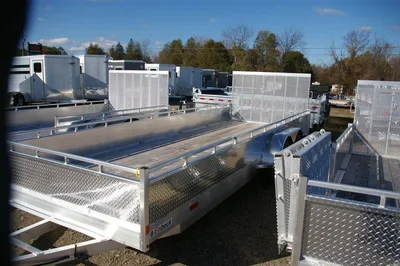
Utility trailer sizes and what each one carries
This table is our starting recommendation, based on what we sell and the loads buyers describe to us. Check it against the real size and weight of what you carry.
| Deck size | Axle | Typical GVWR | Good for | From our stock |
|---|---|---|---|---|
| 5×8 | Single | About 3,000 lb | Garden waste, mulch, a push mower, small moves | 5×8 steel, 5×8 aluminum |
| 5×10 | Single | 3,000 to 3,500 lb | One ATV, a lawn tractor, furniture | 5×10 steel, 5×10 aluminum |
| 6×12 | Single | About 3,000 lb | Ride-on mower plus tools, small UTV | 6×12 aluminum |
| 77 in x 12 to 16 ft | Ask us | Ask us | Mowers, ATVs, materials | 77×12, 77×14, 77×16 |
| 7×14 to 7×16 | Tandem | 7,000 lb | Landscaping crews, side-by-sides, two ATVs | 7×14 steel, 7×14 aluminum |
| 7×18 to 7×20 | Tandem | 7,000 to 9,900 lb | Long materials, heavy loads, contractors | 7×18 steel, 7×20 aluminum |
| 82 in x 18 to 20 ft | Ask us | Ask us | Crew gear, UTVs, long loads | 82×18, 82×20 |
If you want sizing for every kind of trailer, not just open utility models, our trailer size guide covers the full range.
What counts as a utility trailer
In the trade, “utility trailer” usually means a light to medium open trailer with a deck between the wheels, rails or low sides around the edge, and a gate at the back. It’s the general-purpose trailer most people picture when they think of towing something home from a garden centre or a hardware store.
It differs from a flatbed trailer, which normally has no sides and often a deck over the wheels. It differs from a cargo trailer, which is fully enclosed, and from a dump trailer, which tips its load out. And it’s lighter than an equipment trailer, which is built for machines like skid steers and excavators.
Width: the measurement people get wrong
Most people choose by length and then find their ATV or mower doesn’t fit between the fenders. On a utility trailer, the deck sits between the wheels, so the usable width is the space between the fenders, not the outside width of the trailer.
An ATV example
Polaris lists its Sportsman 570 at 83 in long, 48 in wide and an estimated 703 lb dry. A 5 ft wide deck is 60 in, which leaves about 6 in each side. That fits, but there’s not much room to climb off. An 8 ft deck is 96 in long, so the quad fits with a little space for a fuel can or toolbox. A 5×10 gives more breathing room, and a 6×12 lets you add gear or a second small machine.
Before you buy, measure:
- The widest point of the load, including mirrors, tires, handlebars and mower decks.
- The length, including the tow hitch or bucket if the machine has one.
- The space you need to get on and off the machine once it’s loaded.
Common widths are 5 ft (60 in), 6 ft (72 in), 77 in, 80 in, 82 in and 7 ft (84 in). Ask us for the clear width between the fenders on any model, and we’ll give it to you.
Single or tandem axle?
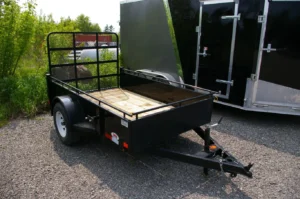
Single axle trailers are cheaper, lighter, easier to push by hand and easier to back into tight spots. Most of our 5×8, 5×10 and 6×12 models are single axle and rated around 3,000 lb GVWR. They suit homeowners, gardeners and light business use.
Tandem axles carry more, keep going if one tire fails, and ride more steadily at speed. All of our 7×14 and longer utility trailers with listed specs are tandem, rated 7,000 lb or more. They suit landscaping businesses, contractors, farms and anyone carrying side-by-sides or heavy materials. Our tandem axle vs single axle guide goes into this in detail.
Our view: if your heaviest load plus the trailer’s own weight comes close to 3,000 lb, buy the tandem. Running a single axle trailer at its limit every week wears tires, bearings and springs fast.
Steel or aluminum?
This is the other big choice, and it affects price, weight and how long the trailer lasts.
| Steel | Aluminum | |
|---|---|---|
| Price | Lower | Higher |
| Weight | Heavier | Lighter, so more payload and easier to tow |
| Rust | Rusts where paint chips | Doesn’t rust like steel |
| Repairs | Easy to weld almost anywhere | Needs an aluminum welder |
| Resale | Lower | Usually holds value better |
Our view: if price comes first and you’ll keep the trailer under cover, steel is fine. Our 5×8 steel utility trailer at $1,050 and 5×10 steel at $1,100 are the cheapest in our range. If you tow on salted winter roads, live near the coast, store the trailer outside, or tow with a smaller car or SUV, aluminum is worth the extra. Our aluminum vs steel trailer guide covers the trade-offs.
GVWR, payload and what you can actually carry
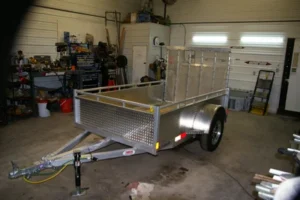
GVWR is the most the trailer may weigh with everything on it, the trailer included. Payload is GVWR minus the trailer’s empty weight. A trailer with a 2,990 lb GVWR that weighs 700 lb empty can carry about 2,290 lb. One that weighs 1,000 lb empty carries about 1,990 lb. Same rating, very different payload.
That’s why aluminum matters on small trailers. The weight it saves goes straight into what you can carry. Always ask us for the empty weight of the model you’re considering.
What common loads weigh
Weights vary a lot, so check your own items. As rough guides only:
- ATV: the Polaris Sportsman 570 above is about 703 lb dry, before fuel, rider gear and accessories.
- Bagged or loose material: soil, gravel and wet mulch are far heavier than they look. A trailer heaped with gravel can go over its rating long before it looks full.
- Firewood: green wood weighs much more than seasoned wood.
- Furniture and household goods: bulky but usually light, so volume runs out before weight.
For loose, heavy material you’ll tip out at the other end, a dump trailer is usually the better tool.
Rear gates, sides and decks
Rear gate
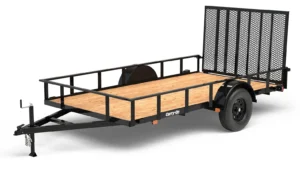
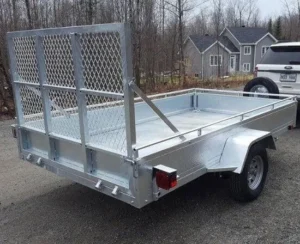
- Fold-down ramp gate: the most common. It folds down to become a ramp for wheeled loads, then folds up and latches as a tailgate.
- Spring-assisted gate: springs take some of the weight, so lifting it is much easier. Worth having on longer, heavier gates.
- Bi-fold gate: folds in half, so it sits lower when closed and catches less wind.
- Removable or no gate: best for loading by hand or forklift.
Sides
- Rail sides: a top rail with open space underneath. Light, with plenty of tie-down points.
- Mesh or solid sides: keep leaves, mulch and small items in.
- Removable sides: turn the trailer into a near-flatbed for wide loads.
Deck
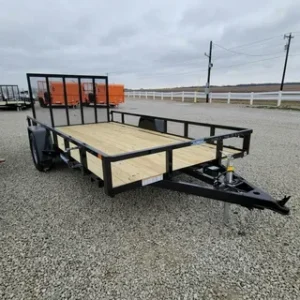
- Treated wood: good grip, cheap to repair one board at a time.
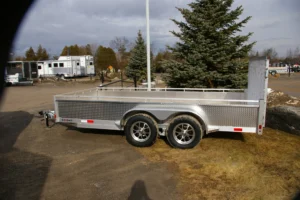
- Aluminum: light and long-lasting, common on aluminum trailers.
- Steel mesh: lets water and dirt fall through, but small items can too.
Loading over the rear gate
The fold-down gate on a utility trailer is short compared with a long tilting deck, so the slope is steeper. That’s fine for most mowers and quads, but a few things help:
- Hitch the trailer first, on level ground, with the vehicle’s parking brake on. An unhitched trailer can tip up when weight hits the gate.
- Check ground clearance. Low mower decks can catch at the top of the gate. Raise the deck to its highest setting before you load.
- Drive or push on straight. Turning on the gate is how wheels come off the edge.
- Go slowly and steadily. On a quad, keep your weight forward as you climb.
- Use a winch for anything that doesn’t run, or if you’re loading alone often.
Our view: if you’ll load low machines every day, a longer gate or a model with a dovetail helps a lot. For heavy machines, a tilt trailer gives a much gentler slope.
Rails, stake pockets and building up the sides
A low-sided utility trailer is versatile because you can build on it. Many models have stake pockets, which are square sockets along the top rail. You drop timber or metal uprights into them to add side boards, a mesh cage or a headache rack.
- Side boards: plank sides of 12 to 24 in turn a flat trailer into a high-sided one for garden waste and firewood.
- Mesh cage: keeps light, bulky material in, and lets wind through so it isn’t a sail.
- Headache rack: a frame at the front that protects the tow vehicle from long items sliding forward, and supports ladders and pipe.
- Tie-down points: the top rail itself is a handy anchor for straps.
Ask us whether the model you want has stake pockets, and how many.
Wheels, tires and suspension
Tires are one of the most overlooked parts of a small trailer, and one of the most common reasons for a breakdown.
- Tire size: bigger wheels turn more slowly at the same road speed, which is easier on bearings, and they ride over potholes better. Small 12 in wheels are common on light trailers. Larger 13 to 15 in wheels suit longer trips and heavier loads.
- Load rating: each tire has a maximum load moulded on the sidewall. Together they must cover the trailer’s GVWR.
- Trailer-specific tires: tires marked ST (special trailer) are built with stiffer sidewalls to reduce sway. Don’t swap in car tires without checking their rating.
- Leaf springs: the usual suspension on utility trailers. They’re simple and easy to replace.
- Torsion axles: a rubber-cushioned axle with no springs. It rides more smoothly and needs less upkeep, but repairs mean replacing the whole axle.
Our view: if you’ll do long highway trips, larger wheels and a spare are worth more than almost any other option. Ask us which wheel and tire size each model has.
Why deck height matters
The lower the deck, the easier everything is. Wheeled loads climb a gentler slope over the gate. Heavy bags and boxes don’t need lifting so high. And a lower load sits nearer the ground, which helps the trailer stay stable in crosswinds and corners.
Utility trailers keep the deck low by sitting it between the wheels. That’s the trade-off with width: a deck over the wheels is wider but higher. If you need full width, look at a flatbed trailer. If you need low loading for a mower or quad, a between-the-fenders design is the better choice.
Brakes, lights and wiring
Small single axle trailers often have no brakes of their own. Heavier tandems usually have electric brakes on at least one axle, which need a brake controller in your tow vehicle. Rules differ by country. In Great Britain, GOV.UK says a trailer must have a working brake system if it weighs more than 750 kg loaded. That’s about 1,650 lb, so many small trailers need brakes there even though they might not in parts of North America. Tell us where you’ll tow and we’ll check what you need.
For lights, North American trailers usually use a 4-pin plug for basic lights or a 7-pin plug that also carries brake and charging lines. Other countries use other plugs. We can advise on adapters or rewiring. LED lights last longer and draw less power than old bulbs.
Matching the trailer to your tow vehicle
Check your vehicle’s handbook or door-pillar label for:
- Towing capacity: compare it with the loaded trailer weight.
- Maximum tongue weight: the hitch load the vehicle can take.
- Payload: tongue weight counts against it, along with passengers and gear.
- Hitch class and ball size: they must suit the trailer.
GMC’s towing guide says a conventional trailer should put about 10 to 15 percent of its loaded weight on the hitch, with roughly 60 percent of the load over the front half of the trailer. On a 3,000 lb loaded trailer, that’s about 300 to 450 lb on the hitch. Small cars often can’t take that, so check before you buy.
As a broad guide, a 5×8 or 5×10 aluminum trailer tows behind many SUVs and some larger cars. A 7,000 lb tandem needs a pickup or a large SUV rated for that weight. Always go by your own vehicle’s ratings.
Utility trailer uses, and the model we’d pick for each
These are typical jobs buyers describe to us, with our suggestion for each. They’re recommendations, not rules.
Home and garden
Garden waste runs, mulch, a push mower and the odd trip to the tip. A 5×8 steel or 5×8 aluminum utility trailer is enough, and it fits in most garages and driveways.
Lawn tractor or ride-on mower
Measure the mower deck width. A 5×10 aluminum or the lightweight 5×10 suits most lawn tractors. Wide zero-turn mowers often need the 6 ft or 77 in decks. Our landscape trailer guide has more detail.
ATV or small UTV
One quad fits a 5×10. A small UTV or a quad plus gear suits the 6×12 aluminum utility trailer or the 2027 6×12 single axle aluminum.
Side-by-side or two ATVs
Full-size side-by-sides are wide and heavy. Go for a 7 ft wide tandem, such as the 7×14 aluminum or the 7×16 aluminum, both rated 7,010 lb.
Landscaping crew
Two mowers, trimmers, blowers and fuel every day. A 7×18 steel tandem rated 9,900 lb, or the 7×20 aluminum, gives room for everything plus a trimmer rack.
Contractors and builders
Timber, pipe, scaffolding and tools. Longer decks matter more than width here. The 82×18 or 82×20 take long materials, and stake pockets or rails let you add headache racks and side boards.
Moving house
For a small move, an open trailer with a tarp works if the weather is kind. For anything you want dry and locked, look at our cargo trailers instead.
Farms and smallholdings
Feed, fencing, hay bales and small machines. A 7×14 steel tandem at $2,200 is good value for heavy farm use. If you’ll carry a compact tractor, look at our tilt trailers instead.
A year with one utility trailer
To show why so many people end up using one more than they expected, here’s a typical year for a homeowner with a 5×10 aluminum utility trailer. It’s an illustration, not data from a study.
- Spring: mulch and compost from the garden centre, bags of soil, and a trip to the tip with winter storm debris.
- Summer: the ride-on mower to a relative’s place, a quad to the campsite, a new barbecue and patio furniture home from the store.
- Autumn: leaves and hedge cuttings to the green waste site, and a load of firewood.
- Winter: helping a friend move a sofa and a bed, and a Christmas tree run.
Each of those jobs would otherwise mean a delivery charge, a hire trailer or a favour from someone with a truck. That’s the real reason a small utility trailer is often one of the most-used things people buy for the house.
Setting up a utility trailer for a lawn care business
Lawn care is one of the biggest uses for open trailers, and a well-set-up one saves time at every stop. Here’s what we’d suggest for a two-person crew. It’s a recommendation, not a rule.
- Size: a 7×14 to 7×18 tandem, or an 82 in wide deck if you run wide zero-turns.
- Gate: spring-assisted, so you’re not lifting a heavy gate dozens of times a day.
- Racks: lockable trimmer racks on one side, a blower rack, and a fuel can holder.
- Layout: the heaviest mower at the front, the smaller mower behind it, handheld tools on the racks.
- Security: chain locks through the mowers and a coupler lock for lunch breaks.
- Finish: aluminum if you want low upkeep and better fuel use, steel if you want the lower price.
The 7×18 steel utility trailer rated 9,900 lb and the 80×16 aluminum utility trailer are both good fits.
Loading and tying down
Loose loads are a real hazard on the road. The AAA Foundation for Traffic Safety found that road debris was a factor in an average of about 50,658 police-reported crashes a year in the US from 2011 to 2014, with about 125 deaths a year. It found that about two-thirds came from items falling off vehicles, often because of poor maintenance or unsecured loads.
US federal cargo rules for commercial vehicles give a useful benchmark for how many straps to use. Under 49 CFR 393.110, an article 5 ft or shorter weighing 1,100 lb or less needs at least one tiedown. If it’s longer or heavier, it needs at least two, with more for longer items. On a utility trailer, that means:
- Strap every machine at four corners, using its own tie-down points.
- Use a cargo net or tarp, strapped down, over loose material like mulch or garden waste.
- Put heavy items forward of the axle, low and centred left to right.
- Check the straps after the first few miles, because loads settle.
Our guide to securing a load on a trailer covers strap ratings and methods.
Towing a utility trailer safely
- Do a walk-around before every trip: hitch locked, safety chains crossed, lights working, tires inflated, gate up and latched.
- Allow more room to stop. Extra weight means longer stopping distances, especially on unbraked trailers.
- Take corners wider. The trailer wheels cut inside the vehicle’s path.
- Practise reversing in an empty car park. Short trailers react faster than long ones.
- If it starts to sway, ease off the accelerator, keep the steering straight, and don’t brake hard. Sway usually means too little weight at the front.
- Check speed limits for towing. Many countries set lower limits for vehicles with trailers.
Our trailer towing tips go into reversing, braking and sway in more depth.
Towing rules in different countries
Rules change from place to place, so check locally before you buy. In Great Britain, GOV.UK sets a maximum width of 2.55 m for a trailer towed by most vehicles, and requires brakes on trailers over 750 kg loaded. Our widest utility trailers, at 82 in and 7 ft, are about 2.08 m and 2.13 m across. That’s well inside that limit. Other countries have their own rules on width, braking, lights, registration and licences. Tell us where you’ll tow, and we’ll point out anything that matters before you order.
Utility trailers we sell
Prices are in US dollars and correct when this was written. Click through for current prices, photos and full specs.
Steel utility trailers
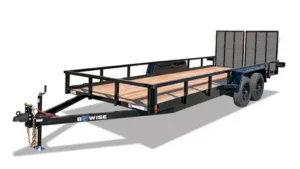
- 2026 5×8 utility trailer: single axle, steel, black, 2,990 lb GVWR, $1,050.
- 2026 5×10 utility trailer: single axle, steel, black, 3,500 lb GVWR, $1,100.
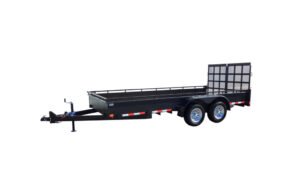
- 2026 7×14 utility trailer: tandem, steel, black, 7,000 lb GVWR, $2,200.
- 2027 7×18 utility trailer: tandem, steel, black, 9,900 lb GVWR, $3,800.
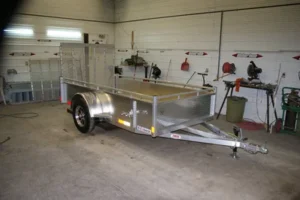
Aluminum single axle
- 2027 5×8 aluminum trailer: single axle, silver, 2,996 lb GVWR, $1,800.
- 2026 5×10 aluminum trailer: single axle, silver, 2,996 lb GVWR, $1,780.
- 2026 5×10 lightweight utility trailer: single axle, aluminum, silver, 2,990 lb GVWR, $1,850.
- 2026 6×12 aluminum trailer: single axle, silver, 2,996 lb GVWR, $2,150.
- 2027 6×12 single axle aluminum trailer: silver, 2,996 lb GVWR, $2,450.
Aluminum tandem axle
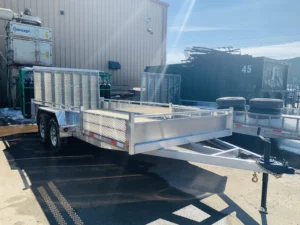
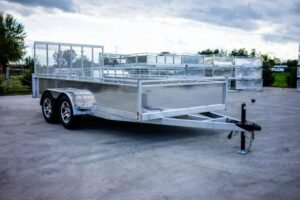
- 2026 7×16 aluminum trailer: tandem, straight axles, silver, 7,010 lb GVWR, $3,200.
- 2026 80×16 utility trailer: tandem, aluminum, silver, 7,010 lb GVWR, $3,900.
- 2027 7×14 aluminum utility trailer: tandem, silver, 7,010 lb GVWR, $4,100.
- 2027 7×20 aluminum trailer: tandem, silver, 7,010 lb GVWR, $4,900.
Open utility trailers by deck size
For these, ask us for the axle setup, GVWR and finish before you order.
- 5×10 utility trailer with low rail sides: $1,450.
- 77 in x 12 ft utility trailer: $1,750.
- 77 in x 14 ft utility trailer: $1,900.
- 77 in x 16 ft utility trailer: $2,100.
- 82 in x 18 ft utility trailer: $2,600.
- 82 in x 20 ft utility trailer: $2,900.
Browse every model in our utility trailers category, see the smaller lawn and garden trailers, or look through our used trailers.
Hot, cold and wet climates
- Salted winter roads: rinse the frame, axle and wiring underneath after salty trips. Aluminum resists this much better than painted steel.
- Coastal areas: salt air corrodes steel even when the trailer isn’t used. Aluminum or galvanized steel is the better choice.
- Hot, sunny places: sun ages tires and wood decks. Cover the tires when parked, and treat wood decks once a year.
- Wet regions: water sitting on a wood deck causes rot. Park with the tongue slightly raised so rain runs off.
Storing a utility trailer
- Upright storage: some small trailers can be stood on end against a wall to save space. Ask us if the model you want can be.
- Under cover where possible, especially for steel trailers and wood decks.
- Off the ground: a block under the tongue keeps the coupler out of puddles.
- Tires: keep them inflated, and move the trailer now and then to avoid flat spots.
- Security: a coupler lock, a wheel clamp and a photo of the VIN plate.
Accessories worth adding
- Spare tire and mount. Small trailer tires are hard to find at the roadside.
- Coupler lock and wheel clamp. Open trailers are easy to hitch up and steal.
- Ratchet straps and a cargo net rated for your loads.
- Tarp for mulch, leaves and anything that can blow out.
- Jack with a wheel on the tongue, so you can move the trailer by hand.
- Mesh side extensions for bulky, light material like garden waste.
- Trimmer and blower racks for lawn care businesses.
- Brake controller in the tow vehicle, if the trailer has electric brakes.
Looking after a utility trailer
- Grease the wheel bearings on schedule. Bearing failure is one of the most common roadside problems with small trailers.
- Check tire pressure before every trip, using the figure on the tire sidewall, not your car’s.
- Look at the tire date codes. Trailer tires often age out before they wear out.
- Test all lights with the vehicle before you leave.
- Lubricate the gate hinges and springs.
- Wash off road salt and mud, especially underneath.
- Touch up paint chips on steel trailers before rust spreads.
- Replace damaged deck boards before they break under a load.
Our trailer maintenance checklist covers bearings, brakes and tires in more depth.
Buying a used utility trailer
- Frame and tongue: look for rust, cracked welds and bends, especially around the coupler and spring hangers.
- Axle and springs: uneven tire wear can mean a bent axle. Look for broken spring leaves.
- Bearings: jack up each wheel and spin it. Listen for grinding and check for play.
- Deck: soft or broken boards, or cracked welds on metal decks.
- Gate: does it fold, latch and lift as it should?
- Lights and wiring: test everything.
- VIN plate and paperwork: make sure you can register the trailer where you live.
What owning one costs beyond the price
We can’t give exact figures, because they vary so much between countries. Plan for:
- Registration and plates, where your local rules require them.
- Insurance, which is often cheap for small trailers but worth checking.
- Tires and bearings over time.
- Straps, locks and a spare.
- A hitch and wiring for your vehicle, if it doesn’t have them.
- Storage, if you can’t keep the trailer at home.
Against that, a utility trailer often replaces delivery charges, skip or dumpster hire, and rental trailer fees. Our view is that someone who uses one a couple of times a month usually gets their money back faster than they expect. That’s an opinion based on what buyers tell us, not a calculation.
Mistakes we see buyers make
These come from our own conversations with buyers, so treat them as experience rather than statistics.
- Measuring the outside width, not between the fenders. It’s the most common reason a machine doesn’t fit.
- Forgetting the trailer’s own weight. GVWR isn’t payload.
- Heaping gravel or soil on a small trailer. It goes over the rating long before it looks full.
- Buying too small. Most owners find more uses than they planned.
- Skipping the spare. A flat on a small trailer can end your day.
- Not checking the tow vehicle’s ratings. Tongue weight catches a lot of people out.
Questions to ask before you order
- What’s the clear width between the fenders?
- What does the trailer weigh empty, and what’s the payload?
- Single or tandem axle? Are there brakes?
- Steel or aluminum? What’s the deck made of?
- What kind of rear gate does it have? Is it spring-assisted?
- What plug does it have, and what does my vehicle need?
- What tire size, and is a spare included?
- What paperwork comes with it for registration where I live?
- What’s the delivered price to my address or port?
We’ll answer all of these for any model we sell.
Worldwide delivery
We deliver trailers to customers in many countries. Small single axle models are compact to ship. Ask for a delivered quote on each model you’re considering. Tell us where you’ll tow, and we’ll flag any width, brake or lighting points that matter there. We supply the paperwork you need for registration.

Utility trailer FAQs
What size utility trailer do I need?
For yard work and small loads, a 5×8 or 5×10. For a ride-on mower with tools or a small UTV, a 6×12. For side-by-sides, landscaping crews and heavy materials, a 7×14 to 7×20 tandem.
Is aluminum or steel better for a utility trailer?
Steel is cheaper and easy to repair. Aluminum is lighter, carries more for the same rating and doesn’t rust like steel. Choose aluminum for salted roads, coastal areas or smaller tow vehicles.
How much weight can a utility trailer carry?
Its payload: GVWR minus empty weight. Our single axle models are rated about 3,000 to 3,500 lb GVWR, and our tandems 7,000 to 9,900 lb.
Will an ATV fit on a 5×8 utility trailer?
Many will, but it’s tight. A Polaris Sportsman 570 is 48 in wide and 83 in long, so a 5×10 gives more room.
Does a utility trailer need brakes?
It depends on its weight and where you tow it. In Great Britain, any trailer over 750 kg loaded needs brakes. Check your local rules.
Can I carry a car on a utility trailer?
Generally no. Most are rated too light. Use a car hauler trailer or a tilt trailer instead.
Can a utility trailer be used for moving?
Yes, for small moves in dry weather, with a tarp and plenty of straps. For valuables or bad weather, an enclosed cargo trailer is safer.
What’s the difference between a utility trailer and a flatbed?
A utility trailer usually has low sides or rails and a rear gate, with the deck between the wheels. A flatbed usually has no sides and is often built heavier.
How often should I grease the bearings?
Follow the axle maker’s schedule. Many owners check them at least once a year and before long trips.
Can I stand a utility trailer on end?
Some small models are designed for it. Ask us about the specific trailer before you try it.
Do you deliver utility trailers outside the US?
Yes, we deliver worldwide. Ask for a delivered quote.
Find your utility trailer
Tell us what you’ll carry, how heavy it is, and what you tow with, and we’ll recommend the utility trailer that fits. Browse our utility trailers, lawn and garden trailers, dump trailers and enclosed trailers, or see everything in the shop. For more background, read how to choose a trailer, types of trailers and enclosed vs open trailers. Questions? Contact us.