

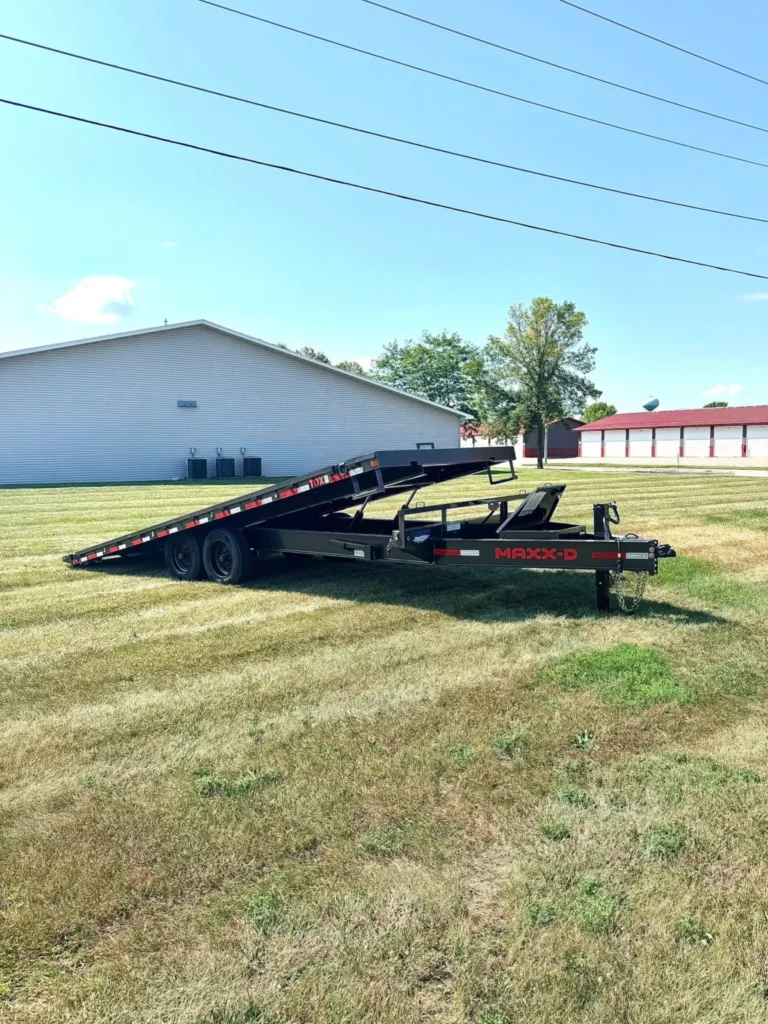
A tilt trailer is a flatbed trailer whose whole deck pivots so the back end drops to the ground. You drive, roll or winch the load straight on, and you don’t need loading ramps. Choosing one comes down to four questions. Does the deck tip by gravity or by a hydraulic pump? What does your heaviest load weigh, and does the GVWR cover it? Does the machine fit between the fenders, or do you need a deckover? And how long should the deck be?
As a rough guide, a 6×12 gravity tilt trailer handles mowers, ATVs and small tractors. A 7×18 to 7×22 tandem covers skid steers, mini excavators and cars. An 8 ft wide deckover or tri-axle model takes wide machines and heavier equipment.
We sell all of the trailers in this guide, from a $2,450 6×12 to a $11,900 tri-axle, and we deliver worldwide. The specs and prices come from our own listings. Outside facts link to the source they came from, and where something is our opinion, we say so.
Tilt trailer sizes and what each one carries
This table is our starting recommendation. It’s based on the trailers we stock and the loads buyers tell us about, and you should always check it against the real weight of your own machine.
| Deck | Tilt type | GVWR | Good for | From our stock |
|---|---|---|---|---|
| 6×12 | Gravity / manual | 5,000 lb | Ride-on mowers, ATVs, golf carts, small tractors | 6×12 tilt trailer, TL612-5K |
| 6×12 | Gravity | 7,000 lb | Compact tractor with loader | TL612-7K |
| 6×14 | Gravity | 5,000 lb | Mower plus tools, longer small machines | TL614-5K |
| 7×18 | Hydraulic | 10,000 to 14,000 lb | Skid steers, cars, dead machines | ETL718-10K, ETL718-14K |
| 7×20 to 7×22 | Tilt and load | 14,000 to 15,400 lb | Skid steer or mini excavator plus attachments | 7×20, 7×22, ETL722-14K |
| 8×22 to 8×26 | Hydraulic deckover | 14,000 lb | Wide machines, two compact machines | ETL822-14K, ETL826-14K |
| 8×24 | Tilt and load | 17,280 to 22,679 lb | Mid-size excavators, big tractors | 8×24 tandem, 8×24 tri-axle |
How a tilt trailer works
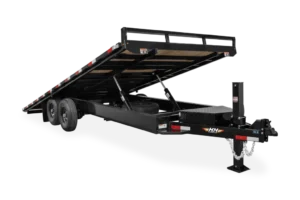
An ordinary flatbed has a fixed deck and a pair of ramps at the back. A tilt trailer has a deck that sits on a pivot near the axles. Unlock it, and the rear of the deck drops to the ground while the front lifts. Your machine goes up a single long, gentle slope instead of two narrow ramps. Once the weight is forward of the pivot, the deck comes back level, and you lock it for the road.
That one change solves the three things people hate about ramp trailers. You don’t lift heavy ramps in and out. You don’t have to line up tracks or tires on two narrow strips. And low machines and cars don’t scrape, because the loading angle is so much shallower.
Gravity tilt or hydraulic power tilt?
This is the first real decision, and it changes the price, the upkeep and how the trailer feels to use.
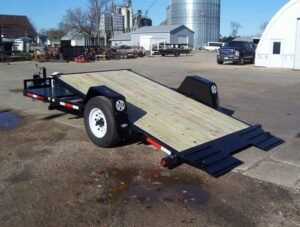
Gravity tilt
The deck tips under its own weight and the load’s. You release a lock, drive on, and as the machine passes the pivot the deck rocks back level. Most models have a cushion cylinder or damper so the deck doesn’t slam. There’s no pump, no battery and nothing electrical, so there’s very little to go wrong. Our TL612-5K gravity tilt trailer and TL614-5K work this way.
Hydraulic power tilt
A pump, usually run off an onboard battery, drives a cylinder that tilts the deck when you press a button. You can lower an empty deck, winch a dead machine or a car up it, and hold the deck at any angle while you line things up. It costs more and needs a charged battery and the odd hydraulic check, but it gives far more control. Our ETL718-10K hydraulic tilt trailer and the ETL718-14K power tilt trailer are this type.
| Gravity tilt | Hydraulic power tilt | |
|---|---|---|
| How it tilts | Load weight passes the pivot | Push-button pump and cylinder |
| Non-running loads | Awkward | Easy with a winch |
| Control | Deck moves when the weight shifts | Deck moves only when you tell it |
| Maintenance | Pivot, lock, damper | Also battery, pump, hoses |
| Price | Lower | Higher |
| Typical buyer | Homeowners, landscapers, light loads | Recovery, dealers, contractors, hire firms |
Our view: if you’ll mostly load machines that drive themselves on, and they’re light, gravity tilt does the job at a lower price. If you move broken-down machines, cars, or anything you want to load slowly and carefully, pay for hydraulics.
Why the loading angle matters so much
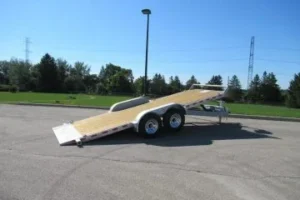
The angle a machine climbs onto a trailer decides whether a low car scrapes, whether a tracked machine tips forward at the top, and how nervous the operator feels. It comes down to simple geometry: the height you climb divided by the length of the slope.
Here’s an illustration we worked out ourselves, not a measurement of any one trailer. Take a deck 20 in off the ground. With 6 ft ramps, the slope is about 16 degrees. With 8 ft ramps, about 12 degrees. If a tilting deck reaches the ground 12 ft behind its pivot, the slope drops to about 8 degrees. At 18 ft, it’s around 5 degrees.
Halving the angle makes a real difference with long, low loads. Front splitters on cars, the counterweight on a mini excavator and the bucket edge on a skid steer all clear more easily. It also means the machine’s weight shifts gradually rather than all at once at the crest, which is where most loading scares happen.
Inside a hydraulic tilt system
If you’ve never owned one, the hydraulics can sound complicated. They aren’t. A typical system has five parts:
- Battery: a deep-cycle battery, usually in a box on the tongue.
- Pump and motor: a small electric-hydraulic power unit, the same type used on many dump bodies.
- Cylinder: one or two rams between the frame and the deck that push it up or let it down.
- Hoses and valves: they carry fluid and hold the deck where you stop it.
- Control: a wired or wireless remote, so you can stand clear while the deck moves.
Most owners charge the battery from the tow vehicle while driving, through the 7-pin plug, or with a small charger or solar panel at the yard. A flat battery is the most common problem we hear about, so a charge line is worth having. Ask us how each model is wired.
GVWR, payload and the weight of your machine
GVWR is the most the trailer may weigh when loaded, the trailer itself included. Payload is GVWR minus the trailer’s empty weight. A tilt trailer carries a pivot, a heavier frame and sometimes a hydraulic system, so it usually weighs more than a fixed flatbed of the same size. Always ask for the empty weight.
A worked example
Bobcat lists its S70 skid-steer loader at an operating weight of 2,892 lb and an overall width of 35.5 in. Add a bucket, a pallet fork and fuel, and you might be near 3,500 lb. That would fit on a 6×12 rated at 5,000 lb only if the trailer weighs well under 1,500 lb empty. That’s why many owners of even small skid steers move up to our 7,000 lb TL612-7K for more headroom.
Bigger skid steers and compact track loaders often weigh two or three times as much as an S70. For those, look at the 14,000 lb and higher models. Check the operating weight in your machine’s own spec sheet, not a figure you remember. Attachments add a lot.
Why two similar trailers can carry very different loads
Our ETL718-10K and ETL718-14K share a 7×18 deck and hydraulic tilt, but they are rated 10,000 lb and 14,000 lb. The higher rating means heavier axles, tires and brakes. If there’s any chance your next machine is bigger than your current one, the extra rating is cheap insurance.
Deck width: between the fenders or a deckover?
Most 7 ft models have the deck between the wheels, with fenders on each side. That keeps the deck low, which helps loading. The usable width is limited by the fenders, though, so measure your machine’s widest point, including tracks, tires and mirrors.
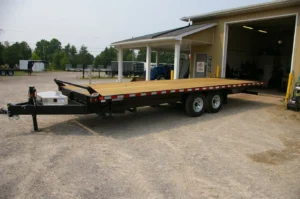
A deckover puts the deck above the wheels. You lose a little height but gain the full 8 ft of width with nothing in the way. Wide skid steers, tracked loaders, tractors with dual wheels and pallets that overhang all fit. Our ETL822-14K deckover tilt trailer, the hydraulic deckover trailer and the 26 ft ETL826-14K are built this way. If you want a fixed deckover without the tilt, see our 8×20 deckover trailer.

How long a deck do you need?
Deck length does two jobs on a tilt trailer. It holds the load, and it sets the loading angle. A longer deck tips to a gentler slope for the same deck height, which matters for low cars, long-boomed machines and anything with poor ground clearance.
- 12 to 14 ft: one small machine, a mower and tools, an ATV or a golf cart.
- 18 ft: a skid steer with a bucket, or most cars.
- 20 to 22 ft: a machine plus attachments, a mini excavator, or a car with gear.
- 24 to 26 ft: two compact machines, long vehicles, or larger equipment.
Place the load so about 60 percent of its weight sits ahead of the axles. GMC’s towing guide gives that rule along with a tongue weight of 10 to 15 percent for bumper-pull trailers and 15 to 30 percent for goosenecks. A deck that’s too short forces you to put weight in the wrong place.
Steel, painted or galvanized?
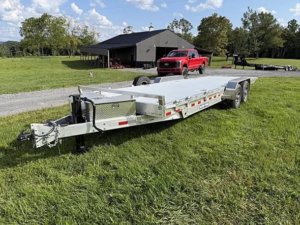
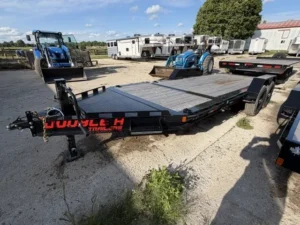
All of our tilt trailers have steel frames. The difference is the finish. Painted steel looks sharp and is cheaper, but stone chips and scrapes from tracks let rust start, and road salt speeds that up. Hot-dip galvanized steel is dipped in molten zinc, which coats the steel inside and out.
The American Galvanizers Association reports that structural steel thicker than 1/4 in can reach 72 to 73 years to first maintenance even in industrial atmospheres. A trailer is thinner steel and sees road salt and grit, so expect much less than that. Even so, it shows why galvanized trailers stored outside last so much longer than painted ones. Our 80×20 galvanized tilt trailer is the one to pick if your trailer lives outdoors, near the coast or on salted winter roads.
Wood deck or steel deck?
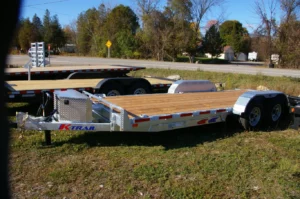
The deck surface matters more on a tilt trailer than on a flat one, because machines climb it at an angle, sometimes in rain or mud.
| Wood deck | Steel deck | |
|---|---|---|
| Grip for tracks and tires | Good, even when wet | Can be slippery when wet or muddy unless textured |
| Wear from steel tracks | Boards wear and need replacing | Resists gouging |
| Repair | Swap individual boards cheaply | Needs welding |
| Weight | Lighter | Heavier, which cuts payload |
| Life | Shorter, depends on care | Longer |
Our view: for rubber tracks, tires and mixed loads, wood is the practical choice on a tilt trailer. For steel-tracked machines used every day, a steel deck or steel strips over wood at the wheel paths lasts longer. Either way, keep mud off the deck before loading on a slope. Ask us which deck each model in our range has.
Tandem, tri-axle or gooseneck?
Single axle models suit light loads up to about 7,000 lb GVWR. They’re cheaper, lighter and easy to move by hand. Tandem axles carry more, share the load if a tire fails and track more steadily. Almost every model from 7×18 upward is tandem. Our guide to tandem axle vs single axle trailers explains the trade-offs.
A tri-axle spreads very heavy loads over three axles. Our 8×24 tri-axle tilt trailer is rated 22,679 lb and has electric brakes. It’s for mid-size excavators, telehandlers and big tractors.
A gooseneck hitch sits in the truck bed over the rear axle. It carries more weight on the truck and turns tighter than a bumper pull of the same length. Our used 8.5×25 gooseneck tilt trailer is set up this way. See our gooseneck vs bumper pull guide for more.
Who buys a tilt trailer, and which one we’d suggest
These are typical buyers we hear from, with our suggestion for each. They’re recommendations, not rules, so check your own weights.
Homeowner with a ride-on mower or garden tractor
A 6×12 manual tilt trailer at $2,450 is our lowest-priced option. It tows behind a pickup or large SUV, parks in a driveway, and you never lift a ramp.
Landscaper or lawn care business
The 6×14 TL614-5K gives two extra feet for a push mower, trimmers and fuel. If you carry a compact tractor with a loader, step up to the TL612-7K. Our landscape trailer guide compares other options.
Contractor with a skid steer or mini excavator
A 7×20 tilt trailer rated 15,400 lb or a 7×22 rated 15,119 lb carries the machine plus attachments with room to spare. Our skid steer trailer guide covers sizing in more detail.
Car dealer, collector or recovery service
A hydraulic deck lets you winch cars that don’t run, and the low angle protects low bumpers. The ETL718-14K or the longer ETL722-14K fit this job. For a fixed deck alternative, see our car hauler trailer.
Plant hire firm or large farm
The 8×24 tandem at 17,280 lb, or the 8×24 tri-axle at 22,679 lb, takes wider and heavier machines.
Matching the trailer to your tow vehicle
The trailer is only half the setup. Before you buy, check these figures in your vehicle’s handbook or on the door-pillar label:
- Towing capacity. The heaviest trailer your vehicle is rated to pull. Compare it with the loaded trailer weight, not just the machine.
- Gross combined weight rating. The limit for the vehicle, the trailer, the load, passengers and fuel together.
- Vehicle payload. The tongue weight counts against it, along with people and tools in the truck. A 1,500 lb tongue load on a half-ton pickup uses up a lot of payload fast.
- Hitch rating. The receiver, ball mount and ball must all be rated for the trailer’s weight and tongue load.
- Brake controller. Needed for electric brakes, and set to suit the load each trip.
As a broad guide, the single axle models in our range tow behind most pickups and larger SUVs. The 14,000 lb tandems usually need a three-quarter-ton or one-ton truck. The tri-axle and gooseneck models need a heavy-duty truck with the right hitch. Always go by your own vehicle’s ratings, not this summary.
Setting up for the loads you actually carry
Mini excavator
Load with the blade forward or backward depending on the trailer’s balance, and bring the boom and bucket down onto the deck before you tie it down. Swing the house straight and lock it. Watch the counterweight as the deck comes level.
Compact tractor with a front loader
Tractors with loaders are front-heavy, which helps get weight ahead of the axles. Lower the loader bucket onto the deck and remove any rear implement if it pushes you over the rating or the deck length.
Car
Use a hydraulic deck and a winch for cars that don’t run. Wheel straps over the tires stop the suspension bouncing the car loose. Measure the car’s width against the space between the fenders.
ATV, UTV and golf cart
A small single axle model does the job. Strap at all four corners, and use the handbrake as well as the straps.
Scissor lifts and access equipment
Narrow, heavy and often with small wheels, these benefit most from a low angle. Check the machine’s own tie-down points and the deck’s rating at the point where the wheels sit.
Pallets and materials
A deckover takes standard pallets across its width. Use straps over every pallet, and edge protectors on soft loads.
Tilt trailer vs a ramp trailer or a dump trailer
| Tilt trailer | Equipment trailer with ramps | Dump trailer | |
|---|---|---|---|
| Loading | Whole deck tips; no ramps | Two ramps or a dovetail | Rear gate or ramps |
| Loading angle | Low | Steeper | Steep |
| Low cars | Good | May scrape | Not suited |
| Loose material | No | No | Yes, tips it out |
| Price | Higher | Lower | Higher |
If you carry gravel, mulch or debris, a dump trailer is the right tool. If price matters most and your machines climb ramps happily, a ramp-style 7×20 equipment trailer costs less. A tilt trailer earns its price when loading speed, a low angle, or a dislike of heavy ramps matters to you.
One job, two ways of loading
To show where the difference comes from, picture a landscaper moving a compact track loader between three sites in a day. This is a scenario we describe to buyers, not a timed test.
With a ramp trailer, every stop means pulling out two heavy ramps, setting them to the track width, checking they’re seated, climbing a steep slope, then lifting the ramps back up and pinning them. Do that six times a day and it adds up, along with the risk of a ramp kicking out or a track slipping off the edge.
With a tilting deck, each stop means releasing a lock, driving up one wide, shallow slope, and locking the deck again. There’s nothing to lift and nothing to line up. Over a working week, the saved effort and lower risk are what most buyers say they’re paying for.
Loading a tilt trailer safely
- Hitch to the tow vehicle first, on level, firm ground, with the parking brake on.
- Chock the trailer wheels.
- Release the deck lock or, on a hydraulic model, lower the deck with the controls.
- Keep people clear of the deck edges and the pivot.
- Drive on slowly and straight, bucket or blade low. On a gravity tilt, expect the deck to move as you pass the pivot.
- Position the load so about 60 percent of the weight is ahead of the axles.
- Lock the deck level and check the lock has engaged.
- Lower attachments and tie the machine down before you move.
Tying down a machine on a tilt trailer
In the US, federal cargo rules give a clear standard for heavy machines. Under 49 CFR 393.130, equipment weighing 10,000 lb or more must have accessories such as shovels completely lowered and secured, and must be restrained with at least four tiedowns placed close to the front and rear of the machine. Articulated machines must be restrained so they can’t articulate in transit. Lighter loads fall under the general tiedown rules.
In practice, use chains or straps rated for the load, attach to the machine’s own tie-down points, lower the bucket or blade to the deck, and check everything again after the first few miles. Our guide to securing a load on a trailer covers the details.

Towing rules around the world
Rules differ by country, so check locally before you buy. In Great Britain, for example, GOV.UK says a trailer needs a working brake system if it weighs over 750 kg loaded, and sets a maximum trailer width of 2.55 m. An 8 ft deck is about 2.44 m, which is inside that limit. An 8.5 ft deck is about 2.59 m, which is over it. Most of our heavier models have electric brakes, which need a brake controller in the tow vehicle.
Tell us where you’ll tow, and we’ll point out width, braking or lighting issues before you order. Our trailer towing tips cover reversing, braking and sway.
Tilt trailers we sell
Prices are in US dollars and correct when this was written. Click through for current prices, photos and full specs.
Small tilt trailers (single axle)
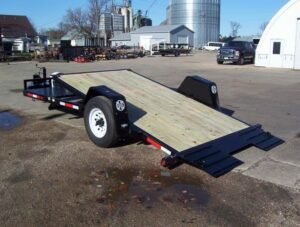
- 2027 6×12 tilt trailer: manual tilt, single axle, steel, black, 5,000 lb GVWR, $2,450.
- TL612-5K gravity tilt trailer: 6×12, single axle, 5,000 lb GVWR, $3,000.
- TL612-7K 7000 lb tilt trailer: 6×12, single heavy-duty axle, 7,000 lb GVWR, $2,950.
- TL614-5K 6×14 tilt trailer: 6×14, single axle, 5,000 lb GVWR, $3,400.
Hydraulic power tilt trailers
- ETL718-10K hydraulic tilt trailer: 7×18, 10,000 lb GVWR, $6,900.
- ETL718-14K power tilt trailer: 7×18, tandem, 14,000 lb GVWR, $7,500.
- ETL722-14K 22 ft power tilt trailer: 7×22, tandem, 14,000 lb GVWR, $7,600.
Hydraulic deckover tilt trailers (8 ft wide)
- ETL822-14K hydraulic deckover trailer: 8×22, tandem, 14,000 lb GVWR, $9,500.
- ETL822-14K deckover tilt trailer: 8×22, tandem, 14,000 lb GVWR, $9,600.
- ETL826-14K 26 ft tilt trailer: 8×26, tandem, 14,000 lb GVWR, $11,250.
Tilt and load trailers
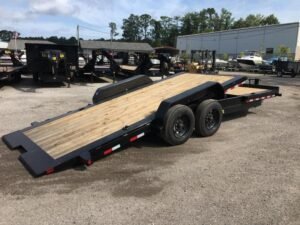
- 2027 7×22 tilt trailer: tandem, steel, black, 15,119 lb GVWR, $6,800.
- 2026 80×20 galvanized tilt trailer: tandem, hot-dip galvanized, silver, 14,000 lb GVWR, $7,500.
- 2026 7×20 tilt trailer: tandem, steel, black, 15,400 lb GVWR, $7,800.
- 2026 8×24 tilt trailer: tandem, steel, black, 17,280 lb GVWR, $10,900.
- 2026 8×24 tri-axle tilt trailer: electric brakes, steel, black, 22,679 lb GVWR, $11,900.
Used
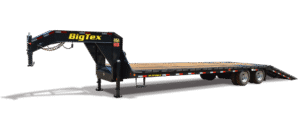
- 2024 used 8.5×25 gooseneck tilt trailer: tandem, gooseneck hitch, 2-5/16 in listed, black, $8,300.
Browse every model in our tilt and load trailers category, or see our equipment trailers and used trailers.
For hire firms and fleets
Equipment hire companies have their own reasons to choose tilting decks. Customers of very different experience levels load the trailer, so a single wide slope with no ramps to set up is less likely to end in a damaged machine or an injury. Fewer loose parts also means fewer lost or bent ramps to replace.
For a fleet, we’d suggest standardising on one or two deck sizes, picking galvanized for trailers stored outside, and choosing hydraulic models where staff will load machines that may not be running. Ask us about pricing on multiple units.
Storing the trailer between jobs
- Park on firm, level ground with the deck locked level.
- Raise the tongue slightly on a jack so rain runs off a wood deck.
- Cover the hydraulic power unit and keep the battery on a maintenance charger if the trailer will sit for weeks.
- Take the weight off the tires for long storage, or move the trailer now and then to avoid flat spots.
- Fit a coupler lock and a wheel clamp. Flatbeds are easy to hitch up and steal.
Hot, cold and wet climates
- Cold winters and salted roads: galvanized frames resist rust far better than paint. Hydraulic fluid thickens in deep cold, so the deck may move more slowly until it warms up.
- Hot, sunny places: wood decks dry out and crack faster. A deck treatment once a year helps. Batteries also wear faster in heat.
- Wet and coastal areas: rinse the pivot and the underside often, and grease the pivot after washing.
- Dusty sites: dust and grit wear the pivot bushings, so grease more often.
Features worth asking about
- Deck surface. Wood decks grip tracks and rubber well and are easy to replace. Steel decks last longer but can be slippery when wet.
- Deck lock. Check how it engages and that you can see it’s locked.
- Cushion cylinder on gravity models, so the deck doesn’t slam.
- Winch mount at the front, for machines and cars that don’t run.
- Stake pockets and rub rails for extra tie-down points.
- D-rings or chain points along the deck, rated for your load.
- Brakes and breakaway kit on heavier models.
- Battery charging from the tow vehicle on hydraulic models.
- Toolbox on the tongue for chains and binders.
- Spare tire and mount.
Looking after a tilt trailer
It has the same needs as any flatbed plus a few of its own:
- Grease the pivot regularly, or the deck will start to stick and groan.
- Check the deck lock for wear and make sure it still engages fully.
- Inspect the cushion cylinder on gravity models for leaks.
- On hydraulic models, keep the battery charged, check the fluid level and look for weeping hoses.
- Service bearings, brakes and tires on schedule.
- Wash off salt and mud, especially around the pivot.
Our trailer maintenance checklist covers bearings, brakes and tires in more depth.
Buying a used tilt trailer
- Tilt the deck several times. It should move smoothly and lock solidly.
- Look at the pivot for worn bushings or play.
- Check the frame for cracks around the pivot and tongue, and for bent cross-members.
- Test hydraulics: does the deck hold its position, or slowly drift down?
- Inspect the deck boards for rot or breaks.
- Look at tire wear. Uneven wear can mean a bent axle.
- Check the VIN plate and paperwork so you can register it where you live.
What owning one costs beyond the price
We can’t give exact figures because they vary so much between countries, but plan for:
- Registration and inspection, where your local rules require them.
- Insurance for the trailer, and for the machine while it’s being carried.
- Chains, binders and straps rated for your heaviest load.
- Tires, bearings and brake parts over time.
- A battery every few years on hydraulic models.
- A heavier tow vehicle, if your current one isn’t rated for the loaded trailer.
Against that, many owners stop paying for machine delivery or hire-company transport. Our view is that a contractor who moves a machine several times a week usually gets the money back sooner than a homeowner who tows a mower twice a month. That’s an opinion based on what buyers tell us, not a calculation.
Questions to ask before you order
- What does the trailer weigh empty, and what’s the real payload?
- What’s the clear width between the fenders, or is it a deckover?
- How long is the tilting section, and how high is the deck when level?
- Gravity or hydraulic? If hydraulic, how is the battery charged?
- Which axles have brakes, and what type?
- How many tie-down points, and what are they rated for?
- Wood or steel deck?
- What paperwork comes with it for registration in my country?
- What’s the delivered price to my address or port?
We’ll answer every one of these for any model we sell.
Mistakes we see buyers make
These come from our own conversations with buyers, so treat them as experience rather than statistics.
- Using the machine’s brochure weight without attachments. Buckets, forks and breakers add up fast.
- Forgetting the trailer’s own weight. GVWR is not payload.
- Buying gravity tilt for non-running loads. If you’ll winch things on, get hydraulics.
- Not measuring between the fenders. A deckover may be what you need.
- Buying too short. Most people add a second machine or more attachments within a few years.
Worldwide delivery
We deliver trailers to customers in many countries. Ask for a delivered quote on each model you’re considering. Tell us where you’ll tow, and we’ll flag any width, brake or lighting points that matter there. We supply the paperwork you need for registration.
Tilt trailer FAQs
What is a tilt trailer?
A flatbed with a deck that pivots so the back drops to the ground. You load straight up the deck without ramps, then the deck returns level and locks.
Is a gravity or hydraulic tilt trailer better?
Gravity is cheaper and simpler. Hydraulic gives you control and lets you winch non-running loads. Pick hydraulic for cars, dead machines and frequent careful loading.
What size tilt trailer do I need for a skid steer?
Small skid steers can fit a 6×12 rated at 7,000 lb. Most need a 7×18 to 7×22 rated at 14,000 lb or more once attachments are added.
Can a tilt trailer carry a car?
Yes. The low loading angle suits low cars, and a hydraulic deck with a winch handles cars that don’t run.
Does a tilt trailer need brakes?
Heavier ones do, and many countries require brakes above a set weight. In Great Britain, it’s over 750 kg loaded.
Is galvanized worth it?
If the trailer is stored outside or used on salted roads, yes. It resists rust far longer than paint.
How low does the deck go?
The rear of the deck reaches the ground when tilted. The angle depends on the pivot height and the length of deck behind it. Longer decks give a gentler slope.
Can I load a machine that doesn’t run?
Yes, on a hydraulic model with a winch. Lower the empty deck, winch the machine up, then raise the deck level.
What maintenance does the pivot need?
Regular greasing, and a check for worn bushings or play. Wash grit out of it after muddy jobs.
Is a deckover harder to load?
The deck sits a little higher, but on a tilting deckover the slope is still gentle, and you gain the full 8 ft width.
Do you ship tilt trailers internationally?
Yes, we deliver worldwide. Ask for a delivered quote.
Get your tilt trailer
Tell us what you carry, its weight with attachments, and what you tow with. We’ll recommend the tilt trailer that fits. Browse our tilt and load trailers, equipment trailers and dump trailers, or see everything in the shop. For more background, read how to choose a trailer, types of trailers and aluminum vs steel trailers. Questions? Contact us.