
A cargo trailer is an enclosed box trailer with walls, a roof and lockable doors. It keeps whatever you carry dry, out of sight and secure. Choosing the right one comes down to five things: the floor size you need, the interior height, the rear door (a ramp for anything with wheels, barn doors for loading by hand or forklift), single or tandem axles, and whether your vehicle can tow it.
A 6×10 or 6×12 single axle cargo trailer suits a household move or a small business. A 7×14 or 7×16 tandem is the workhorse for trades and motorcycles. An 8.5 ft wide trailer at 20 ft or more is what you need for a car, a UTV or a mobile workshop.
That’s the short answer. Below we go through cargo trailer sizes and what fits in each, doors, height, V-nose fronts, axles and weight, steel versus aluminum, the main uses (moving, trades, motorcycles, cars, business conversions), towing rules in different countries, and which models from our stock fit which buyer. We sell every trailer mentioned here and deliver worldwide. Prices and specs come from our listings, outside facts are linked to their sources, and where something is our opinion, we say so.
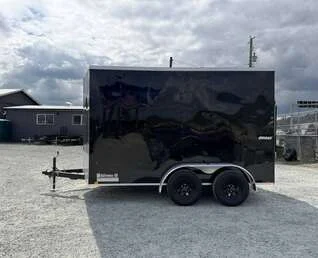
Cargo trailer sizes at a glance
This is how we usually match a cargo trailer to the job. It’s a starting point. The sections below explain how to check it against your own load and vehicle.
| Size | Typical use | Axles | From our stock |
|---|---|---|---|
| 6×10 | Small move, market stall, one small motorcycle, tools for one trade | Single | 6×10 aluminum cargo trailer |
| 6×12 | Apartment move, contractor tools, events | Single | 6×12 enclosed cargo trailer |
| 7×14 | Trades, two motorcycles, house move | Tandem | 7×14 cargo trailer, 7×14 ramp door |
| 7×16 | Mobile workshop, bikes plus gear, larger moves | Tandem | 7×16 enclosed trailer |
| 8.5×20 to 8.5×24 | Car, UTV, race gear, business conversions | Tandem | 8.5×20 car trailer, 8.5×24 |
The pairings are our recommendation, based on what we sell and the jobs buyers describe to us.
How cargo trailer sizes are measured
A cargo trailer is usually sold by width and box length in feet, so a 7×14 is about 7 ft wide and 14 ft long. Three things to watch:
- Box length versus overall length. The number in the name is usually the box. The overall length, with the tongue, is several feet longer. That matters for parking, storage and some towing rules.
- Exterior versus interior width. Walls, posts and wheel wells take up space. A “7 ft” trailer has a little less than 7 ft clear inside, and the space between the wheel wells is narrower still on many models.
- V-nose. A pointed front adds some floor space at the front, but it’s triangular. Some sellers include the V-nose in the length, some don’t.
Before you buy, ask for the interior length, the width between the walls and between the wheel wells, the interior height, and the door opening. We’ll give you all four for any cargo trailer we sell.
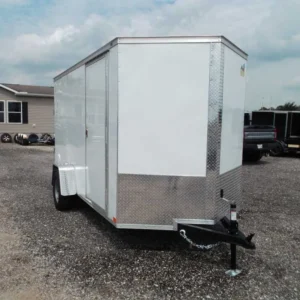
Interior height and door opening
Most cargo trailers come with interiors around 78 in (6 ft 6 in) or 84 in (7 ft). Taller ones, like our 90 in interior on the 8.5×20 cargo trailer, are made for tall loads, side-by-side UTVs with roll cages, or people who want to stand and work inside.
The door opening is always smaller than the interior. The frame of the rear door takes a few inches off the height and width. If you’re loading a tall machine, a stacked wardrobe, or a motorcycle with a tall windscreen, measure it against the door opening, not the inside of the box.
How tall do you need?
- Furniture and boxes: 78 in is usually enough. Taller lets you stack higher.
- Standing inside to work: 84 in or more feels much better for most adults.
- Motorcycles: 78 in clears most bikes. Touring bikes with tall screens and riders who want to walk in upright do better with 84 in.
- UTVs and lifted machines: check the machine’s height carefully. Some need 84 to 90 in plus clearance for the ramp angle.
Ramp door or barn doors?
This is the choice that changes how a trailer gets used every day.
| Rear ramp door | Barn doors | |
|---|---|---|
| Best for | Anything with wheels: bikes, mowers, carts, cars, UTVs, pallet trucks | Hand loading, forklifts, backing up to a dock, tight parking |
| Loading | Ride or roll straight in | Lift in, or use separate ramps |
| Space behind the trailer | Needs room for the ramp to come down | Doors swing to the sides and can latch open |
| Weight | Heavier door | Lighter |
| Price | Usually costs more | Usually costs less |
Our view: if anything you’ll carry has wheels, buy the ramp door. Carrying separate ramps every time gets old fast. If you’re mainly moving boxes, stock or equipment by hand or forklift, barn doors are cheaper, lighter and handier at a loading dock. Many enclosed trailers also have a side door, which is worth having on any trailer longer than 12 ft so you can get things out without climbing past the whole load.

Single or tandem axle?
Single axle cargo trailers are cheaper, lighter, easier to push by hand and easier to back into tight spaces. Most 6×10 and 6×12 models are single axle and rated around 3,000 lb. Tandem axles carry more weight, keep going if a tire fails, and track more steadily at speed, which matters with a tall box catching wind. From 7×14 upward, almost every enclosed model is tandem. Our full guide to tandem axle vs single axle trailers explains the trade-offs.
Weight, payload and what you can actually carry
GVWR (gross vehicle weight rating) is the most the trailer may weigh, itself plus everything in it. Payload is GVWR minus the empty weight. An enclosed trailer has walls, a roof and doors, so it weighs more than an open trailer of the same size, and its payload is lower for the same rating.
Look at our own listings and you’ll see why this matters. Our two 7×14 barn door trailers look alike, but one is rated 7,055 lb and the other 10,141 lb. If you carry heavy tools, stock or machines, the higher rating gives you a lot more room. Always ask for the empty weight so you can work out the real payload.
A motorcycle example
Harley-Davidson lists its Road Glide at 838 lb in running order, 94.9 in long and 37.2 in wide. Two of those come to about 1,680 lb before helmets, tools and luggage. In length, two bikes nose to tail need a little over 16 ft of floor, so they’re usually loaded side by side and slightly staggered in a 7 ft wide trailer. A 7×14 tandem with a ramp door and wheel chocks handles that comfortably. A 6×12 single axle would be tight on width and payload once the trailer’s own weight is counted. Ask us for the empty weight and do the sum with your own bikes.
Steel or aluminum?
Most cargo trailers have a steel frame. The difference is often in the skin, the roof and the floor framing. Steel trailers are cheaper and easy to weld if something bends, but painted steel rusts where the paint is chipped, especially on the floor frame and around the tongue. Aluminum is lighter, which means more payload and less strain on the tow vehicle, and it doesn’t rust like steel. It costs more up front.
Our view: if you’ll tow on salted winter roads, keep the trailer outside or want the lightest trailer for a smaller vehicle, aluminum is worth paying for. If price comes first and you’ll keep it under cover, steel is fine. Our aluminum vs steel trailer guide covers this in detail. Our 6×10 aluminum cargo trailer is the lightest enclosed trailer in our range.

Floor, walls and build quality
Two trailers can share a size and a door type and still be built very differently. When you compare models, look past the paint and ask how the box is put together.
- Floor. Most enclosed trailers use plywood over steel cross-members. Ask how thick the plywood is and how far apart the cross-members sit. Closer spacing means a stiffer floor that copes better with point loads like a motorcycle stand, a toolbox on casters or a forklift wheel.
- Wall posts. Posts behind the skin carry the roof and give you something solid to screw shelving into. Closer spacing makes for stronger walls and more mounting points.
- Roof. A one-piece roof sheet has fewer seams to leak. Roof bows underneath stop the sheet from flexing and drumming at speed.
- Skin fastening. Screwed and riveted skins are common. Bonded skins look smoother. Either works if it’s done well, so check for loose or missing fasteners.
- Interior lining. Plywood or composite walls protect the outer skin from dents and give you a surface for hooks and shelves.
- Undercoating. A coating on the frame underneath slows rust from road spray.
None of this shows in a photo, which is why we’re happy to answer build questions before you order. A well-built box lasts years longer, and the price difference is often small.
Wiring, lights and brakes
Lighting and brakes are the parts most likely to cause trouble on the road, and they’re easy to check before delivery.
- Plug type. North American trailers usually use a 4-pin or 7-pin connector. A 7-pin plug carries the brake signal and a charge line. Other countries use different plugs, so tell us where you’ll tow and we’ll note what adapter or rewiring you may need.
- Brakes. Tandem trailers rated around 7,000 lb or more normally have electric brakes on at least one axle. Your tow vehicle needs a brake controller to work them.
- Breakaway kit. A small battery and switch that applies the brakes if the trailer comes off the hitch. Test it before long trips.
- LED lights. They last longer and draw less power than old bulbs. Check that side marker lights work, because a long box is hard to see from the side at night.
- Interior power. A battery, a small solar panel or a shore power inlet keeps lights and chargers running in a work trailer.
Using a cargo trailer for moving house
A cargo trailer is a popular alternative to renting a moving van. You load at your own pace, lock it overnight, and keep it afterwards for storage or the next move. Some practical points:
- Size: a 6×12 handles most studio and small apartment moves. A 7×14 or 7×16 suits a small house. Bigger homes usually take more than one trip, whatever trailer you use.
- Load heavy items first, low and just ahead of the axles: washing machines, fridges, boxes of books.
- Tie everything down. E-track or D-rings along the walls make this much easier.
- Use the full height. Stack boxes heavy-to-light, bottom to top.
- Keep a clear path to the door, so you can unload the most-needed boxes first.
Cargo trailers for trades and contractors
For electricians, plumbers, painters, carpenters and installers, a cargo trailer works as a lockable mobile store and workshop. Tools stay organised, materials stay dry, and nothing has to be unloaded at night.
- Shelving and racks along both walls, with a clear aisle down the middle.
- Ladder racks on the roof or inside the ceiling.
- Workbench at the front, especially in a V-nose model.
- Lighting and power: LED lights and, if needed, a battery or shore power inlet for chargers.
- Side door so you can reach tools without dropping the rear door.
- Branding: the flat sides of an enclosed trailer make a good mobile advert for your business.
A 7×14 or 7×16 tandem is the usual size for one trade. Our 7×14 barn door enclosed trailer and 7×16 ramp door enclosed trailer are popular for this. If you also need site storage that stays put, compare the cost with a shipping container. If you mainly carry machinery rather than tools, our skid steer trailer guide is a better fit.

Carrying a car or UTV
An 8.5 ft wide cargo trailer with a ramp door, often sold as an enclosed car trailer, carries a car, a UTV, a race kart setup or a collector vehicle under cover. Things to check:
- Width: the vehicle’s width across the mirrors, plus room to open a door and climb out.
- Length: the vehicle’s length plus a few feet for weight placement. A 20 ft box takes most cars. Longer vehicles and car-plus-gear setups need 24 ft.
- Ramp angle: low cars can scrape. Ramp extensions or a beavertail help.
- Tie-downs: recessed D-rings or E-track in the floor.
- Weight: a car plus a heavy enclosed trailer is a serious load. Check the GVWR and your tow vehicle.
Our 8.5×20 enclosed car trailer and 8.5×24 cargo trailer are built for this. For an open alternative, see our car hauler trailer.
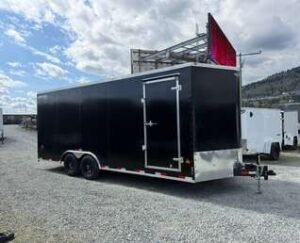
Turning a cargo trailer into a business
Cargo trailers are often converted into mobile businesses: coffee and food trailers, mobile workshops, pet grooming, mobile offices, merchandise stands and tiny camper conversions.
Food businesses are the most regulated. Local health departments usually want to approve plans before a mobile unit is permitted. The Chesterfield Health District in Virginia, for example, says that new mobile units must submit plans, a menu and permit applications before being permitted. It requires hot and cold running water, and a wastewater holding tank 15 percent larger than the fresh water tank. Rules differ a lot between places, so speak to your local authority before you buy a trailer to convert, not after.
For conversions, a taller interior, a side door, a strong floor and room for windows and vents make life easier. Ask us before ordering and we’ll tell you how each model is built.
Condensation and ventilation
An enclosed box can collect moisture. Virginia Tech’s Center for Packaging and Unit Load Design explains that condensation forms when temperature swings push the air inside a closed container past its dew point. It recommends ventilation when the outside air is drier, desiccants for sensitive goods, and keeping wet wood out. The same applies to any enclosed trailer. Roof vents, side vents, keeping wet gear out and leaving the vents open when parked all help stop mould and rust.
Towing a cargo trailer
Wind and fuel
A tall box behind your vehicle catches a lot of air. The US Department of Energy notes that even a roof-top cargo box can reduce fuel economy by 2 to 17 percent. A full-size enclosed trailer has far more frontal area than a roof box, so expect noticeably higher fuel use, and slow down in crosswinds. A V-nose front helps the air flow a little better than a flat front. That’s a common design argument, but we haven’t measured it ourselves.
Tongue weight
GMC’s towing guide says a conventional trailer should put about 10 to 15 percent of its loaded weight on the hitch, with roughly 60 percent of the load over the front half of the trailer. Inside the box, put heavy items forward and low, not at the back by the door.
Brakes and width rules
Rules differ around the world. In Great Britain, GOV.UK says a trailer must have a working brake system if it weighs over 750 kg loaded, and sets a maximum trailer width of 2.55 m for towing vehicles. An 8.5 ft wide cargo trailer is about 2.59 m across, so it’s over that limit there. Many US-style 8.5 ft trailers are made for North American roads. If you’re buying for another country, tell us where you’ll tow and we’ll suggest a width that suits local law.
Our trailer towing tips cover braking, reversing and sway, and our gooseneck vs bumper pull guide explains hitch types.
Securing the load inside
Walls don’t stop a load sliding into the front of the trailer in a hard stop. US federal cargo rules for commercial vehicles give a useful benchmark: under 49 CFR 393.110, an article longer than 5 ft and up to 10 ft needs at least two tiedowns if it isn’t blocked against moving forward, with more as length increases. In a cargo trailer, that means:
- E-track along the walls, or D-rings in the floor, so you can strap things where they sit.
- Wheel chocks for motorcycles, with soft straps on the bars and rear.
- Load bars or nets for stacked boxes.
- Heavy items strapped low, not just leaned against the wall.
Our guide to securing a load on a trailer covers strap ratings and methods.
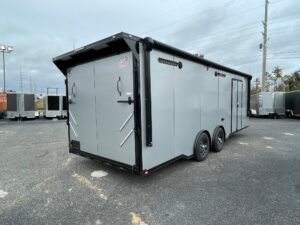
Security: keeping the trailer and contents yours
A locked cargo trailer is far safer than an open one, but the trailer itself can be stolen. A few habits make it harder:
- Coupler lock when unhitched, and a wheel lock when parked for long periods.
- Good padlocks on the doors, ideally closed-shackle or with a hasp guard.
- Park it nose-in against a wall or fence so the doors and coupler are hard to reach.
- Record the VIN and take photos, including any unique marks or decals.
- Don’t advertise what’s inside if you carry expensive tools. A plain trailer draws less attention.
- A GPS tracker hidden inside is cheap insurance for high-value contents.
Cargo trailers we sell
Prices are in US dollars and correct when this was written. Click through for current prices, photos and full specs.
Small cargo trailers
- 2026 6×10 aluminum cargo trailer: rear ramp, 78 in interior, aluminum, black, 2,990 lb GVWR, $3,500. Light and rust-resistant.
- 2027 6×12 cargo trailer: single axle, barn doors, 78 in interior, steel, white, 2,990 lb GVWR, $2,900. Our lowest-priced cargo trailer.
7 ft wide tandem cargo trailers
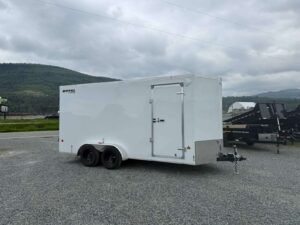
- 2027 7×14 enclosed trailer, barn doors: tandem, 84 in interior, steel, white, 7,055 lb GVWR, $4,600.
- 2026 7×14 cargo trailer, barn doors: tandem, 84 in interior, steel, white, 10,141 lb GVWR, $5,100. Much more payload for a small step up in price.
- 2026 7×14 cargo trailer, ramp door: tandem, 84 in interior, steel, charcoal, 10,141 lb GVWR, $6,500. Our pick for motorcycles and anything on wheels.
- 2026 7×16 enclosed trailer, ramp door: tandem, 84 in interior, steel, charcoal, 10,141 lb GVWR, $7,500.
8.5 ft wide cargo trailers
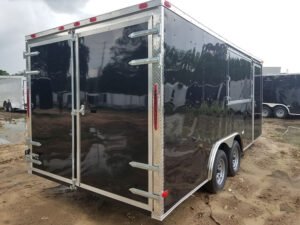
- 2026 8.5×20 cargo trailer: tandem, rear ramp, 90 in interior, steel, black, 10,141 lb GVWR, $6,500. Tall interior for UTVs and conversions.
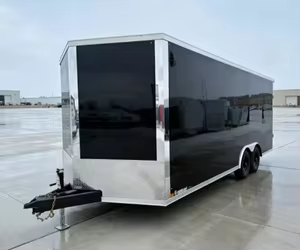
- 2026 8.5×20 enclosed car trailer: tandem, rear ramp, 84 in interior, steel, black, 10,141 lb GVWR, $8,100.
- 2023 8.5×24 cargo trailer: tandem, rear ramp, 84 in interior, 7,000 lb GVWR, $8,900. Length for a car plus gear.
Used and specialist
- 2023 used 8.5×16 cargo trailer: tandem, 2-5/16 in coupler, charcoal, $5,100.
- Snowmobile-specific aluminum enclosed trailers: our 7×21, 7×25 and used 7×19. See our snowmobile trailer guide.
Browse all cargo and enclosed trailers.
Four buyers and the cargo trailer we’d match to each
These are typical situations buyers describe to us, with our suggestion for each. Check your own load and vehicle before deciding.
The family moving house and keeping it for storage
A small house move now, garden gear and holiday kit afterwards, an SUV or half-ton pickup. A 6×12 single axle is light and easy to park. If the move is bigger, a 7×14 barn door tandem gives more room and more payload.
The electrician or plumber
Tools, cable, pipe and fittings every day, a three-quarter-ton van or pickup. A 7×14 or 7×16 tandem with shelving, a side door and good lighting becomes a mobile store. Choose the 10,141 lb rated model if you carry heavy stock.
The motorcycle rider
Two touring bikes and luggage for rallies and track days. The 7×14 ramp door cargo trailer, with wheel chocks and E-track, carries both and keeps them clean.
The weekend racer or classic car owner
A car, tools, tires and a toolbox. An 8.5×20 enclosed car trailer covers most cars. Go to 8.5×24 if you carry a lot of gear or a longer vehicle.
Planning the inside layout
An empty box is easy to fill badly. Spend half an hour with a tape measure before you fit anything, and the trailer will work far better for years.
- Measure what you carry. List your largest items and the ones you reach for most often.
- Put weight forward and low. Heavy shelving, generators and stock belong at the front, just ahead of the axles. Light, bulky things go higher and further back.
- Keep the centre aisle clear. You need to walk in, and wheeled loads need a straight path.
- Use the side door. Put the things you grab many times a day right beside it.
- Balance left and right. Don’t line one wall with all the heavy items.
- Leave space for growth. Most people add tools and stock over time.
Fit shelving to the wall posts, not just the skin. Thin wall sheets aren’t made to carry weight on their own, and a loaded shelf that tears loose in a hard stop can do real damage.
Trailer, van hire or storage unit?
Many people buying an enclosed trailer are weighing it against renting a van or paying for a storage unit. Here’s how we see the trade-offs. These are general points, not measured costs, because prices differ so much from place to place.
| Own an enclosed trailer | Hire a van | Rent a storage unit | |
|---|---|---|---|
| Up-front cost | Purchase price | None | Deposit |
| Ongoing cost | Insurance, upkeep, registration | Every hire | Monthly rent |
| Available when you need it | Always | Subject to booking | Fixed location |
| Moves with you | Yes | Yes, for the hire period | No |
| Resale value | Yes | No | No |
| Needs a tow vehicle | Yes | No | No |
If you’d hire a van several times a year, or pay for storage every month, owning the trailer usually starts to make sense. If you need one trip a year and have no suitable vehicle, hiring is simpler.
Hot, cold and wet climates
Where you live changes what you should look for.
- Hot, sunny places. A dark box gets very hot inside in direct sun. A white or silver exterior, roof vents and insulation keep it cooler, which matters for batteries, paint, food stock and anyone working inside.
- Cold places. Salt on winter roads is the main enemy. Aluminum, a good undercoat and regular washing underneath all help. Insulation and a heater make a work trailer usable all year.
- Wet and humid places. Vents, a well-sealed roof and a floor that’s sealed or coated reduce rot and mould. Parking with the nose slightly higher helps rain run off the roof.
- Dusty places. Good door seals keep fine dust out of tools and stock. Check them every few months.
Options and upgrades worth considering
- Side door on anything 12 ft or longer.
- V-nose for extra front storage and a little less drag.
- E-track on walls and floor.
- Roof vents and side vents.
- LED interior and exterior lights.
- Extra height for UTVs, conversions and standing room.
- Ramp extension or beavertail for low vehicles.
- Spare tire and mount.
- Stabiliser jacks at the back, so the trailer doesn’t tip when you walk in with the tongue unhitched.
- Insulation and lining for workshops, conversions and sensitive cargo.
Looking after a cargo trailer
- Check the roof seams and door seals once or twice a year. Leaks start small.
- Keep the floor dry. Plywood floors rot if water sits on them.
- Grease the door hinges, ramp springs and latches.
- Service the bearings, brakes and tires on schedule.
- Wash off road salt in winter, especially underneath.
- Test the lights before every trip.
Our trailer maintenance checklist covers bearings, brakes and tires in detail.
Buying a used cargo trailer: what to inspect
- Roof and walls. Look for water stains, soft spots and loose rivets inside.
- Floor. Walk every part. Soft or spongy plywood means rot.
- Frame and tongue. Rust, cracked welds and bent cross-members.
- Doors and ramp. Do they close and seal properly? Are the ramp springs working?
- Axles, tires and bearings. Uneven tire wear can mean a bent axle. Check tire date codes.
- Lights and wiring. Test everything with your vehicle.
- VIN plate and paperwork. Make sure the trailer can be registered where you live.
What owning a cargo trailer costs
We can’t give exact figures because they vary so much between countries, but plan for:
- Registration, plates and inspection, where local rules require them.
- Insurance for the trailer, and separately for valuable contents.
- Tires, bearings and brakes.
- Locks, tracker and accessories.
- Storage, if you can’t keep the trailer at home.
- Extra fuel while towing a tall box.
Against that, a cargo trailer often replaces repeated van hire, storage unit rent or a second vehicle. That’s why many owners say it pays for itself, though that depends on how much you use it. It’s our observation, not a measured figure.
Cargo trailer buying checklist
- What will you carry most, and how big and heavy is the largest item?
- Interior length, width, width between wheel wells, and height?
- Door opening size?
- Ramp door or barn doors? Side door?
- Single or tandem axle?
- GVWR and empty weight (payload)?
- Steel or aluminum?
- Vents, lights, E-track and D-rings?
- Can your vehicle tow it, with the tongue weight it brings?
- Width and braking rules where you’ll tow?
We’ll answer every question on this list for any cargo trailer we sell. For more background, see our guides on enclosed vs open trailers, how to choose a trailer and the types of trailers.
Mistakes we see people make
These come from our own conversations with buyers, so treat them as experience rather than statistics.
- Measuring the outside, not the inside. Wheel wells and door frames take more space than you’d think.
- Buying barn doors for a wheeled load. Separate ramps are a nuisance every single time.
- Ignoring the empty weight. Two trailers of the same size can have very different payloads.
- Loading heavy items at the back. That takes weight off the hitch and invites sway.
- Buying too short. Most owners find more to put in the trailer than they planned.
Delivery worldwide
We deliver cargo trailers to customers in many countries. Enclosed trailers take up space in transport, so ask for a delivered quote on each model you’re considering. Tell us where you’ll tow and we’ll flag any width, braking or lighting points that matter where you live.
Here’s how an order usually goes:
- Pick a model, or tell us your load and vehicle and we’ll suggest one.
- Get a delivered quote to your address or nearest port.
- Confirm the specs: size, doors, height, axle rating, colour and options.
- Arrange paperwork. We supply the documents you need for registration where you live.
- Delivery or collection. Check the trailer on arrival: doors, lights, tires, brakes and the floor.
Before the first trip, set your tow vehicle’s brake controller, check tire pressures against the sidewall rating, and do a short loaded test drive on quiet roads to get used to the extra length and wind.
Cargo trailer FAQs
What size cargo trailer do I need?
6×10 or 6×12 for small moves and light business use. 7×14 or 7×16 for trades, motorcycles and house moves. 8.5×20 or longer for cars, UTVs and conversions.
Ramp door or barn doors on a cargo trailer?
Ramp door for anything with wheels. Barn doors for hand or forklift loading and loading docks.
How much can a cargo trailer carry?
Its payload: GVWR minus empty weight. Ask for the empty weight of any model you’re considering.
Can a cargo trailer carry a motorcycle?
Yes. A 6×10 or 6×12 with a ramp takes one smaller bike. A 7×14 ramp door model takes two large touring bikes.
Do cargo trailers use more fuel?
Yes. A tall box adds drag. The US Department of Energy notes even a roof-top cargo box can cut fuel economy by 2 to 17 percent.
Is an 8.5 ft wide cargo trailer legal everywhere?
No. It’s about 2.59 m wide, which is over the 2.55 m limit in Great Britain, for example. Check your local rules.
Can I turn a cargo trailer into a food trailer?
Often, yes, but health departments usually require plan approval before permitting. Check local rules first.
How long does an enclosed trailer last?
With a sealed roof, a dry floor and regular bearing and brake service, many last well over a decade. Water getting into the floor is what usually shortens their life.
Do I need a brake controller?
If the trailer has electric brakes, yes. Most tandem models do. Check the rules where you live too, since some places require brakes above a set weight.
Can I live or sleep in one?
People do convert them into campers. You’ll need ventilation, insulation and windows, and some places have rules about using a trailer as accommodation. Check those first.
Do you ship cargo trailers outside the US?
Yes, we deliver worldwide. Ask for a delivered quote.
Find your cargo trailer
Tell us what you’ll carry, how often, and what you tow with, and we’ll recommend a cargo trailer that fits. Browse our cargo and enclosed trailers, snowmobile trailers, used trailers and utility trailers, or see everything in the shop. Questions? Contact us.
Sources and References
- Harley-Davidson: Road Glide specifications
- US Department of Energy, FuelEconomy.gov: Driving more efficiently
- GMC: Tongue weight and why it’s key to safe towing
- GOV.UK: Towing with a car
- 49 CFR 393.110: Minimum number of tiedowns (Cornell LII)
- Virginia Tech Center for Packaging and Unit Load Design: Moisture in Sea Containers
- Virginia Department of Health, Chesterfield: Mobile units, push carts and vending trucks