

Shopping for a race car trailer? Here is the short answer. Most club racers and track day drivers are best served by an 8.5 ft wide enclosed trailer, 20 to 24 ft long, with a ramp door and a tandem axle rated around 10,000 lb. That carries the car, spare wheels, tools and fuel, locked and out of the weather. If budget or tow weight matters more, an open car hauler or a tilt deck does the job for less. We sell all three, from a galvanized car hauler at $5,100 to 8.5×20 enclosed trailers and a 24 ft enclosed trailer.
This guide explains how to choose a race car trailer by car size, ground clearance and what you carry to the track, with published specs and our current prices.
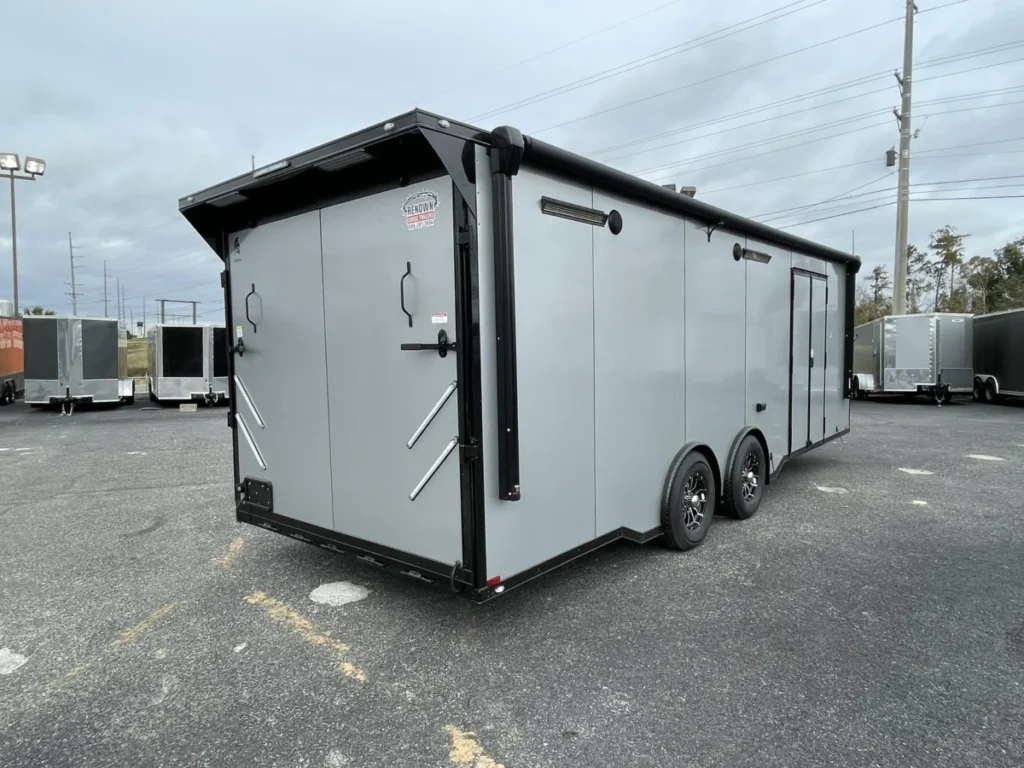
A race car trailer has a harder job than a normal car trailer. The car is usually low, stiffly sprung and has a splitter or long nose that scrapes on anything steep. You also bring a lot more than the car: wheels and tyres, a jack and stands, a toolbox, fluids, fuel, a canopy and spares. At the track, the trailer often becomes your garage, workshop and shelter for the weekend. Get the size or the loading angle wrong and every event starts with a fight at the ramp.
Below, we use published dimensions for two very common track cars, work out what they mean on a trailer, and match them to the trailers in our enclosed trailer, car hauler and equipment and tilt and load ranges.
Key takeaways before you buy a race car trailer
- Width matters more than people think. A Corvette Stingray is 76.1 inches wide without mirrors, so a 7 ft wide enclosed trailer is very tight. An 8.5 ft box is the usual choice.
- Ground clearance decides the loading angle. A Mazda MX-5 has as little as 4.9 inches of ground clearance. Long ramps, a dovetail or a tilt deck help.
- Length goes on more than the car. A 20 ft box takes most sports cars plus a bench and a tyre rack. 24 ft gives real working room.
- Weight adds up. Car, spares, tools and fuel can easily reach several thousand pounds before the trailer itself.
- Never run a generator inside the trailer. Carbon monoxide builds up fast in an enclosed space.
Race car trailers we sell right now
Every race car trailer in this table is listed in our shop with a price. Prices are the current listed prices and can change, so check the product page or contact us for a quote before ordering.
| Trailer | Size | Type | Inside height | GVWR | Price |
|---|---|---|---|---|---|
| 2026 8.5×20 cargo trailer | 8.5 x 20 ft | Enclosed, ramp door, tandem | 90 in | 10,141 lb | $6,500 |
| 2026 8.5×20 enclosed car trailer | 8.5 x 20 ft | Enclosed, ramp door, tandem | 84 in | 10,141 lb | $8,100 |
| 2023 8.5×24 cargo trailer | 8.5 x 24 ft | Enclosed, ramp door, tandem | 84 in | 7,000 lb (confirm) | $8,900 |
| Used 2023 8.5×16 cargo trailer | 8.5 x 16 ft | Enclosed, tandem | Ask us | Ask us | $5,100 |
| 2026 7×16 cargo trailer | 7 x 16 ft | Enclosed, ramp door, tandem | 84 in | 10,141 lb | $7,500 |
| 2026 galvanized car hauler, “18+2 x 20” | Ask us to confirm deck | Open, dovetail, tandem | Open | 10,000 lb | $5,100 |
| 2026 galvanized car hauler, “18+2 x 14” | Ask us to confirm deck | Open, dovetail, tandem | Open | 14,000 lb | $6,400 |
| 2026 80×20 galvanized tilt | 80 in x 20 ft | Tilt and load, tandem | Open | 14,000 lb | $7,500 |
| ETL718-14K hydraulic tilt | 7 x 18 ft | Hydraulic tilt, tandem | Open | 14,000 lb | $7,500 |
| 2026 7×20 tilt and load | 7 x 20 ft | Tilt and load, tandem | Open | 15,400 lb | $7,800 |
| 2026 8×24 tilt and load | 8 x 24 ft | Tilt and load, tandem | Open | 17,280 lb | $10,900 |
A few honest notes on the table. The 90 inch 8.5×20 is listed for less than the 84 inch version, and the 2023 8.5×24 lists a 7,000 lb GVWR, which is low for its size. The two car hauler listings describe their decks as “18+2 x 20” and “18+2 x 14”, and we will confirm what those mean before you buy. Please check all of these with us first.
Enclosed, open or tilt: which race car trailer?
| Enclosed | Open car hauler | Tilt deck | |
|---|---|---|---|
| Weather and security | Full | None | None |
| Doubles as a garage at the track | Yes | No | No |
| Loading angle | Set by the ramp door | Dovetail and ramps | Shallow, whole deck tilts |
| Weight and wind resistance | Highest | Lowest | Low |
| Price in our range | From $5,100 used, $6,500 new | From $5,100 | From $7,500 |
Our view: if you race or do track days more than a few times a year, an enclosed race car trailer is worth the extra cost. It protects the car on the road, keeps your tools and spares together, and gives you somewhere dry to work and sit between sessions. If you mostly go to local events in good weather, an open hauler or tilt deck is cheaper, lighter to tow and simpler to load. Our enclosed vs open trailer guide goes into the trade-offs.
What size race car trailer do I need?
Start with your car’s length, width, height and ground clearance. Here are published figures for two popular track cars, one small and light, one wide and heavier.
| Car | Length | Width | Height | Ground clearance | Curb weight |
|---|---|---|---|---|---|
| 2026 Mazda MX-5 Miata | 154.1 in | 68.3 in (with mirrors) | 48.8 in | 4.9 to 5.3 in | 2,366 lb |
| 2026 Chevrolet Corvette Stingray | 182.3 in | 76.1 in (no mirrors) | 48.6 in | 5.3 in | 3,366 lb |
Where the figures come from: the MX-5 figures are from Kelley Blue Book’s 2026 MX-5 specs (the 4.9 inch clearance is the Sport trim, 5.3 inches the Club and Grand Touring), and the Corvette Stingray 2LT figures are from J.D. Power’s 2026 Corvette specs. Faster versions are bigger: KBB’s 2026 Corvette specs list the Z06 at 3,500 lb and 184.5 inches long. Race cars with cages, wings and wider wheels will differ again, so measure your own.
Width
Width is where a race car trailer choice is often decided. A 7 ft enclosed trailer is about 84 inches wide on paper, but the inside is narrower once you count the walls, and the wheel wells narrow it again at floor level. A 76.1 inch Corvette might physically roll in, but you would have almost no room to open a door or walk past. An MX-5 at 68.3 inches is easier, but still tight.
An 8.5 ft wide enclosed trailer gives you real room. Even so, measure the clear width between the wheel wells and the door opening on the exact trailer you are looking at, and compare with your car’s width at the tyres and at the doors. Ask us and we will measure it for you.
Length
The MX-5 is 154.1 inches, just under 13 ft. The Corvette Stingray is 182.3 inches, a little over 15 ft. A 20 ft race car trailer takes either with about 5 to 7 ft left over for a tyre rack, a bench or cabinets at the front. A 24 ft trailer gives you room to walk all the way round the car and set up a proper work area. A 16 ft box takes an MX-5 with a little room to spare, but not much else.
Height
Most sports cars are under 50 inches tall, so height is rarely a problem inside an 84 inch enclosed trailer. It matters if you add a roof-mounted camera, a tall wing or a car on a lift inside the trailer. Our 90 inch interior 8.5×20 gives extra headroom for cabinets and an overhead tyre rack.
Quick race car trailer size chart
| Your setup | Suggested race car trailer |
|---|---|
| Small car, local events, tight budget | Open car hauler with dovetail or used 8.5×16 enclosed |
| Small car, regular track days, tools and spares | 8.5×20 enclosed |
| Wide car like a Corvette | 8.5×20 enclosed or 8.5×24 enclosed |
| Full race weekend, work area inside | 8.5×24 enclosed |
| Very low car, open trailer | 80×20 tilt or 8×24 tilt |
Loading a low car: angles, ramps and tilt decks
This is where most race car trailer buyers have the most trouble. A low car can scrape in three places: the front lip or splitter as it reaches the ramp, the underside in the middle as it crests from ramp to deck (the breakover point), and the rear as it leaves the ground.
A rough way to check breakover
Here is a simple approximation we use. A car’s breakover angle is roughly twice the angle whose tangent is twice the ground clearance divided by the wheelbase. Using the published figures above, an MX-5 with 4.9 inches of clearance and a 90.9 inch wheelbase comes out at about 12 degrees. A Corvette Stingray with 5.3 inches of clearance and a 107 inch wheelbase comes out at about 11 degrees. That is our calculation, not a manufacturer figure, and it ignores suspension movement and splitters, so treat it as a warning sign rather than a precise limit.
Now compare that with the trailer. A ramp’s angle is the angle whose tangent is the deck height divided by the ramp length. As an example, a deck 20 inches high with a 7 ft (84 inch) ramp gives an angle of about 13 degrees. That is already steeper than our estimate for both cars. Those trailer numbers are an illustration, not measurements of any of our models, but they show why low cars so often scrape on standard ramps.
How to fix it
- Longer ramps or ramp extensions reduce the angle.
- A dovetail on an open car hauler lowers the rear of the deck, which is why our car haulers are listed with a short dovetail section.
- A tilt deck, like our 80×20 galvanized tilt or the ETL718-14K hydraulic tilt, tips the whole deck to give a shallow angle.
- Raising the trailer’s tongue with the jack before loading lowers the rear of the deck a little on some trailers.
- Driving onto wooden blocks or low ramps to lift the car before it reaches the trailer ramp is a common trick for very low cars.
- A winch lets you pull the car in slowly and straight, without riding the clutch on a steep ramp.
Ask us for the deck height and ramp length on any race car trailer you are considering, and we will help you work out the angle.
Enclosed race car trailers in detail
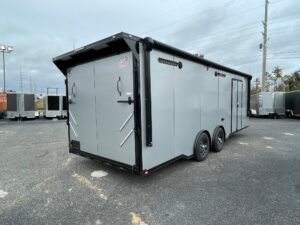
2026 8.5×20 cargo trailer, 90 in interior, 10,141 lb GVWR: $6,500
The 8.5×20 cargo trailer is a black steel tandem axle trailer with a rear ramp door, a 90 inch (2.29 m) interior height and a 10,141 lb (4,600 kg) GVWR. Its listing names car owners among the buyers it suits. The extra height is useful for an overhead tyre rack or tall cabinets at the front.
- Year: 2026
- Size: 8.5 ft x 20 ft (2.6 x 6.1 m)
- Axle: tandem
- Rear door: ramp
- Interior height: 90 in (2.29 m)
- GVWR: 10,141 lb (4,600 kg)
- Price: $6,500
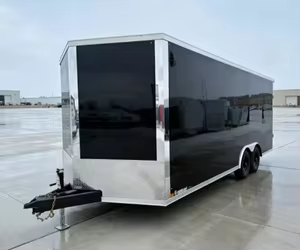
2026 8.5×20 enclosed car trailer, 84 in interior: $8,100
The 8.5×20 enclosed car trailer has the same footprint, an 84 inch (2.13 m) interior, a ramp door and a 10,141 lb GVWR. Its listing describes it as built for moving cars, with space left over for tools, spares and a tyre rack.
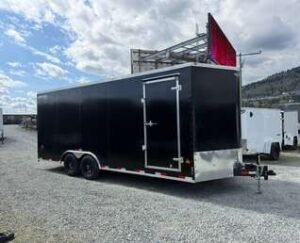
2023 8.5×24 cargo trailer: $8,900
The 8.5×24 cargo trailer has a 24 ft box, an 84 inch interior and a rear ramp. Its listing mentions car enthusiasts and racers among the buyers it suits. Four extra feet over a 20 footer is enough for a proper bench and cabinets. Please confirm its 7,000 lb GVWR with us before you plan your loads.
Used 2023 8.5×16 cargo trailer: $5,100
If budget matters and your car is small, our used 8.5×16 cargo trailer is a sensible start. It has tandem axles and a 2 5/16 inch coupler. An MX-5 at 154.1 inches fits with a little room to spare. Ask us for photos and details of the rear door. Our used trailer guide covers what to check.
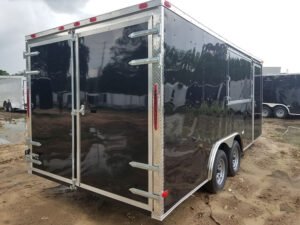
2026 7×16 cargo trailer, ramp door: $7,500
The 7×16 cargo trailer has an 84 inch interior, a ramp door and a 10,141 lb GVWR. As explained above, a 7 ft wide box is tight for most cars, so we only suggest it for narrow cars, karts or a support trailer for wheels, tools and spares alongside an open car hauler.
Open car haulers and tilt decks
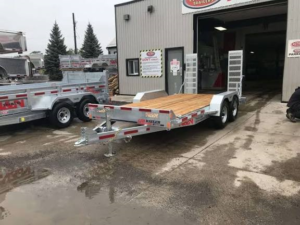
Galvanized car haulers: $5,100 and $6,400
Our galvanized car hauler is a tandem axle open trailer with a 10,000 lb (4,536 kg) GVWR, listed at $5,100. The heavier galvanized car hauler has a 14,000 lb (6,350 kg) GVWR, listed at $6,400. Both have a dovetail at the back to lower the loading angle, and galvanizing helps against rain and road salt. An open race car trailer is lighter, cheaper and easier to tow, but the car arrives with whatever the road threw at it.
Tilt decks for very low cars
A tilt deck race car trailer avoids the steep ramp altogether. The 2026 80×20 galvanized tilt and load has an 80 inch by 20 ft deck and a 14,000 lb GVWR at $7,500. The ETL718-14K has a hydraulic power tilt and a 14,000 lb GVWR at $7,500. The 7×20 tilt and load at $7,800 and the 8×24 tilt and load at $10,900 offer more length and width.
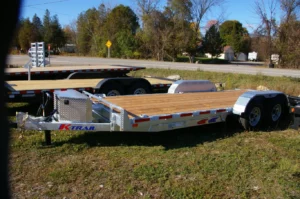
Check the clear width between the fenders on tilt and open trailers against your car’s track and tyre width. An 80 inch or 8 ft deck suits wider cars better. Our tilt trailer guide and car hauler trailer guide have more detail.
Weight: how heavy is a loaded race car trailer?
Add up the car, then everything else. Using the curb weights above, an MX-5 is 2,366 lb and a Corvette Stingray is 3,366 lb. Then add, as rough estimates from us rather than published figures, a few hundred pounds for spare wheels and tyres, a couple of hundred for tools, jacks and stands, and more for fuel, fluids, a canopy, chairs and cabinets. A loaded weekend setup can easily reach 4,000 to 5,000 lb of cargo before the trailer’s own weight.
GVWR is the most the trailer may weigh loaded, including itself. Payload is the GVWR minus the empty weight. An enclosed race car trailer is heavier empty than an open one, so it has less payload at the same rating. Ask us for the empty weight of the exact trailer you want, and do the sum.
Tongue weight
GMC’s tongue weight guide recommends 10 to 15 percent of total trailer weight for a conventional hitch, with about 60 percent of the load in the front half. With a race car, that usually means driving the car in nose first and placing it slightly ahead of the axles, then putting heavy cabinets and spares at the front of the box. A loaded race car trailer weighing 8,000 lb should put about 800 to 1,200 lb on the hitch by that guideline.
Strapping the car down
A race car that shifts inside an enclosed trailer can damage the walls and the car. On an open trailer it can come off altogether. US rules for commercial vehicles make a good benchmark for anyone. Under 49 CFR 393.128, cars and light trucks being carried must be restrained at both the front and the rear with at least two tiedowns.
- Use four straps, one at each corner, pulling outwards and away from the car.
- Wheel nets or axle straps hold the car by the tyres or suspension, so the car’s springs can move without loosening the straps.
- Avoid strapping to the body, bumpers or thin suspension links.
- Use E-track or floor D-rings in an enclosed trailer.
- Secure everything else. Spare wheels, toolboxes and fuel cans must not slide forward under braking.
- Recheck after the first few miles.
The AAA Foundation for Traffic Safety estimated that road debris was involved in 50,658 police-reported crashes a year in the US between 2011 and 2014, with about 125 deaths a year, and about two-thirds of that debris came from vehicles. Our load securing guide covers straps and anchors.
Setting up the inside of an enclosed race car trailer
The fit-out is what turns a box into a mobile garage. A few principles help, whatever you race.
- Heavy items low and at the front: toolboxes, spare engine parts and fluids.
- Tyre racks on the front wall or overhead keep wheels off the floor.
- A bench across the front gives you a work surface at the track.
- E-track on the walls and floor for straps and hooks.
- Lighting on a battery, plus a shore power inlet if the track has hook-ups.
- Roof vents to move hot air and fumes out.
- Rubber matting near the door to stop slipping when the floor is wet.
Shelving and cabinets add weight, so include them in your payload sums.
Fuel, generators and safety at the track
Race car trailers often carry fuel and a generator, and that needs care. Never run a generator inside the trailer, even with the doors open. The CDC warns that generators should be kept at least 20 feet from windows, doors and vents because of carbon monoxide. Carry it inside, then set it up well away before you start it.
Carry fuel only in approved containers, upright and strapped down, away from anything that could spark, and keep the trailer ventilated. Check the rules at your track and the transport rules where you drive, because limits on how much fuel you can carry vary. Keep a fire extinguisher in the trailer where you can reach it quickly.
Towing a race car trailer
Width and towing rules
An 8.5 ft wide race car trailer is about 102 inches, or 2.59 m. In the US, 102 inches is the standard width limit for vehicles on the National Network of highways under 23 CFR 658.15. In the UK, GOV.UK sets a 2.55 m maximum trailer width for most cars, which is slightly less than an 8.5 ft trailer. Rules vary around the world, so check yours before you buy an 8.5 ft trailer. GOV.UK also says trailers over 750 kg loaded need working brakes.
Licences
In the US, the Federal Motor Carrier Safety Administration requires a Class A commercial licence for combinations with a gross combination weight rating of 26,001 lb or more where the towed unit is rated over 10,000 lb. Our 10,141 lb enclosed trailers are just over that trailer threshold, so check your truck and trailer ratings together, and ask your local licensing authority whether non-commercial use changes anything for you.
Wind and fuel use
An enclosed race car trailer is a tall box, so crosswinds push it around and fuel use goes up compared with an open trailer. Slow down in wind, keep tongue weight in the right range, and leave longer braking distances. Our towing tips cover sway and braking.
Race car trailer features worth paying for
- A ramp door with a low angle, or ramp extensions.
- A side door so you can get in without dropping the ramp.
- E-track and floor D-rings for wheel nets and straps.
- Brakes on both axles and a brake controller.
- Interior lighting, roof vents and a shore power inlet.
- A winch mount at the front.
- A light-coloured exterior keeps the inside cooler in sun, while black looks smart but gets hot, as our 24 ft listing notes.
- A spare wheel and jack rated for the loaded trailer.
Ask us which of these are fitted on the trailer you are looking at.
Using your race car trailer as a pit garage
At many club events there is no garage to rent, so the race car trailer becomes your base for the day. An enclosed box gives you shade in the heat, shelter in the rain and a lockable place for tools when you walk to the drivers’ briefing. With the ramp down, it also makes a level, clean floor to work on.
A few habits make that work better. Park with the ramp door facing away from the wind and the worst of the sun. Unload the car first, then lay out the floor in the same order every time, so you always know where the torque wrench and the tyre gauge are. Keep the fuel and the generator outside, as covered above. If the track has power hook-ups, a shore power inlet lets you run lights and chargers without a generator at all.
Plan the layout before you buy. A 20 ft race car trailer with a 15 ft car inside leaves about 5 ft at the front for cabinets and a bench. On a 24 ft trailer that becomes about 9 ft, which is enough to stand at a bench with the car still loaded. That extra space is worth weighing up before you choose.
Buying a used race car trailer
A used race car trailer can save money, but enclosed trailers hide problems well. Before you buy one, from us or anyone else, check these points.
- Floor: look for soft spots, oil soaking and rot, especially near the ramp and the wheel wells.
- Roof and seams: look for water stains inside, which mean leaks.
- Ramp door: check the springs, hinges and seal, and make sure it lifts and closes without forcing.
- Axles and suspension: uneven tyre wear can mean bent axles or worn spring hangers.
- Tyres: read the date code. Old tyres need replacing even with good tread.
- Brakes and wiring: test every light and the brakes before you tow it home.
- Paperwork: make sure the VIN on the frame matches the title or registration.
Our used 8.5×16 cargo trailer is a good starting point for a small car, and we are happy to send extra photos of anything on this list.
Ordering a race car trailer from us
Buying a race car trailer from us is simple. Choose the model, then contact us with your car, your tow vehicle and where you are. We confirm the specs that matter for your car, such as clear width, door opening, deck height and empty weight, and send you a quote that includes delivery. Tell us your country and we will confirm delivery options and cost, and we will tell you up front if your local width or braking rules mean a different model would suit you better.
If you are not sure which race car trailer fits, send us your car’s measurements and a list of what you bring to the track. We will suggest a size and explain why.
What does a race car trailer cost?
In our range, an open race car trailer starts at $5,100 for the galvanized car hauler. Enclosed trailers start at $5,100 used and $6,500 new for the 8.5×20 with a 90 inch interior, and run to $8,900 for the 8.5×24. Tilt decks run from $7,500 to $10,900. These are listed prices at the time of writing and can change.
Compare that with the value of the car and your time. A trailer that protects a car from stone chips and theft, and lets you arrive with everything you need, earns its keep over a season. In our opinion, buying the longer box is usually worth it, because almost everyone carries more to the track than they planned. Delivery depends on where you are in the world, so ask us for a delivered price.
Three example racers and the trailer we would suggest
A track day driver with an MX-5
You do six to ten events a year and bring a spare set of wheels and basic tools. The 8.5×20 enclosed race car trailer at $6,500 carries the car, wheels and tools with room for a bench.
A club racer with a Corvette
The car is 76.1 inches wide and heavier. An 8.5 ft wide box is a must. The 8.5×20 enclosed car trailer or the 8.5×24 gives room to open the doors and work around it.
An autocrosser on a budget
You run local events in fair weather and want the lightest, cheapest option. The galvanized car hauler with its dovetail, or a galvanized tilt for a very low car, does the job.
Common mistakes with a race car trailer
- Buying too narrow. A 7 ft box is tight for most cars.
- Ignoring the loading angle. Low cars scrape on standard ramps.
- Underestimating weight. Spares, tools and fuel add up fast.
- Strapping to the body. Use wheel nets or axle straps.
- Running a generator inside. Carbon monoxide is a real risk.
- Forgetting width rules. 8.5 ft is over the limit in some countries.
Looking after your race car trailer
- Tires: check pressure and age. NHTSA notes many vehicle makers recommend replacing tires 6 to 10 years after manufacture regardless of tread.
- Bearings and brakes: service them before the season starts.
- Ramp door springs, hinges and seals: check and lubricate.
- Floor: clean up oil and fuel spills promptly.
- Lights and wiring: test every time you hitch up.
- Recalls: US owners can check NHTSA’s recall search.
Our trailer maintenance guide has a full checklist.
Race car trailer buying checklist
- Measure your car’s length, width at the tyres and doors, height and ground clearance.
- List everything you take to the track and estimate its weight.
- Choose enclosed, open or tilt.
- Choose a width that lets you open the doors, usually 8.5 ft for enclosed.
- Choose a length with room for a bench, wheels and cabinets.
- Ask for the deck height and ramp length and check the loading angle.
- Check the payload against your loaded weight.
- Check your tow vehicle’s towing capacity and tongue weight limit.
- Check width, brakes and licence rules where you drive.
For more help, see our cargo trailer guide, trailer size guide and how to choose a trailer.
Frequently asked questions
What size enclosed trailer do I need for a race car?
Most racers choose an 8.5 ft wide enclosed race car trailer, 20 to 24 ft long. A 20 ft box takes most sports cars plus wheels and tools. 24 ft gives room for a proper work area.
Will a car fit in a 7 ft wide enclosed trailer?
Some narrow cars will roll in, but there is usually no room to open the doors. A Corvette Stingray is 76.1 inches wide without mirrors, which leaves almost nothing spare. We suggest 8.5 ft.
How do I load a low car onto a trailer?
Use longer ramps, ramp extensions, a dovetail or a tilt deck to reduce the angle, and consider a winch. Check the car’s clearance against the trailer’s deck height and ramp length first.
Is an open or enclosed race car trailer better?
Enclosed is better for security, weather protection and working at the track. Open is cheaper, lighter and easier to tow. It depends on how often you race and how far you travel.
How many straps do I need for a car on a trailer?
Use four, one at each corner. US cargo rules require cars to be restrained front and rear with at least two tiedowns, and four is the common practice.
Is an 8.5 ft trailer legal everywhere?
No. In the US, 102 inches is the standard width limit on the National Network. In the UK, the limit for most cars is 2.55 m, slightly less than 8.5 ft. Check your local rules.
How much does a loaded race car trailer weigh?
Add the trailer’s empty weight, the car and everything else you carry. An MX-5 alone is 2,366 lb and a Corvette Stingray 3,366 lb. With spares, tools and fuel, a loaded enclosed race car trailer often ends up well above the car’s weight alone, so weigh it on a public scale once it is packed.
Can I fit a kart or a second small vehicle in a race car trailer?
Often, yes, in a 24 ft box. Measure the car and the kart, add space to walk between them, and check the total weight against the trailer’s GVWR. Ask us and we will check the layout with you.
Do I need brakes on a race car trailer?
Almost certainly. Our tandem enclosed trailers are rated over 10,000 lb, and many places require brakes at much lower weights. In the UK, trailers over 750 kg loaded need working brakes.
Do you sell race car trailers outside the US?
Contact us with your country and the model you want, and we will confirm availability, delivery options and anything that needs to change for your local road rules.
Ready to buy your race car trailer?
The right race car trailer gets your car to the track clean, loads without scraping and carries everything you need for the weekend. Measure the car, check the loading angle and choose a box with room to spare. Then browse our enclosed trailers, tilt and load trailers and car haulers, or contact us with your car and setup for a recommendation and quote.
Sources and References
- Kelley Blue Book: 2026 Mazda MX-5 Miata specs
- J.D. Power: 2026 Chevrolet Corvette Stingray specs
- Kelley Blue Book: 2026 Chevrolet Corvette specs
- GMC: Tongue weight
- 49 CFR 393.128 (Cornell LII)
- 23 CFR 658.15: Width (Cornell LII)
- CDC: Carbon monoxide dangers
- AAA Foundation: Crashes involving road debris
- GOV.UK: Towing weight and width limits
- GOV.UK: Towing with a car
- FMCSA: Commercial driver’s license
- NHTSA: Tires
- NHTSA: Recalls