

A car hauler trailer is a flat-deck trailer built to carry a car, truck or SUV, usually on tandem axles with brakes, a dovetail or ramps at the back for loading, and tie-down points sized for vehicles. Choosing one comes down to five things: the weight of your heaviest vehicle, the deck length and the width between the fenders, how low cars get on (ramps, dovetail or tilting deck), open or enclosed, and whether your tow vehicle is rated for the loaded trailer.
As a quick guide, an open tandem car hauler trailer rated around 10,000 lb GVWR handles most cars and small SUVs. A 14,000 lb model suits full-size pickups, heavy electric cars and vehicles with tools and spares on board. An enclosed car trailer protects classic and race cars from weather, stones and prying eyes.
We sell every trailer in this guide, from a $5,100 open car hauler to enclosed and hydraulic tilt models, and we deliver worldwide. Specs and prices come from our own listings. Outside facts link to their source, and where something is our opinion, we say so.

Car hauler trailers we sell at a glance
| Trailer | Type | GVWR | Best for | Price |
|---|---|---|---|---|
| 2026 car hauler trailer | Open, galvanized, dovetail | 10,000 lb | Most cars, light trucks | $5,100 |
| 2026 galvanized car hauler | Open, galvanized, dovetail | 14,000 lb | Pickups, heavy EVs, car plus gear | $6,400 |
| ETL718-10K hydraulic tilt | Open, power tilt deck | 10,000 lb | Low cars, non-runners | $6,900 |
| ETL718-14K power tilt | Open, power tilt deck | 14,000 lb | Recovery, heavier vehicles | $7,500 |
| 8.5×20 enclosed car trailer | Enclosed, rear ramp, 84 in | 10,141 lb | Classic, race and show cars | $8,100 |
| 8.5×24 enclosed trailer | Enclosed, rear ramp, 84 in | 7,000 lb | Car plus tools and tires | $8,900 |
The pairings are our recommendation, based on what we sell and the vehicles buyers tell us about. Always check against the real weight and size of your own vehicle.
What makes a trailer a car hauler
Almost any strong flatbed can carry a car once. What sets a proper car hauler trailer apart is a set of features that make it safe and quick to do over and over:
- Tandem axles with brakes, because even a small car plus the trailer is heavy.
- A deck sized for vehicles: long enough for the car with room to set the weight forward, and wide enough between the fenders for the tires.
- A dovetail, ramps or tilting deck so cars climb on at a shallow angle.
- Tie-down points in the right places: stake pockets, D-rings or rails that suit wheel straps and chains.
- A winch plate at the front for cars that don’t run.
- Removable or drive-over fenders on many models, so you can open the doors once the car is on.
If you want a general-purpose deck for machines and pallets as well, our flatbed trailer guide compares the wider range.
Start with what your vehicle weighs
The first number to check is the vehicle’s curb weight, which is printed on the door-pillar label or in the owner’s manual. Then add anything you’ll carry on the car hauler trailer with it: fuel, spare wheels, tools, a toolbox or a jack.
The trailer’s GVWR is the most it may weigh with everything on it, the trailer included. Payload is GVWR minus the trailer’s empty weight. A steel car hauler trailer often weighs well over 2,000 lb on its own, so ask for the empty weight of the model you’re considering. We’ll give it to you.
Why heavier vehicles need the 14,000 lb hauler
Full-size pickups, large SUVs and many electric cars are heavier than people expect. Battery packs add a lot of weight. If you regularly move trucks or EVs, the extra rating on our 14,000 lb galvanized car hauler leaves headroom instead of running at the limit. For lighter cars and track-day machines, the 10,000 lb car hauler trailer is usually plenty.
Our view: buy for the heaviest vehicle you’re likely to carry in the next few years, not the one you carry today. Many buyers start with a sports car and end up moving a pickup for a friend.
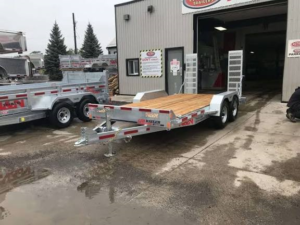
Car hauler trailer deck length and width
Length
Ford’s official 2026 F-150 spec sheet lists an overall length of 209.4 to 243.9 inches, depending on cab and box. That’s about 17.5 to 20.3 ft. A short regular cab fits an 18 ft deck, with a little room left over. A long SuperCrew with a 6.5 ft box, at over 20 ft, overhangs a 20 ft deck. That’s worth knowing before you choose.
Most cars are much shorter than a full-size pickup, so an 18 ft flat deck plus a 2 ft dovetail suits the majority of them. Our car hauler listings describe the deck as “18+2”, which in the trade usually means an 18 ft flat section and a 2 ft dovetail. We’ll confirm the exact measurements of any unit before you buy.
Width between the fenders
On most car hauler trailers, the deck sits between the wheels, so the space between the fenders decides what fits. The same Ford spec sheet gives the F-150’s width as 79.7 to 86.6 in without mirrors. The widest versions are as wide as many car hauler decks, or wider. Measure your vehicle’s track (tire outside to tire outside) and ask us for the clear width of the deck. Drive-over or removable fenders help, because the body and mirrors can sit above them.
If you carry wide trucks often, a deckover, which puts the deck above the wheels, gives you the full width. Our 8×20 deckover trailer and the 102 in deckover work this way, though the higher deck makes the loading angle steeper.
Getting low cars onto a car hauler trailer
On a car hauler trailer, the loading angle is the difference between a smooth load and a cracked front bumper. Here are the main options.
| Loading method | How it works | Best for | Watch out for |
|---|---|---|---|
| Dovetail plus ramps | The rear of the deck slopes down, and slide-in ramps finish the climb | Most cars, everyday use | Very low cars may still need ramp extensions |
| Ramps only | Two ramps on a flat deck | Taller vehicles | Steeper angle, ramps to store |
| Gravity tilt | The whole deck tips when weight passes the pivot | Running cars, quick loading | Deck moves suddenly at the pivot point |
| Hydraulic power tilt | A pump lowers and raises the deck on command | Non-runners, very low cars, recovery | More cost and a battery to look after |
| Enclosed with rear ramp | The rear door folds down as a ramp | Classic and race cars | Ramp angle and door height |
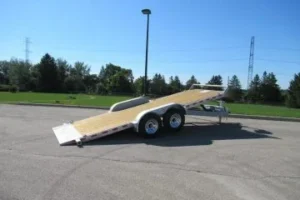
Our view: if you move lowered cars, sports cars or non-runners often, a hydraulic tilt deck is worth the extra money. Our ETL718-10K hydraulic tilt trailer and 22 ft ETL722-14K let you lower the deck, winch the car up slowly, and raise it level. Our tilt trailer guide explains how tilting decks work.
Tips for very low cars
- Use ramp extensions or plank shims to soften the angle at the bottom.
- Watch the point where the ramp meets the dovetail. That’s where front splitters usually catch.
- Winch rather than drive if traction is poor or the clutch is tired.
- Have someone outside watch the front clearance as you climb.
Open or enclosed?
| Open car hauler trailer | Enclosed car trailer | |
|---|---|---|
| Price | Lower | Higher |
| Weight | Lighter, easier to tow | Heavier |
| Protection | Weather, stones and road spray reach the car | Full protection |
| Security | Car is visible | Locked and out of sight |
| Wind and fuel | Less drag | More drag, crosswind sensitive |
| Other uses | Machines, pallets, materials | Mobile workshop, storage, tools |
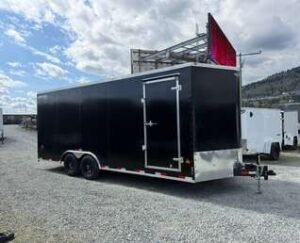
For dealers, recovery work and everyday car moves, an open car hauler trailer is faster and cheaper. For classic, collector and race cars, an enclosed trailer pays for itself in stone chips you never have to fix. Our 8.5×20 enclosed car trailer and 8.5×20 with a 90 in interior suit most cars, and the 8.5×24 leaves room for tires and tools. Our cargo trailer and enclosed vs open trailer guides go into more depth.

Car hauler trailer or tow dolly?
A tow dolly lifts only the front wheels of the car, and the rear wheels roll on the road. It’s cheaper and lighter than a car hauler trailer, and it stores in a small space. But it suits only some cars, puts wear on the car’s rear tires and drivetrain, and can’t carry a vehicle that doesn’t roll freely. Many rear-wheel and all-wheel-drive cars need extra steps, or can’t be dollied at all. Check the vehicle maker’s towing advice.
A car hauler trailer carries all four wheels off the ground. Nothing on the car wears while it travels, you can carry non-runners and damaged cars, and the trailer doubles as an equipment trailer between car moves. Our view: if you’ll move more than one kind of vehicle, or anything you care about, a full car hauler trailer is the better buy.
A car hauler trailer for a small business
For dealers, mechanics, detailers and recovery operators, the trailer is a working tool, so set it up for the jobs you do most. Here’s what we’d suggest. It’s a recommendation, not a rule.
- Rating: 14,000 lb if trucks and SUVs are a regular part of the mix.
- Finish: galvanized, because the trailer will live outside and see salt and grit.
- Winch: an electric winch on the front plate, with a long enough cable to reach the bottom of the ramps.
- Straps: a full set of wheel straps plus spares, because they wear out with daily use.
- Lighting: work lights at the front for loading after dark.
- Toolbox: on the tongue for straps, chocks, gloves and a jack.
- Branding: your name and number on the fenders or a sign on the front rail.
Our 14,000 lb galvanized car hauler trailer is the usual starting point for this kind of use, with a power tilt car hauler trailer for operators who move a lot of non-runners.
Steel, painted or galvanized?
A car hauler trailer spends a lot of its life outside, parked on gravel, splashed with road salt and scraped by tie-down hooks. Painted steel looks sharp when new, but every chip is a place for rust to start. Hot-dip galvanized steel is coated in zinc inside and out, so scratches don’t turn into rust spots nearly as fast.
Both of our open car hauler trailers are galvanized, which is why we recommend them to anyone who stores the trailer outdoors or tows through winter. Our aluminum vs steel trailer guide covers the frame options in detail.
Brakes, tires and running gear
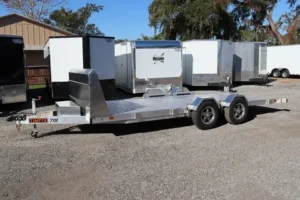
- Brakes on both axles are worth having on any car hauler trailer. A loaded trailer can weigh as much as the tow vehicle.
- Brake controller: electric brakes need one in your tow vehicle, set for the load each trip.
- Breakaway kit: applies the brakes if the trailer separates from the vehicle. Test it regularly.
- Tires: trailer-specific tires with a load rating that covers the GVWR together. Check the date codes, because trailer tires often age out before they wear out.
- Spare wheel: carry one, plus a jack and wrench that fit the trailer.
Rules differ by country. In Great Britain, GOV.UK says a trailer needs a working brake system if it weighs over 750 kg loaded, and sets a maximum trailer width of 2.55 m for most towing vehicles. Every loaded car hauler trailer is well over 750 kg, so brakes are a given there. Tell us where you’ll tow, and we’ll check the width, brakes and lighting of the unit you want against local rules.
Your tow vehicle
Check your vehicle’s handbook or door-pillar label for:
- Towing capacity, compared with the loaded trailer weight.
- Maximum tongue weight and the hitch’s rating.
- Payload, because tongue weight counts against it, along with passengers and gear.
- Gross combined weight rating, the limit for the whole rig.
GMC’s towing guide says a conventional trailer should put about 10 to 15 percent of its loaded weight on the hitch, with roughly 60 percent of the load over the front half of the trailer. On a loaded car hauler trailer at 8,000 lb, that’s about 800 to 1,200 lb on the hitch. That’s why most car haulers are towed with three-quarter-ton or larger pickups. Always go by your own vehicle’s ratings.
Placing the car
Drive the car on nose-first in most cases, because the engine is usually the heavy end. Position it so roughly 60 percent of the combined weight is ahead of the trailer axles. With a rear-engined or mid-engined car, you may need to load it backward to get the balance right. Too little weight on the hitch is the main cause of sway.
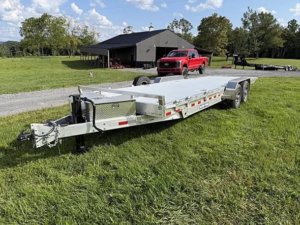
Tying a car down on a car hauler trailer
US federal cargo rules give a clear standard. Under 49 CFR 393.128, cars, light trucks and vans weighing up to 10,000 lb must be restrained at both front and rear with at least two tiedowns, to stop movement sideways, forward, backward and up. Tiedowns fixed to the vehicle must use mounting points designed for that purpose. Straps that hold the wheels must restrain the vehicle in all those directions too.
In practice, most experienced haulers use four points, one at each corner:
- Wheel straps (tire bonnets) over the tires, which let the suspension work and don’t touch the bodywork.
- Axle straps around solid points on the suspension or frame, with a soft sleeve where they touch metal.
- Chains and binders on heavy trucks, attached to the vehicle’s own tow points.
- Parking brake on and the car in gear or park, as a backup, never as the main restraint.
On any car hauler trailer, avoid strapping over suspension arms that move or brake lines, and check every strap after the first few miles. Our guide to securing a load on a trailer covers strap ratings.
The consequences of a poorly secured load are real. The AAA Foundation for Traffic Safety estimates road debris was a factor in an average of 50,658 police-reported crashes a year in the US from 2011 to 2014, and that about two-thirds involved items falling from vehicles, often because loads weren’t properly secured.
Who buys a car hauler trailer, and which one we’d suggest
These are typical buyers we hear from, with our suggestion for each. They’re recommendations, not rules.
Track-day and weekend racers
A light car, a set of spare wheels, a jack and fuel cans. The 10,000 lb car hauler trailer carries all of it. If the car is very low, the hydraulic tilt saves a lot of scraped bumpers.
Classic and collector car owners
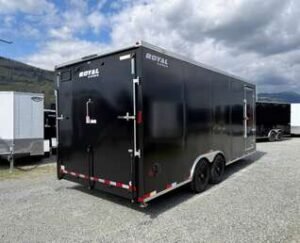
Weather, stones and theft are the worries. The 8.5×20 enclosed car trailer keeps the car covered and locked. The 90 in tall version helps with taller classics.
Dealers and auction buyers
Different vehicles every week, many of them trucks and SUVs. The 14,000 lb galvanized car hauler gives headroom for heavy vehicles and stands up to daily use.
Recovery and breakdown services
Non-runners, accident damage and low cars. A hydraulic tilt deck with a winch is the tool for the job. Look at the ETL718-14K power tilt trailer or the longer ETL722-14K.
Farms and small businesses
A pickup one week, a compact tractor or pallets the next. An open car hauler trailer doubles as an equipment trailer. The 7×20 tilt trailer rated 15,400 lb and the 7×20 equipment trailer are good all-rounders.
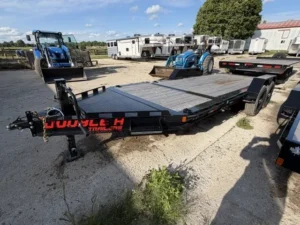
Loading a car hauler trailer step by step
- Hitch the trailer first on level, firm ground, with the tow vehicle’s parking brake on.
- Chock the trailer wheels.
- Set the ramps to the car’s track width, and check they’re seated and pinned.
- Remove or fold the fenders if your trailer allows it and the doors need to clear.
- Drive on slowly and straight, with a spotter outside watching the front and the ramps. Winch if the car doesn’t run.
- Stop with the weight in the right place, roughly 60 percent of the combined load ahead of the axles.
- Parking brake on, car in gear or park.
- Strap all four corners, then tension evenly.
- Stow the ramps and check the lights.
- Re-check the straps after the first few miles.
Towing a loaded car hauler trailer
- Allow more space to stop. The rig may weigh twice what your truck does alone.
- Take corners wider. The trailer wheels cut inside the truck’s path.
- Watch crosswinds, especially with an enclosed trailer.
- If it sways, ease off the accelerator, keep the steering straight, and apply the trailer brakes gently with the controller. Sway usually means not enough weight at the front.
- Check speed limits for towing. Many countries set lower limits for vehicles with trailers.
Our trailer towing tips go into reversing, braking and sway.
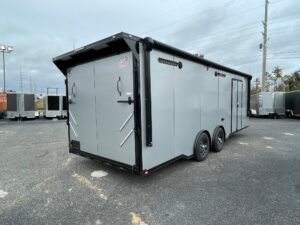

Planning a long-distance car move
- Weigh the loaded rig at a public scale before a long trip, and compare it with the trailer’s GVWR and your truck’s ratings.
- Plan fuel stops that can take a truck and a long trailer. Many small fuel stations are tight to get in and out of.
- Check the route for steep grades, low clearances on enclosed trailers, and any roads that restrict trailers.
- Stop and check the straps after the first 10 to 20 miles, then at every fuel stop.
- Feel the hubs at each stop. A hub much hotter than the others can mean a failing bearing or a dragging brake.
- Carry a kit: spare tire, jack, lug wrench, spare straps, gloves, a torch and a tire pressure gauge.
- Keep the paperwork for both the trailer and the car you’re carrying in the truck.
A typical track day with an open car hauler trailer
To show how the setup works in practice, here’s how a track day might go. It’s an illustration, not a timed test.
- The night before: load the car, a set of spare wheels, a trolley jack and fuel cans. Strap the car at four corners, and strap the wheels and cans down separately.
- On the road: check the straps at the first stop. The car settles on its suspension in the first few miles.
- At the circuit: unload in the paddock, use the trailer deck as a dry place to change wheels, and keep tools in the tongue box.
- Going home: load the car, strap it, check the lights, and drive home without worrying about a tired car or worn tires on public roads.
That last point is why so many track-day drivers buy a car hauler trailer in the first place. The car doesn’t need to be road-legal or road-ready after a hard day.
Licences and commercial use
If you haul cars for money, check the commercial rules where you live. In the US, the Federal Motor Carrier Safety Administration defines a Class A commercial licence as covering a combination with a gross combination weight rating of 26,001 lb or more, where the towed unit is rated over 10,000 lb. A heavy-duty pickup with a 14,000 lb car hauler trailer can approach that range, depending on the truck’s own rating. Other countries have their own licence categories for trailers. Ask your licensing authority what applies to your setup.
Electric vehicles on a car hauler trailer
Electric cars and trucks need a little extra thought. They’re usually heavier than a petrol car of the same size, because of the battery, so check the curb weight on the door-pillar label against the payload of the car hauler trailer you’re looking at. Many EVs also sit low, with the battery forming a flat floor, so the loading angle matters.
- Check the maker’s transport mode. Many EVs have a setting that lets them roll freely or be winched. Read the owner’s manual before loading.
- Use the maker’s tie-down or tow points, or wheel straps. Never strap over the battery pack.
- Consider a tilt deck if the car is low or can’t be driven on.
- Allow for weight. A heavy EV on a 10,000 lb trailer leaves less room for anything else. The 14,000 lb hauler gives more headroom.
Storing and securing the trailer
- Use a coupler lock whenever the trailer is unhitched, and a wheel clamp for long stays.
- Park it where you can see it, or behind a gate. Open flatbeds are easy to hitch up and steal.
- Record the VIN and take photos for insurance.
- Keep the tires off soft ground, and move the trailer every few weeks to avoid flat spots.
- Store the ramps and straps somewhere dry. Straps left in the sun weaken.
- Don’t leave a car on the trailer overnight in a public place unless it’s locked and chained down.
Winter and wet-weather hauling
Ice and rain make loading a car hauler trailer much harder. Wet ramps and wood decks get slippery, and tires spin. Brush snow off the ramps and deck first, and winch the car on if traction is doubtful. On the road, salt spray coats the car and the trailer. That’s another reason galvanized steel is the better choice for winter use, and an enclosed trailer for any car you want to keep clean. Wash the trailer underneath after salty trips, and grease the ramp pins and latches so they don’t seize.
Car hauler trailers for sale
Prices are in US dollars and correct when this was written. Click through for current prices, photos and full specs.
Open car haulers
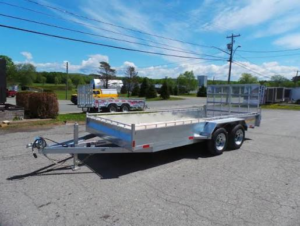
- 2026 car hauler trailer: open, tandem axle, galvanized, silver, deck listed as 18+2, 10,000 lb GVWR, $5,100.
- 2026 galvanized car hauler: open, tandem axle, hot-dip galvanized, silver, deck listed as 18+2, 14,000 lb GVWR, $6,400.
Tilt decks for cars and recovery
- ETL718-10K hydraulic tilt trailer: 7×18, 10,000 lb GVWR, $6,900.
- ETL718-14K power tilt trailer: 7×18, tandem, 14,000 lb GVWR, $7,500.
- ETL722-14K power tilt trailer: 7×22, tandem, 14,000 lb GVWR, $7,600.
- 80×20 galvanized tilt trailer: tandem, hot-dip galvanized, 14,000 lb GVWR, $7,500.
- 7×22 tilt trailer: tandem, steel, black, 15,119 lb GVWR, $6,800.

Enclosed car trailers
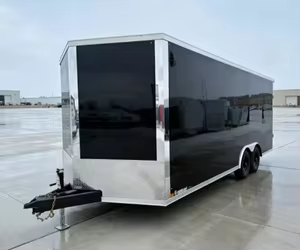
- 2026 8.5×20 enclosed car trailer: tandem, rear ramp, 84 in interior, steel, black, 10,141 lb GVWR, $8,100.
- 2026 8.5×20 cargo trailer: tandem, rear ramp, 90 in interior, steel, black, 10,141 lb GVWR, $6,500.
- 2023 8.5×24 enclosed trailer: tandem, rear ramp, 84 in interior, 7,000 lb GVWR, $8,900.
Equipment trailers that also carry cars
- 2026 7×20 equipment trailer: tandem, steel, black, 10,000 lb GVWR, $4,200.
- 2027 7×18 galvanized equipment trailer: tandem, 7,560 lb GVWR, $4,100.
- 2026 8×20 deckover trailer: tandem, steel, black, 15,400 lb GVWR, $4,200.
Browse every model in our equipment trailers, tilt and load trailers and enclosed trailers categories.
Features worth asking about
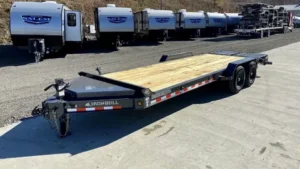
- Dovetail length and whether the ramps slide in under the deck.
- Removable or drive-over fenders.
- Winch plate and whether a winch is included.
- Tie-down layout: stake pockets, D-rings, rub rails or E-track.
- Wood, steel or open-mesh deck. Some car haulers use open channel decks to save weight.
- Brakes on both axles and a breakaway kit.
- Spare tire mount and toolbox on the tongue.
- LED lights, including side markers.
Looking after a car hauler trailer
- Service bearings and brakes on schedule. A car hauler trailer works its running gear hard.
- Check tire pressure before every trip, using the trailer tire’s sidewall figure.
- Inspect the ramps and their pins or latches for cracks and bends.
- Look at the deck for broken boards or cracked welds where wheels land.
- Wash off road salt and mud, especially underneath.
- Check straps and chains for cuts, fraying and worn hooks, and replace them before they fail.
- Test the lights and the breakaway battery.
Our trailer maintenance checklist covers bearings, brakes and tires in more depth.
Buying a used car hauler trailer
- Frame and tongue: cracks around the coupler, spring hangers and dovetail joint.
- Axles: uneven tire wear can mean a bent axle from an overloaded past.
- Brakes: test them with a controller. Check the magnets and wiring.
- Ramps: bent or cracked ramps are a common, sometimes dangerous, problem.
- Deck: rotten or broken boards where the wheels sit.
- Paperwork: make sure the VIN matches and you can register it where you live.
What owning one costs beyond the price
We can’t give exact figures, because they vary so much between countries. Plan for:
- Registration and inspection, where required.
- Insurance for the trailer and for vehicles while they’re carried.
- Straps, chains, binders and wheel chocks.
- A winch, if you’ll move non-runners.
- Tires, bearings and brake parts over time.
- A brake controller and wiring for your truck, if it doesn’t have them.
Against that, owners stop paying for transport companies or rental trailers. Our view is that anyone who moves a car more than a few times a year usually gets their money back faster than they expect. That’s an opinion based on what buyers tell us, not a calculation.
Mistakes we see buyers make
These come from our own conversations with buyers, so treat them as experience rather than statistics.
- Not measuring the space between the fenders. Wide trucks and some sports cars don’t fit.
- Forgetting the trailer’s own weight. GVWR isn’t payload.
- Loading too far back. It takes weight off the hitch and invites sway.
- Strapping over suspension parts that move or brake lines that can be crushed.
- Using car-rated tires instead of trailer tires with the right load rating.
- Buying a 10,000 lb trailer and then moving trucks every week.
Questions to ask before you order
- What’s the deck length, including the dovetail?
- What’s the clear width between the fenders? Are they removable?
- What does the trailer weigh empty, and what’s the payload?
- Brakes on one axle or both? Is a breakaway kit fitted?
- What kind of ramps, and where are they stored?
- Is there a winch plate, and what tie-down points are there?
- What plug does it have, and what does my truck need?
- What paperwork comes with it for registration where I live?
- What’s the delivered price to my address or port?
We’ll answer all of these for any car hauler trailer we sell.
Worldwide delivery
We deliver trailers to customers in many countries. Ask for a delivered quote on each model you’re considering. Tell us where you’ll tow, and we’ll flag any width, brake or lighting points that matter there. We supply the paperwork you need for registration.
Car hauler trailer FAQs
What size car hauler trailer do I need?
Most cars fit an 18 ft deck with a 2 ft dovetail. Long-bed pickups can be over 20 ft long, so they may need a longer deck. Measure your vehicle first.
How much weight can a car hauler trailer carry?
Its payload: GVWR minus the trailer’s empty weight. Our open car haulers are rated 10,000 lb and 14,000 lb GVWR.
Is a 10,000 lb car hauler enough?
For most cars, yes. For full-size pickups, large SUVs and heavy electric cars, the 14,000 lb model leaves more headroom.
Open or enclosed car trailer?
Open is cheaper, lighter and faster to load. Enclosed protects valuable cars from weather, stones and theft.
How many straps do I need to tie down a car?
US federal rules for cars up to 10,000 lb require restraint at the front and rear, with at least two tiedowns. Most haulers use four, one at each corner.
Can I load a car that doesn’t run?
Yes, with a winch. A hydraulic tilt deck makes it much easier and safer.
Does a car hauler trailer need brakes?
Yes, in practice. Loaded car haulers are heavy, and many countries require brakes above a set weight, such as 750 kg in Great Britain.
Do you deliver car hauler trailers outside the US?
Yes, we deliver worldwide. Ask for a delivered quote.
Find your car hauler trailer
Tell us what you’ll carry, how heavy it is, and what you tow with, and we’ll recommend the car hauler trailer that fits. Browse our equipment trailers, tilt and load trailers, enclosed trailers and used trailers, or see everything in the shop. For more background, read our guides to trailer sizes, tandem vs single axle and how to choose a trailer. Questions? Contact us.