
A tandem axle trailer has two axles mounted close together instead of one, so the load is shared across four wheels. Compared with a single axle trailer, it carries more weight, tracks straighter at speed, copes better if a tyre fails and usually comes with brakes. A single axle trailer is lighter, cheaper to buy and run, easier to move by hand and turns more tightly. If your loads stay under roughly 3,000 to 3,500 lb (about 1,400 to 1,600 kg) and your trips are short, a single axle is usually enough. If you carry machines, heavy materials or long loads, or tow on fast roads, a tandem axle trailer is usually the better buy.
That’s the short answer. This guide explains why, with real numbers from the 50 single and tandem trailers in our own range, the brake rules that often apply to heavier trailers, what each setup costs to run, and which one suits your kind of work. Where something comes from an official source we link to it; where it’s our opinion from selling trailers, we say so.
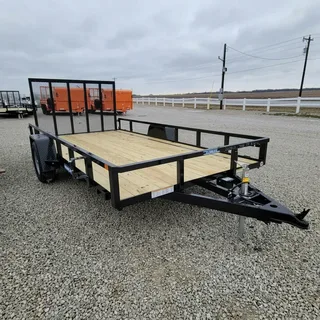
Tandem axle trailer vs single axle: the quick comparison
| Single axle | Tandem axle trailer | |
|---|---|---|
| Typical GVWR in our range | About 3,000 to 3,500 lb (tilt models up to 7,000 lb) | About 7,000 lb to 15,400 lb, heavy deckovers far more |
| Wheels and tyres | 2 | 4 |
| Stability at speed | Good when loaded well | Better, steadier |
| If a tyre fails | Trailer drops on that side | The other tyre on that side helps hold it up |
| Brakes | Often none on light models | Usually fitted |
| Tight turns | Turns easily | Tyres scrub on very tight turns |
| Moving by hand | Often possible | Usually not practical |
| Running costs | Lower | Higher: twice the tyres, bearings and brakes |
| Purchase price | Lower | Higher, but often similar or better per lb of capacity |
The GVWR ranges come from our current product listings. The handling and running-cost rows are general trailer knowledge and our experience, explained in more detail below.
What is a tandem axle trailer?
“Tandem” simply means two axles, one behind the other, close together under the middle of the trailer. On most tandem axle trailers the springs on each side are linked by an equaliser, a pivoting link that lets the two axles share bumps and weight between them. A trailer with three axles is called a tri-axle; our tri axle tilt trailer is one, rated at 22,679 lb.
A single axle trailer has one axle and two wheels, usually set just behind the middle of the deck so that some of the weight sits on the hitch. Most small utility, garden and cargo trailers are single axle; most trailers 14 ft and longer are tandem.
The choice between a single and a tandem axle trailer is one of the first decisions you make when buying, and it shapes almost everything else: how much you can carry, what you can tow it with, whether it needs brakes and what it costs to run.
Capacity: how much more a tandem axle trailer carries
The biggest reason people buy a tandem axle trailer is capacity. Two axles spread the load over four tyres, so the trailer can be rated much higher. You can see it clearly in our own range. This is our own count of our current listings, using the GVWR printed in each product’s specs:
| Trailer | Axles | GVWR |
|---|---|---|
| 5×8 utility trailer | Single | 2,990 lb |
| 5×10 utility trailer | Single | 3,500 lb |
| 6×12 enclosed cargo trailer | Single | 2,990 lb |
| 6×12 tilt trailer | Single | 5,000 lb |
| 7×14 utility trailer | Tandem | 7,000 lb |
| 7×14 enclosed trailer | Tandem | 7,055 lb |
| 7×18 utility trailer | Tandem | 9,900 lb |
| 7×14 cargo trailer | Tandem | 10,141 lb |
| Heavy duty equipment trailer | Tandem | 15,400 lb |
| 30 ft deckover trailer | Tandem | 35,250 lb |
Across our range, most single axle utility and cargo trailers are rated at about 3,000 to 3,500 lb, while our tandem axle trailers start around 7,000 lb and go up from there. Notice that the 7×14 enclosed box comes in two tandem versions, one at 7,055 lb and one at 10,141 lb. Axle and tyre ratings matter, not just the number of axles.
Two axles don’t simply double capacity
It’s tempting to think a tandem axle trailer with two 3,500 lb axles can carry 7,000 lb of cargo. It can’t. The GVWR covers the trailer itself plus its load, and the maker sets it by considering the axles, tyres, frame, coupler and everything else. Part of the weight also sits on the hitch rather than the axles. So always work from the GVWR on the plate, and subtract the trailer’s empty weight to find your real payload.
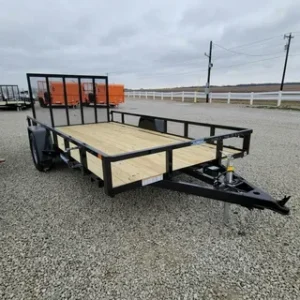
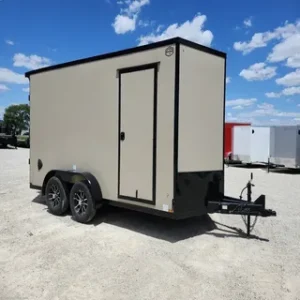
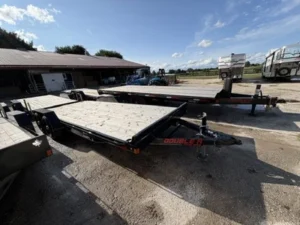
Not sure what deck length you need before choosing axles? Our trailer size guide walks through length, width, height and weight for common loads.
Stability and safety on the road
Ask anyone who tows for a living and they’ll tell you a tandem axle trailer feels calmer at speed. With two axles spaced apart, the trailer has more tyre contact and is less inclined to pitch over bumps or wander in crosswinds. Loaded properly, both types are safe, but a tandem gives you more margin when something goes wrong. That’s our experience and the general view among trailer users, not a measured study.
If a tyre fails
This is the safety point that matters most. On a single axle trailer, a blowout drops that side of the trailer onto the rim, and the trailer can pull hard to one side. On a tandem axle trailer, the other tyre on the same side carries the load for long enough to pull over safely. It isn’t something to rely on for long, but it can turn a dangerous moment into an inconvenience.
Sway
Sway is mainly about loading, not axles. Whatever you tow, keep the heavy part of the load slightly forward of the axles. For a standard ball hitch, the Manitoba Public Insurance trailer safety guide says tongue weight should be about 10 to 15 percent of the loaded trailer’s weight. A tandem axle trailer is a bit more forgiving of small loading mistakes, but it won’t save a badly loaded trailer. Our guide to securing a load covers placement and tie-downs in detail.
Brakes: why heavier tandem axle trailers usually have them
Rules on trailer brakes vary around the world, but most places require brakes once a trailer passes a certain loaded weight. A few official examples:
- United Kingdom: GOV.UK says a trailer must have a working brake system if it weighs over 750 kg when loaded (GOV.UK: trailer and towing equipment).
- South Australia: the state government says trailers must be fitted with brakes if the gross trailer mass exceeds 750 kg, and that above 2 tonnes the braking system must have a breakaway system (Government of South Australia: light vehicle towing regulations).
- Manitoba, Canada: the Manitoba Public Insurance guide says trailers with a registered gross vehicle weight over 1,360 kg (2,998 lb) must have brakes, and that trailer brakes should have a breakaway device.
These are examples only; check the rules where you live. The practical point is this: almost every tandem axle trailer in our range is rated well above those thresholds once it’s loaded, so brakes come with the territory. Many small single axle trailers are rated below them and are sold without brakes. If you’ll tow near the limit, or tow in a place with a low brake threshold, factor brakes, a brake controller and the wiring into your budget.
Towing and handling
On the road
A tandem axle trailer tracks straighter and rides more smoothly, especially when lightly loaded or empty, when a single axle trailer can bounce. On long trips and fast roads, most people find a tandem far less tiring to tow.
Tight turns and parking
Here the single axle wins. When a tandem axle trailer turns very tightly, the tyres are dragged sideways because the two axles can’t both follow the curve. You’ll hear and see it as tyre scrub, and it wears tyres faster if you do it all the time. On normal roads it doesn’t matter, but if you constantly manoeuvre in tight yards, driveways or job sites, keep it in mind.
Reversing
People often say longer trailers are easier to reverse than very short ones, because they react more slowly to steering, and most tandem axle trailers are longer. Whatever you tow, practise in an empty car park first; our trailer towing tips explain the hand-at-the-bottom-of-the-wheel trick.
Moving the trailer by hand
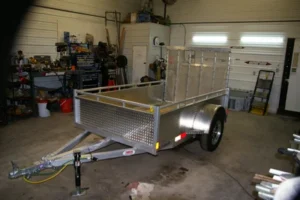
Small single axle trailers balance on one axle, so one person can often lift the tongue and wheel them around a yard or garage. A tandem axle trailer sits on four wheels and resists being turned by hand. If you’ll store the trailer in a tight space and move it without a vehicle, a light single axle model like the 5×8 aluminum trailer or lightweight utility trailer is far easier.
Tyres, bearings and running costs
A tandem axle trailer has four wheels instead of two, so it has twice the tyres, twice the wheel bearings, and often twice the brakes to look after. That’s the main extra cost of owning one.
- Tyres: NHTSA tire safety guidance recommends checking tyre pressure at least once a month when the tyres are cold, and warns that tyre aging can’t be detected by looking and that some manufacturers recommend replacing tyres six to 10 years old regardless of tread. On a tandem, that’s four tyres to check and eventually replace, plus a spare.
- Bearings: axle maker Dexter’s light duty axle service manual says bearings should be lubricated every 12 months or 12,000 miles. With four hubs instead of two, a full service takes longer and costs more.
- Brakes: the same manual lists brake adjustment at 200 and 3,000 miles for electric brakes. More axles with brakes means more to adjust.
- Wheel nuts: Dexter lists wheel nut torque checks at 10, 25 and 50 miles after fitting wheels. Sixteen or more nuts on a tandem instead of eight or ten on a single.
None of this is difficult, and our trailer maintenance checklist walks through it, but it’s fair to say a tandem axle trailer costs a little more each year to keep in top shape.
Price: is a tandem axle trailer worth the extra money?
A tandem axle trailer costs more than a single axle trailer, because it has more parts and is usually bigger. But the more useful question is what you pay for each unit of capacity. To answer that properly, we compared pairs from our own current listings, dividing each trailer’s price by its GVWR. This is our own analysis of our own prices, which change over time, so read the results as a guide:
| Comparison | Single axle | Tandem axle | Price per lb of GVWR, tandem vs single |
|---|---|---|---|
| Steel utility | 5×10 utility trailer, 3,500 lb | 7×14 utility trailer, 7,000 lb | About the same |
| Aluminum utility | 5×10 aluminum trailer, 2,996 lb | 7×16 aluminum trailer, 7,010 lb | About 23% lower for the tandem |
| Enclosed cargo | 6×12 enclosed cargo trailer, 2,990 lb | 7×14 enclosed trailer, 7,055 lb | About 33% lower for the tandem |
In other words, in our range, you pay more in total for a tandem axle trailer but you don’t pay more for the capacity, and in two of the three pairs you pay noticeably less per pound of rating. The trailers in each pair also differ in size, so this isn’t a perfect like-for-like comparison, but it shows that a tandem isn’t the luxury many buyers assume. If you’re anywhere near the limit of a single axle trailer, the step up is often good value.
Empty weight and payload
A tandem axle trailer weighs more empty, because it has an extra axle, two more wheels and usually a longer frame. That eats into your payload a little and adds to what your vehicle has to pull. Before you buy, check:
- The trailer’s GVWR.
- Its empty weight.
- GVWR minus empty weight: that’s your real payload.
- Your vehicle’s towing limit, which must be higher than the loaded trailer.
- Your vehicle’s payload, because tongue weight counts against it.
Ask us for the empty weight of any trailer we sell and we’ll give it to you. Our guide on how to choose a trailer explains towing limits in more detail.
Storage, parking and size
Most tandem axle trailers are longer, and length is what usually causes storage problems. Measure your driveway, side passage or garage before you choose. A 7×14 tandem fits most driveways; a 20 ft or longer deck often doesn’t fit behind a house gate. If you’re tight on space and your loads are light, a single axle trailer can live where a tandem never will.
What about tri-axle trailers?
For very heavy loads there are tri-axle trailers. They carry even more weight, spread it further, and are steadier still, but they scrub tyres more on tight turns and cost more to maintain. Our tri axle tilt trailer is an 8×24 rated at 22,679 lb, built for mid-size machines. For most buyers a tandem axle trailer is the sweet spot; a tri-axle only makes sense when your loads really need it.
Tandem axle trailer or single axle: which one for your work?
Homeowners and garden jobs
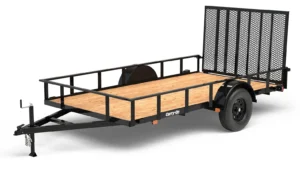
For tip runs, garden waste, a push mower and furniture, a single axle trailer is usually all you need. It’s cheap, light and easy to store. The 5×8 utility trailer and 5×10 utility trailer are our most popular starting points, and the 5×10 aluminum trailer is a rust-free alternative. See all lawn and garden trailers.
Landscapers
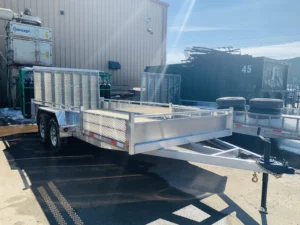
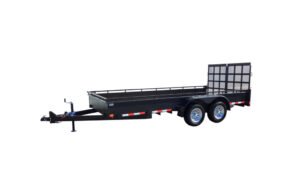
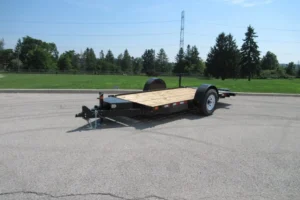
Once you carry a ride-on mower plus tools, or a zero-turn and a push mower, you’ll soon outgrow a single axle. A tandem axle trailer like the 7×14 utility trailer, 7×16 aluminum trailer or 7×18 utility trailer gives you room and capacity for a full day’s kit. A single axle tilt such as the 6×14 tilt trailer suits one-machine jobs.
Trades and enclosed cargo
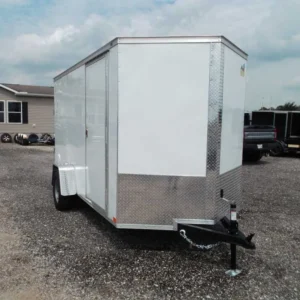
A single axle 6×12 box like the 6×12 enclosed cargo trailer is fine for a one-person trade with hand tools. If you carry heavy tool chests, generators or stock, step up to a tandem axle trailer such as the 7×14 enclosed trailer, the higher-rated 7×14 cargo trailer or the 7×16 enclosed trailer. See all enclosed trailers.
Machines and equipment
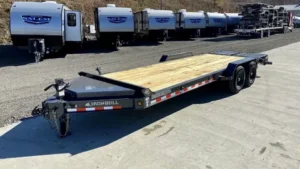
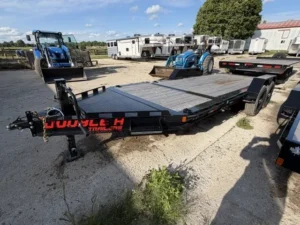
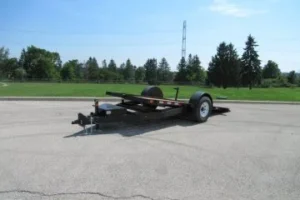
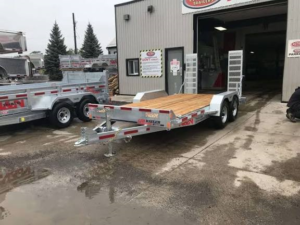
For skid steers, mini excavators and compact tractors, a tandem axle trailer is the standard, and almost every equipment trailer we sell is tandem. Look at the 7×20 equipment trailer, heavy duty equipment trailer, 7×20 tilt trailer and 20 ft deckover trailer. Small garden tractors can go on a single axle tilt like the 7000 lb tilt trailer. See all equipment trailers and tilt and load trailers.
Dump work
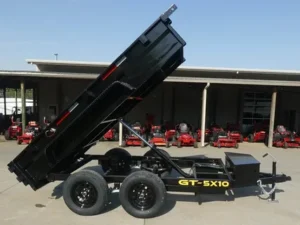
Gravel, soil and rubble are heavy, so dump trailers are almost always tandem. Even our smallest, the 5×10 dump trailer, is a tandem axle trailer rated at 7,700 lb. Bigger jobs suit the 83×14 dump trailer or the galvanized 16 ft dump trailer. See all dump trailers.
Cars and car hauling
Cars are heavy and long, so car haulers are tandem by default. Our car hauler trailer is rated at 10,000 lb and the galvanized car hauler at 14,000 lb; the enclosed car trailer is a 10,141 lb tandem box.
Snowmobiles and ATVs
One sled or one quad can go on a small single axle trailer. For two or more sleds plus gear, especially on long winter drives, a tandem axle trailer is steadier and safer. All our sled trailers are tandem: the aluminum snowmobile trailer, 7×25 snowmobile trailer and used snowmobile trailer.
Horses
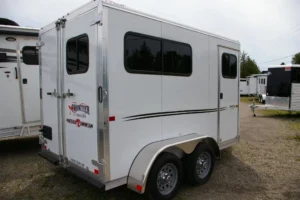
Live animals shift their weight and need a smooth ride, so horse trailers that carry two or more horses are normally tandem. Look at the 2 horse trailer, 3 horse trailer or straight load horse trailer, all rated at 7,000 lb; ask us to confirm the axle setup on any model. See all horse trailers.
When a single axle trailer is the smarter buy
We sell plenty of tandem axle trailers, but we’d steer you to a single axle when:
- Your heaviest regular load is well under the single axle trailer’s payload.
- Most trips are short and local, at lower speeds.
- You need to move the trailer by hand or store it in a small space.
- Your tow vehicle is small and every kilo of trailer weight counts.
- You want the lowest purchase price and the lowest running costs.
- You’d rather avoid brakes and the extra wiring and controller they need, and your loads keep you under the brake threshold where you live.
A good single axle trailer, used within its rating, is a perfectly safe and practical tool. There’s no point paying for and maintaining a tandem axle trailer you don’t need.
When a tandem axle trailer is worth it
- You regularly carry 2,500 lb (about 1,100 kg) or more of cargo.
- You carry machines, heavy materials, cars or several animals.
- You need a deck longer than about 14 ft.
- You tow on fast roads or long distances.
- You want the extra safety margin if a tyre fails.
- Your loads will grow, so you’d rather buy once.
That 2,500 lb figure is our rule of thumb, not an official limit. It leaves a safety margin below the roughly 3,000 to 3,500 lb ratings of typical single axle utility trailers once you allow for the trailer’s own weight.
The other big choice is body style; our enclosed vs open trailer guide covers it.
Leaf springs or torsion axles?
Once you’ve decided on two axles, the next choice is suspension. Most work trailers use leaf springs: stacks of curved steel strips bolted to the axle, with an equaliser between the front and rear springs on each side. They’re simple, cheap, easy to repair almost anywhere, and they spread bumps between the two axles. Many horse, cargo and some utility trailers use torsion axles instead, where rubber cords inside the axle tube act as the spring. Torsion axles give a smoother, quieter ride and need less greasing, but each wheel works independently and a worn torsion axle is replaced rather than repaired.
Neither is wrong. For rough job sites and heavy machinery, leaf springs are the common choice. For horses and fragile cargo, many owners prefer the smoother ride of torsion. Ask which suspension any trailer uses before you buy.
Tyres on a tandem: load ratings matter
Every tyre has a load rating moulded into the sidewall, and on a tandem the four tyres together have to carry the axle load comfortably. When you replace them, match or exceed the original load rating, keep all four the same type and size, and set the pressure from the trailer’s label or manual rather than the maximum printed on the tyre. NHTSA warns that under-inflation can lead to a flat, a blowout or the tread coming off, and that under-inflated tyres are hard to spot by eye, so a gauge is worth more than a glance. Uneven wear between the front and rear tyres on one side is a sign to check the axle alignment and equaliser.
Three typical buyers
These are made-up examples to show how the decision usually goes, not real customer stories.
A homeowner with a garden and a small SUV
Loads: garden waste, a push mower, the odd piece of furniture. Heaviest load maybe 600 lb. Tow vehicle limit: around 3,500 lb. A single axle 5×8 utility trailer or 5×8 aluminum trailer does everything needed, costs least and fits in the garage. A tandem would be wasted money.
A landscaper with two mowers
Loads: a zero-turn, a push mower, trimmers, fuel and a pallet of slabs now and then. Heaviest load around 2,800 lb. Tow vehicle: a pickup rated for 8,000 lb. That load is too close to a single axle trailer’s limit once the trailer’s own weight is added, so a tandem axle trailer such as the 7×14 utility trailer or 7×16 aluminum trailer is the better buy.
A contractor with a mini digger
Loads: a 3.5 tonne excavator plus buckets. Tow vehicle: a 1-ton pickup. Only a heavy tandem will do: the heavy duty equipment trailer rated at 15,400 lb or the 7×20 tilt trailer, also 15,400 lb, with brakes on both axles.
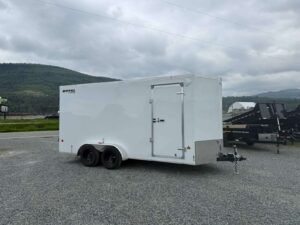

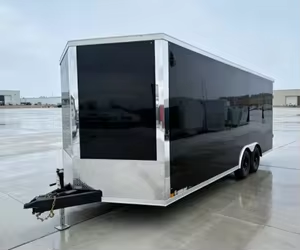
Loading a tandem the right way
On a tandem, the axles sit near the middle of the deck. Put the heaviest part of the load just ahead of the front axle, then spread the rest evenly side to side. That keeps the right share of weight on the hitch and stops one axle doing all the work. Lighter, bulky items can go behind the axles. After loading, the trailer should sit level or very slightly nose-down when hitched; if the back sags, the load is too far rearward. Once it’s balanced, strap everything down properly.
A quick scorecard
Tick each statement that’s true for you:
- My heaviest load is over 2,500 lb (about 1,100 kg).
- I’ll carry a machine, a car or more than one animal.
- I need a deck longer than 14 ft.
- I’ll often tow on fast roads or long trips.
- I have room to park a longer trailer.
- My vehicle can tow 7,000 lb or more.
Three or more ticks: a tandem axle trailer is probably right for you. Zero to two: a single axle trailer will likely do the job for less. This is our rule of thumb, so call us if you’re unsure.
Common mistakes when choosing axles
- Buying for today only. Many people buy a single axle trailer, then add a ride-on mower or a second machine a year later and outgrow it. If your loads are growing, buy the bigger trailer once.
- Ignoring the empty weight. A heavy trailer can leave less payload than you expect. Always do the GVWR minus empty weight sum.
- Forgetting the tow vehicle. A tandem axle trailer rated at 10,000 lb is no use if your vehicle can only tow 5,000 lb. Match the trailer to the vehicle, not the other way round.
- Skipping the brake budget. Brakes, a controller and 7-pin wiring add to the real cost of a heavier trailer.
- Not measuring the parking space. Longer tandems often don’t fit where the old single axle lived.
- Choosing on price alone. Price per pound of capacity is a better measure than the sticker price, as our comparison above shows.
How long do tandem trailers last?
There’s no official lifespan for a trailer, single or tandem, because it depends almost entirely on how it’s used and looked after. In our experience, a well-maintained trailer that’s loaded within its rating, washed after salty trips and serviced every year can give many years of work, and frames often outlast several sets of tyres and bearings. The parts that wear on a tandem axle trailer are the same as on a single axle, there are just more of them: tyres, bearings, brake parts, spring bushes and equaliser pivots. Replace those as they wear and the trailer keeps going.
Material matters too. Galvanized and aluminum frames resist rust better than painted steel, which is a big part of why they hold their value. Our aluminum vs steel trailer guide covers that in depth, and the trailer maintenance checklist gives a full service routine.
Buying a used tandem axle trailer
A used tandem axle trailer can be great value, but check everything twice, because there’s twice as much running gear. Spin and rock every wheel to feel for bearing play, check the date code on all four tyres, look at the springs, equaliser and hangers for cracks or wear, and test the brakes on every wheel. Uneven tyre wear between the front and rear axles can point to a bent axle or a worn equaliser. Our current used stock includes the used deckover trailer, used gooseneck tilt trailer and used cargo trailer, all tandems. See all used trailers.
Tandem axle trailer myths
“Two axles double the capacity”
No. The GVWR is set by the maker for the whole trailer. Work from the plate, not the axle count.
“A tandem can’t sway”
Any trailer can sway if it’s loaded tail-heavy. A tandem axle trailer is more forgiving, not immune.
“Single axle trailers are unsafe”
Not when they’re loaded within their rating and maintained. Millions of single axle trailers do safe, useful work every day.
“A tandem is always too expensive”
In our own listings, price per pound of capacity is about the same or lower for tandems. You pay more in total, but you get a lot more trailer.
For very heavy trailers, the hitch style matters too; see our gooseneck vs bumper pull comparison.
Getting your vehicle ready for a heavier trailer
Moving from a small single axle to a tandem axle trailer often means upgrading the tow vehicle setup too. Before your first trip, check these:
- Towing limit: your vehicle’s limit must be higher than the loaded trailer’s weight, with some margin.
- Hitch rating: the receiver, drawbar and ball all need ratings above the loaded trailer. Use the lowest of the three.
- Ball size: heavier trailers often use a 2 5/16 in coupler. The ball must match exactly.
- Brake controller: trailers with electric brakes need a controller in the cab. Set it so the trailer brakes slightly before the vehicle.
- Wiring: braked trailers usually need a 7-pin connector rather than a basic 4-pin.
- Breakaway system: where required, it applies the trailer brakes if the trailer separates from the vehicle. South Australia, for example, requires one on trailers over 2 tonnes (SA Government towing regulations).
- Mirrors: GOV.UK notes you should fit suitable towing mirrors if the trailer is wider than the rear of your car (GOV.UK), and many other places have similar rules.
Getting this right once makes every tandem axle trailer trip easier and safer.
Questions to ask before you buy
- What’s the GVWR, and what’s the empty weight?
- What are the axle ratings, and what are the tyre load ratings?
- Does it have brakes on one axle or both? Electric or surge?
- Is there a breakaway system?
- What suspension does it use: leaf springs with an equaliser, or torsion axles?
- What coupler size does it take?
- How long is the trailer overall, including the tongue?
We’ll answer any of these for any trailer we sell. Answering them honestly is the quickest way to decide between a single and a tandem axle trailer for your situation.
Delivery worldwide
We sell single and tandem axle trailers to customers in many countries. Tell us where you are and we’ll quote delivery to your door, a depot or the nearest port. For overseas buyers, ask for the trailer’s shipping dimensions too, because a long tandem axle trailer may need a larger container or a flat rack, and that affects the delivery cost.
Our honest recommendation
Buy the trailer your heaviest regular load needs, plus some room to grow. For light, local work, a single axle trailer is cheaper to buy, cheaper to run and easier to live with. For machines, heavy materials, long decks, animals or fast roads, a tandem axle trailer gives you more capacity, more stability and more safety margin, often for about the same price per pound of capacity. This is our opinion from selling both, and your own loads and budget should make the final call.
Tandem axle trailer: questions people ask
What is a tandem axle trailer?
A tandem axle trailer has two axles mounted close together, usually linked by an equaliser so they share the load. It carries more weight and tows more steadily than a single axle trailer.
How much can a tandem axle trailer carry?
It depends on the model. In our range, tandem axle trailers start around 7,000 lb GVWR and go up to 15,400 lb for equipment trailers, with heavy deckovers over 30,000 lb. Subtract the empty weight from the GVWR to find the payload.
Is a tandem axle trailer safer than a single axle?
Both are safe when loaded and maintained properly. A tandem is steadier at speed and gives you more margin if a tyre fails, because the other tyre on that side helps carry the load.
Do tandem axle trailers need brakes?
Usually, because their loaded weight is above the brake thresholds in many places, for example 750 kg in the UK and South Australia and 1,360 kg in Manitoba, Canada. Check your local rules.
Are tandem axle trailers harder to turn?
On very tight turns the tyres scrub sideways, which wears them faster. On normal roads it isn’t a problem. Tandems are also harder to move by hand.
Does a tandem axle trailer cost more to maintain?
Yes, a little: four tyres, four hubs and often four brakes instead of two. Dexter recommends lubricating bearings every 12 months or 12,000 miles, so a tandem service takes longer.
Is a single axle trailer enough for a ride-on mower?
Often yes, if the mower plus tools stay well under the trailer’s payload. If you carry two machines or a compact tractor, a tandem axle trailer is the safer choice.
Can I upgrade a single axle trailer to tandem?
It’s rarely worth it. The frame, coupler and rating are designed around one axle. Buying the right trailer is usually cheaper and safer.
Shop single and tandem axle trailers
Whichever you choose, we have both for sale and we deliver worldwide. For light jobs, browse our single axle utility trailers and lawn and garden trailers. For heavier work, every tandem axle trailer we sell is in the equipment, enclosed, dump, tilt and load, snowmobile and horse trailer sections, or see everything in the shop. Not sure? Contact us with what you carry and what you tow with, and we’ll suggest the right trailer. You may also find our aluminum vs steel trailer guide and our article on the types of trailers useful.
Sources and References
- GOV.UK: Towing with a car, trailer and towing equipment (brakes over 750 kg, towing mirrors)
- Government of South Australia: Light vehicle towing and trailer regulations (brakes over 750 kg, breakaway over 2 tonnes)
- Manitoba Public Insurance: Trailer Safety guide (brakes over 1,360 kg, tongue weight, breakaway)
- NHTSA: Tires (pressure checks and tire aging)
- Dexter: Light Duty 600-8K Axle Complete Service Manual (bearing, brake and wheel nut intervals)