
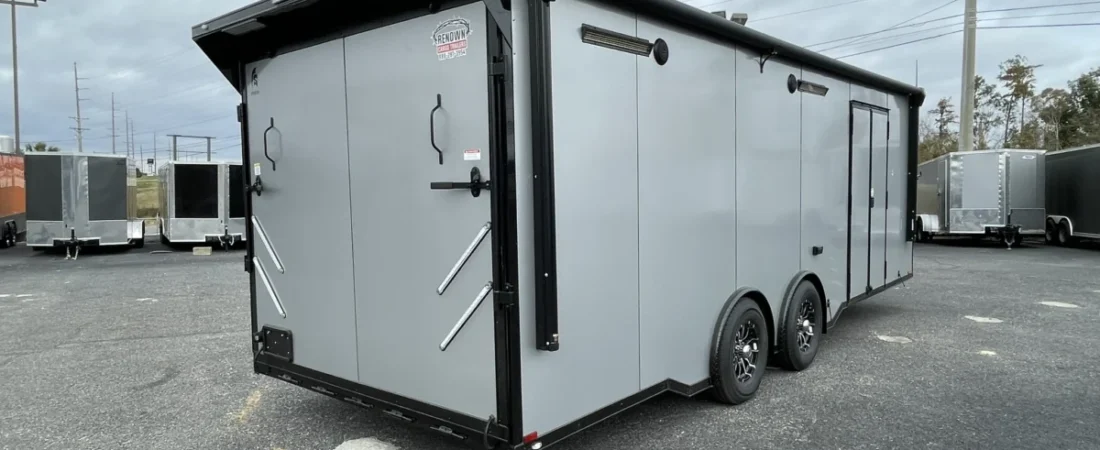
Looking for a contractor trailer? Here is the short answer. Most tradespeople are best served by an enclosed cargo trailer between 6×12 and 7×16, with an 84 inch interior height and a tandem axle rated around 7,000 to 10,000 lb. That gives you a lockable mobile workshop with room for shelving, tools and a day’s materials. Crews hauling bulk materials or machines need an open utility or dump trailer as well. We sell all of these, from a 7×14 open utility trailer at $2,200 to 7×16 enclosed cargo trailers and dump trailers.
This guide explains how to choose a contractor trailer by trade, payload and tow vehicle, with real specs and our current prices.
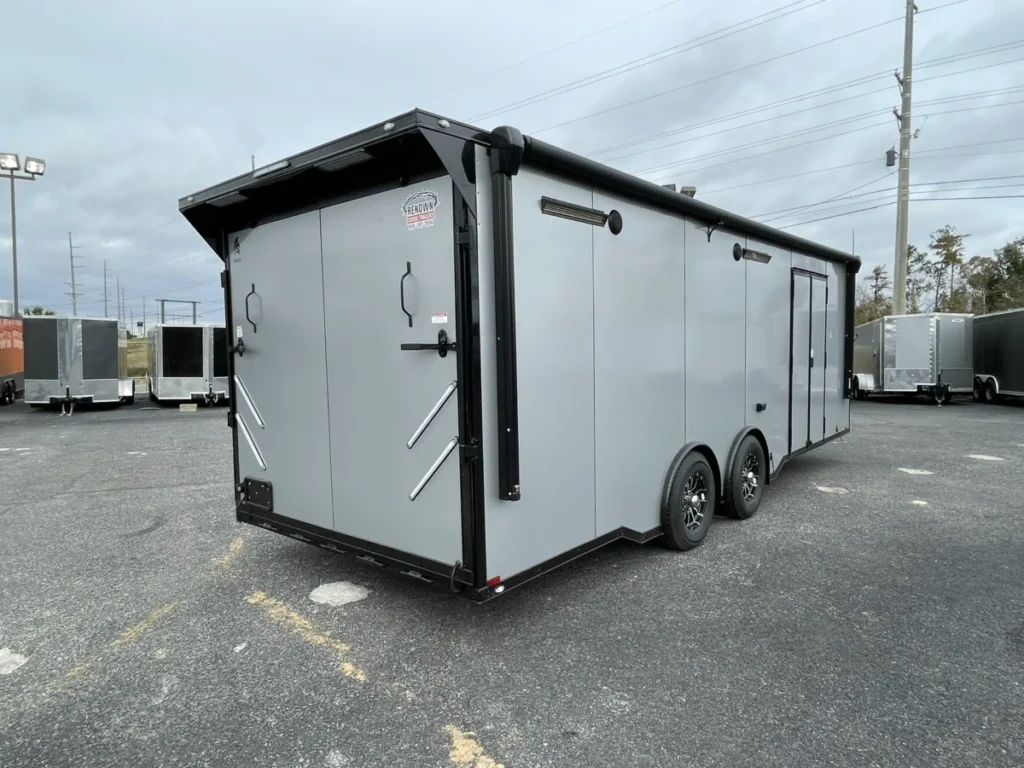
A contractor trailer earns its money in a different way from a weekend trailer. It gets loaded and unloaded every day, it sits on job sites overnight, and it has to carry heavy, awkward things: sheet goods, bagged materials, compressors, generators and boxes of fixings. Pick one that is too small or too lightly rated and you will feel it every single day, in wasted trips, sagging springs and tools you cannot find.
So rather than repeat a generic size chart, this guide works through the real weights of common building materials, the interior dimensions that matter for different trades, and the trailers in our enclosed trailer, utility trailer and dump trailer ranges.
Key takeaways before you buy a contractor trailer
- Enclosed is the default for most trades. It locks, keeps tools dry and doubles as a site workshop.
- Payload decides the axle. A 2,990 lb GVWR single axle trailer runs out of capacity fast once materials go in. Tandem trailers rated around 10,000 lb give real headroom.
- Interior height matters. 84 inches lets most people stand up and work inside. 78 inches is fine for storage but tight for working.
- Materials are heavy. A US bag of Portland cement is 94 lb, so 30 bags is already 2,820 lb.
- Plan the layout before you order. Shelving, ladder racks and door choice change which size works.
Contractor trailers we sell right now
Every contractor trailer below is listed in our shop with a price. Prices are the current listed prices and can change, so check the product page or contact us for a quote before you order.
| Trailer | Floor size | Inside height | Rear door | GVWR | Price |
|---|---|---|---|---|---|
| 2027 6×12 cargo, single axle | 6 x 12 ft | 78 in | Barn doors | 2,990 lb | $2,900 |
| 2026 6×10 aluminum cargo | 6 x 10 ft | 78 in | Ramp | 2,990 lb | $3,500 |
| 2027 7×14 cargo, tandem | 7 x 14 ft | 84 in | Barn doors | 7,055 lb | $4,600 |
| 2026 7×14 cargo, tandem | 7 x 14 ft | 84 in | Barn doors | 10,141 lb | $5,100 |
| 2026 7×14 cargo, tandem | 7 x 14 ft | 84 in | Ramp | 10,141 lb | $6,500 |
| 2026 7×16 cargo, tandem | 7 x 16 ft | 84 in | Ramp | 10,141 lb | $7,500 |
| 2026 8.5×20 cargo, tandem | 8.5 x 20 ft | 90 in | Ramp | 10,141 lb | $6,500 |
| 2026 8.5×20 cargo, tandem | 8.5 x 20 ft | 84 in | Ramp | 10,141 lb | $8,100 |
| 2023 8.5×24 cargo, tandem | 8.5 x 24 ft | 84 in | Ramp | 7,000 lb | $8,900 |
| 2026 7×14 open utility | 7 x 14 ft | Open | Ask us | 7,000 lb | $2,200 |
| 2027 7×18 open utility | 7 x 18 ft | Open | Ask us | 9,900 lb | $3,800 |
| 2027 6×12 dump, galvanized | 6 x 12 ft | Open | Dump | 10,141 lb | $5,700 |
| 2027 7×14 dump | 7 x 14 ft | Open | Dump | 15,400 lb | $7,800 |
Two of the listings above need a word of caution. The 8.5×20 with a 90 inch interior is listed for less than the 84 inch version, and the 2023 8.5×24 lists a 7,000 lb GVWR, which is low for a trailer that size. Please confirm both with us before ordering. We would rather flag it now than have you find out later.
What is a contractor trailer?
There is no official definition. In practice, a contractor trailer is any trailer a tradesperson or small building firm uses to carry tools, equipment and materials to the job. Most people mean an enclosed cargo trailer fitted out with shelves, bins, a ladder rack and good locks, sometimes called a work trailer or job site trailer. Others mean an open utility trailer or a dump trailer for bulk materials and waste.
The right contractor trailer depends on what you carry most often, so the rest of this guide is organised around that question.
Enclosed or open: which contractor trailer suits your work?
| Enclosed contractor trailer | Open utility trailer | Dump trailer | |
|---|---|---|---|
| Security | Locks shut | Nothing hidden | Nothing hidden |
| Weather protection | Full | None, unless tarped | None, unless tarped |
| Works as a workshop | Yes, with shelving and lights | No | No |
| Loading sheet goods and pallets | Through the back only | From the sides with a forklift | Into the bed |
| Bulk material and waste | Poor | Fair | Best |
| Price in our range | From $2,900 | From $2,200 | From $5,700 |
Electricians, plumbers, HVAC technicians, painters, finish carpenters and drywall crews almost always want enclosed. Their value is in tools and stock, and they need it organised and locked. Landscapers, fencing contractors and demolition crews lean towards open and dump trailers, because their loads are bulky, dirty and often loaded by machine. Plenty of general contractors end up owning one of each. Our enclosed vs open trailer guide goes deeper into the trade-offs.
Contractor trailer size by trade
The sizes below are our suggestions based on typical kit for each trade. They are a starting point, not a rule. Your own tools, crew size and job type will move the answer up or down.
| Trade | Typical load | Suggested contractor trailer |
|---|---|---|
| Solo electrician or plumber | Hand and power tools, fittings, wire or pipe, ladders | 6×12 enclosed |
| HVAC technician | Units, ductwork, recovery machine, cylinders | 7×14 enclosed with ramp |
| Painter or decorator | Paint, sprayers, drop cloths, ladders, planks | 7×14 enclosed, barn doors |
| Carpenter or finish trades | Saw station, sheet goods, trim, compressor | 7×16 enclosed with ramp |
| Drywall or insulation crew | Board, mud, lifts, stilts | 7×14 enclosed, 10,141 lb |
| General contractor or small crew | Mixed tools, generator, materials, small machines | 8.5×20 enclosed |
| Landscaper or fencing crew | Mowers, posts, rolls of wire, stone | 7×18 open utility |
| Demolition or clean-out | Waste, rubble, soil | 6×12 dump or 7×14 dump |
Contractor trailer or a bigger van?
Many tradespeople weigh up a contractor trailer against a larger van or a truck with a service body. Each has its place, and the answer depends on how you work.
- A trailer can be left on site. Drop it at a long job, lock it, and use your truck or van freely for supplier runs. A van goes wherever you go.
- A trailer is usually cheaper per square foot of storage than upsizing a vehicle, and it has no engine to service.
- A van is easier to park and drive in cities, and some customers’ driveways and streets are simply too tight for a trailer.
- A trailer keeps the tow vehicle free for family use at weekends, which matters for owner-operators.
- Insurance and licensing differ. A trailer adds its own registration in many places and may change what licence you need.
Our view is that a contractor trailer makes most sense when you spend days or weeks on one site, carry more than a van can hold, or already own a capable truck. A bigger van suits short, frequent city calls. Plenty of firms run both.
Ramp door, barn doors or side door?
The rear door on an enclosed contractor trailer changes how you use it every day, so it is worth thinking through before you order.
A ramp door folds down to make a loading ramp. It is the right choice if you roll in compressors, generators, floor machines, tool carts or a small loader. It also works as a step when you climb in and out. The downside is that you need clear space behind the trailer to lower it, which can be a problem on a tight street or in a supplier’s yard.
Barn doors swing open to the sides. They open in less space behind the trailer, make it easy to grab one item from the back, and give you a surface for hanging tools. You will need separate ramps for anything heavy on wheels.
A side door is a separate entry near the front. It lets you get to your most-used tools without opening the back, which saves time on every stop. Ask us whether the trailer you are looking at has one.
Payload: why the GVWR matters so much on a contractor trailer
GVWR, the gross vehicle weight rating, is the most a trailer may weigh when loaded, including its own weight. Payload is the GVWR minus the trailer’s empty weight. An enclosed contractor trailer has walls, a roof, a door and often shelving, so it weighs more empty than an open trailer of the same size. That eats into payload before you put a single tool inside.
How heavy are building materials?
This is where contractors get caught. A few examples, using published figures:
- Cement: the American Concrete Institute says a bag of cement in the United States weighs 94 lb (43 kg). Thirty bags is 2,820 lb.
- Drywall: USG lists its 1/2 inch UltraLight panels at a nominal 1.25 lb per square foot. A 4×8 sheet is 32 square feet, so about 40 lb each. Forty sheets is around 1,600 lb, and standard board is heavier still.
- Water: a gallon of water weighs about 8.34 lb, so a 100 gallon tank is roughly 834 lb when full. That figure follows from water’s density of about 1 gram per millilitre, as the USGS explains.
Now add the trailer’s shelving, a generator, a compressor, ladders and a few hundred pounds of hand tools and fixings. Our rough estimate is that a fully fitted enclosed contractor trailer can carry 1,000 to 2,000 lb of fit-out and tools before any materials go in. That is an estimate, not a measured figure, so weigh your own setup.
What that means for trailer choice
A single axle 6×12 enclosed trailer with a 2,990 lb GVWR is great for a solo tradesperson carrying tools and modest stock. It is not the right contractor trailer for hauling 30 bags of cement plus tools. The 7×14 and 7×16 tandem trailers rated at 10,141 lb (4,600 kg) give you several thousand pounds more to work with, which is why we point most trade buyers to that bracket.
Always ask us for the empty weight of the exact trailer you are buying, so you can work out the real payload.
Enclosed contractor trailers in detail
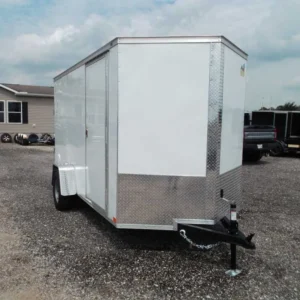
2027 6×12 cargo trailer, single axle, 2,990 lb GVWR: $2,900
The 6×12 enclosed cargo trailer is the entry point for a solo tradesperson. It is a white steel trailer on a single axle with barn doors at the back and a 78 inch (1.98 m) interior height. The 6 by 12 ft floor, about 1.8 by 3.7 m, gives room for shelving down both sides and a walkway between.
- Year: 2027
- Floor: 6 ft x 12 ft (1.8 x 3.7 m)
- Axle: single
- Rear door: barn doors
- Interior height: 78 in (1.98 m)
- Construction: steel, white
- GVWR: 2,990 lb (1,356 kg)
- Price: $2,900
White is a practical colour for a contractor trailer. It shows your signwriting well and, in our view, keeps the inside a little cooler in the sun than a dark trailer.
2026 6×10 aluminum cargo trailer, ramp door, 2,990 lb GVWR: $3,500
The 6×10 aluminum cargo trailer is smaller, but it has a ramp door, a 78 inch interior and an aluminum build that will not rust. It suits a technician who wheels in a pressure washer, a recovery unit or a small floor machine and wants a lighter trailer behind a smaller van or SUV.

2027 7×14 cargo trailer, barn doors, 7,055 lb GVWR: $4,600
The 7×14 tandem axle cargo trailer is a big step up. It has a 7 by 14 ft floor, about 2.1 by 4.3 m, an 84 inch (2.13 m) interior height and a 7,055 lb (3,200 kg) GVWR. Most adults can stand up inside, which matters if you plan to work at a bench in the trailer.
- Year: 2027
- Floor: 7 ft x 14 ft (2.1 x 4.3 m)
- Axle: tandem
- Rear door: barn doors
- Interior height: 84 in (2.13 m)
- Frame: steel, white
- GVWR: 7,055 lb (3,200 kg)
- Price: $4,600
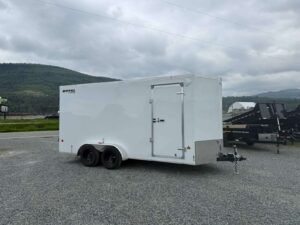
2026 7×14 cargo trailer, barn doors, 10,141 lb GVWR: $5,100
For crews who carry materials as well as tools, the 2026 7×14 cargo trailer has the same floor and 84 inch interior but a 10,141 lb (4,600 kg) GVWR. That extra rating is the difference between one trip and two on a heavy materials day. If we had to pick one contractor trailer for a small crew, this would be near the top of the list.
2026 7×14 and 7×16 cargo trailers with ramp doors: $6,500 and $7,500
If you roll in anything on wheels, such as compressors, generators, tile saws on stands, floor sanders or a mini loader, a ramp door saves your back. The 7×14 ramp door cargo trailer and the 7×16 ramp door cargo trailer both have 84 inch interiors, charcoal steel bodies and 10,141 lb GVWRs. The 7×16 adds 2 ft of floor, which is often enough for a dedicated workbench at the front.

8.5 ft wide cargo trailers: 20 ft and 24 ft
For a general contractor running a crew, an 8.5 ft wide contractor trailer gives a lot more room to work. Our 2026 8.5×20 cargo trailer has a 90 inch (2.29 m) interior height, a ramp door and a 10,141 lb GVWR at $6,500. The other 8.5×20 has an 84 inch interior at $8,100, and the 2023 8.5×24 is $8,900. As noted above, please confirm the details of these before ordering.
An 8.5 ft trailer is wider than most tow vehicles, so check your mirrors and local width limits. The UK government, for example, sets a maximum trailer width of 2.55 m for most cars, and 8.5 ft is about 2.59 m. Rules differ by country, so check yours.
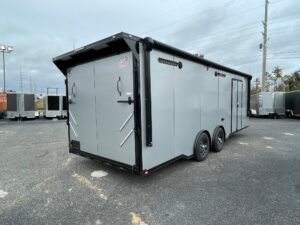
If budget is tight, our used 2023 8.5×16 cargo trailer is listed at $5,100. Our used trailer buying guide explains what to check.
Open and dump contractor trailers
Not every contractor trailer needs walls. If you haul posts, pallets of block, rolls of fencing, mowers or skid steers, an open trailer loads faster from the side and costs less.
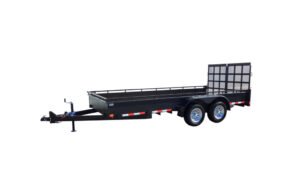
Open utility trailers: 7×14 at $2,200 and 7×18 at $3,800
The 2026 7×14 utility trailer is a black steel tandem axle trailer with a 7,000 lb (3,175 kg) GVWR. The 2027 7×18 utility trailer stretches to 18 ft with a 9,900 lb (4,491 kg) GVWR. Both are good choices for landscapers and fencing crews. Our landscape trailer guide has more on setting one up.
Dump trailers for waste and bulk materials
If you spend part of the day shovelling, a dump trailer pays for itself in labour. Our range includes the 2027 6×12 galvanized dump trailer with a 10,141 lb GVWR at $5,700, the 5×10 dump trailer at $5,900, the 7×14 dump trailer with a 15,400 lb GVWR at $7,800, and the 82×16 galvanized dump trailer at $7,900.
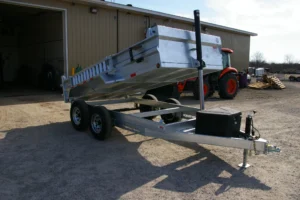
Our dump trailer guide covers bed sizes, hoists and how much soil and gravel weigh.
Setting up the inside of an enclosed contractor trailer
The fit-out is what turns a cargo box into a working contractor trailer. A few principles help, whatever your trade.
- Heavy items low and forward. Put the generator, compressor and heavy stock low, and just ahead of the axles, to help tongue weight and stability.
- Light, bulky items high. Insulation, drop cloths and empty bins go on upper shelves.
- Keep a clear walkway. You will be in and out all day. A 24 to 30 inch aisle is a common target, though that is a rule of thumb rather than a standard.
- Bolt shelves to the frame, not just the wall skin, and fit lips or straps so nothing slides out on a corner.
- Light the inside. LED strips on a battery or a shore power connection make early starts and winter evenings much easier.
- Use the doors. Barn doors are good for hanging cords, levels and small bins.
Shelving and fit-out add weight, so include them in your payload sums.
Generators and fuel: an important safety point
Never run a generator inside an enclosed trailer, even with the doors open. The CDC warns that generators should be kept at least 20 feet from windows, doors and vents because of carbon monoxide. Carry the generator in the trailer if you like, but take it out and set it up well away before you start it. Store fuel in approved containers, upright and secured, and keep the trailer ventilated.
Security: keeping your tools in your contractor trailer
Tool and equipment theft is a real cost for trades. The National Insurance Crime Bureau reported that only 23 percent of heavy equipment stolen in 2014 was recovered. That figure covers machinery rather than hand tools, but it shows how rarely stolen kit comes back.
Practical steps for any contractor trailer:
- A coupler lock and a wheel lock when it is parked unhitched.
- Good locks on every door, ideally with hasps that hide the shackle.
- Park it against a wall or with the doors blocked by another vehicle overnight.
- Record serial numbers of your tools and the trailer’s VIN. In the US, a VIN is 17 characters under 49 CFR 565.13.
- Consider a GPS tracker hidden inside the trailer.
- Check your insurance covers tools stored in a trailer overnight.
Our view: plain trailers attract less attention than ones covered in tool-brand stickers. Your company name and number are fine, but you do not need to advertise what is inside.
Signwriting and branding
The sides of an enclosed trailer are a large, mobile advert that you have already paid for. A clean logo, your trade, a phone number and a web address are usually enough. Keep the lettering big enough to read from a passing car, and put the number on the back as well as the sides, because people often notice a trailer when they are stuck behind it in traffic.
Two practical points. Vinyl lettering goes on best when the trailer is clean and the weather is mild, so plan it soon after delivery. And as mentioned in the security section, there is no need to list the brands of tools inside.
Parking a trailer on a job site
Where you leave the trailer on site affects both safety and security. Park it on firm, level ground where it will not sink in wet weather, chock the wheels, and lower the jack onto a pad or board so it does not sink. Keep it out of the way of deliveries and machines, but close enough that the crew is not walking far for every tool. If it will stay for weeks, ask the site owner or main contractor where they want it and whether there are any rules about trailers on site.
Towing a contractor trailer every day
Tongue weight
GMC’s tongue weight guide recommends 10 to 15 percent of total trailer weight for a conventional hitch, with about 60 percent of the load in the front half of the trailer. On a 7,000 lb loaded contractor trailer, that is 700 to 1,050 lb on the hitch. Check that against your truck or van’s rated tongue weight before you load up.
Brakes and towing rules
Rules vary between countries, states and provinces, so check where you work. In the UK, trailers over 750 kg loaded must have working brakes, according to GOV.UK. In the United States, brake requirements are set by each state. Ask us which of our contractor trailer models have brakes and what kind.
Commercial licences
In the US, the Federal Motor Carrier Safety Administration requires a Class A commercial licence for combinations with a gross combination weight rating of 26,001 lb or more where the towed unit is rated over 10,000 lb. Our 10,141 lb enclosed trailers are just over that trailer threshold, so if you pull one behind a heavy-duty truck, check your combination’s rating. Our 15,400 lb dump trailer is well over it. Outside the US, check your own licence categories.
Securing loads inside and on top
Loose materials in a contractor trailer become missiles under hard braking, and loads on an open trailer can fall onto the road. The AAA Foundation for Traffic Safety estimated that road debris played a part in 50,658 police-reported crashes a year in the US between 2011 and 2014, with about 125 deaths a year, and about two-thirds of that debris came from vehicles.
US cargo rules make a sensible benchmark wherever you work. Under 49 CFR 393.110, an article longer than 5 ft needs at least two tiedowns, and that applies to lumber, pipe and sheet goods on an open trailer. Inside an enclosed trailer, use E-track or D-rings to strap down loose items, and keep heavy boxes on the floor.
Our load securing guide covers straps, E-track and edge protection.
Contractor trailer features worth paying for
- Tandem axles with brakes if you carry materials.
- 84 inch interior height if you work inside the trailer.
- A ramp door for anything on wheels; barn doors for easier access in tight spots.
- A side door so you can reach tools without opening the back.
- E-track or D-rings on the walls and floor.
- Roof vents to keep heat and fumes down.
- Interior lighting and, if you need power on site, a shore power inlet.
- A ladder rack or roof rack rated for the weight you will put on it.
- A spare wheel and a jack rated for the loaded trailer.
Ask us which of these are fitted on the trailer you are looking at and which can be added.
What does a contractor trailer cost?
In our range, an enclosed contractor trailer runs from $2,900 for the 6×12 single axle to $8,900 for the 8.5×24. Tandem 7×14 enclosed trailers are $4,600 to $6,500, and the 7×16 is $7,500. Open utility trailers start at $2,200, and dump trailers run from $5,700 to $7,900. These are listed prices at the time of writing and can change.
Think about cost per working day. If a contractor trailer saves one extra trip to the supplier a week, or a day lost to a stolen tool kit, it pays for itself surprisingly quickly. In our opinion, buying one size up in floor area and GVWR is usually money well spent, because trades almost always end up carrying more than they planned.
Delivery depends on where you are in the world, so ask us for a delivered price.
Looking after a contractor trailer
A trailer that is used every day wears faster than one that comes out at weekends. A quick daily walk-round and a proper check every few months keeps it on the road.
- Tires: check pressure weekly and watch the age. NHTSA notes that many vehicle makers recommend replacing tires 6 to 10 years after manufacture regardless of tread.
- Bearings and brakes: service them on schedule, more often under heavy daily loads.
- Doors, hinges and seals: lubricate hinges and check seals so tools stay dry.
- Floor: look for soft spots where heavy kit sits.
- Lights and wiring: test every time you hitch up.
- Recalls: US owners can check NHTSA’s recall search.
Our trailer maintenance guide and towing tips have full checklists.
Three example contractors and the trailer we would suggest
A solo electrician
Tools, a few hundred pounds of cable and fittings, two ladders and a small generator. The 6×12 enclosed contractor trailer at $2,900 keeps everything locked and organised, and its 2,990 lb GVWR is enough for this kind of load if you keep an eye on stock levels.
A drywall crew of three
Forty UltraLight sheets come to about 1,600 lb using USG’s nominal weight, plus mud, a panel lift and tools. That is too much for a single axle trailer. The 7×14 cargo trailer with a 10,141 lb GVWR handles it, and the 84 inch interior gives room to stack board on edge against a strapped rack.
A general contractor with mixed work
One day it is tools and a compressor, the next it is bagged cement and a mixer, the next it is demolition waste. A sensible setup is an 8.5×20 enclosed contractor trailer for tools and materials, plus a 6×12 galvanized dump trailer for waste and bulk.
Common mistakes when buying a contractor trailer
- Buying for today’s van load. Trades grow. A contractor trailer that is full on day one is likely to feel small soon.
- Ignoring the empty weight. The GVWR is not the payload. Enclosed trailers and their fit-out are heavy.
- Choosing a low interior. If you plan to work inside, 78 inches gets tiring fast.
- Forgetting the tow vehicle. A 10,000 lb trailer behind a half-ton pickup is a mismatch, whatever the trailer can carry.
- Skipping the security plan until after the first break-in.
- Overloading roof racks. Ladders are fine, but stacking lumber on a cargo trailer roof is asking for trouble unless the rack is rated for it.
Heat, cold and storing materials in a contractor trailer
An enclosed trailer protects materials from rain, but not from temperature. Paint, adhesives, sealants and some fillers have storage temperature limits printed on the tin or the product data sheet, so check those before leaving them in a trailer overnight in winter or all day in summer. Batteries for cordless tools also prefer moderate temperatures, and most makers say so in their manuals.
Roof vents help in hot weather, and a light-coloured trailer absorbs less sun than a dark one. In cold climates, some trades bring sensitive materials into a heated building at night rather than leaving them in the contractor trailer. These are practical suggestions rather than rules, so follow the guidance on each product you carry.
Contractor trailer buying checklist
- List everything you carry on a normal day and on your heaviest day.
- Add up the weight, including shelving and fit-out.
- Choose a GVWR that leaves a margin after the trailer’s empty weight.
- Decide on enclosed, open or dump, or a mix.
- Pick an interior height: 84 inches if you work inside.
- Choose ramp or barn doors, and whether you need a side door.
- Check your tow vehicle’s towing capacity and tongue weight limit.
- Check brakes, width limits and licence rules where you work.
- Plan security: locks, tracker, insurance.
For more help, see our cargo trailer guide, trailer size guide, tandem vs single axle guide and how to choose a trailer.
Frequently asked questions
What size trailer does a contractor need?
Most tradespeople do well with a 7×14 or 7×16 enclosed contractor trailer with an 84 inch interior and a tandem axle. A solo trade with light stock can manage with a 6×12. Crews carrying materials and machines may need 8.5×20 or a separate dump trailer.
Is an enclosed or open trailer better for a contractor?
Enclosed is better for tools, stock and security. Open is better for bulky materials, pallets and machines loaded from the side. Many contractors own one of each.
How much weight can a contractor trailer carry?
It depends on the GVWR minus the empty weight. Our enclosed trailers are rated from 2,990 lb to 10,141 lb GVWR. Ask us for the empty weight of the exact unit to find the payload.
Can I stand up in an enclosed contractor trailer?
In a trailer with an 84 inch (2.13 m) interior, most adults can. A 78 inch interior is lower, and our 8.5×20 has a 90 inch interior.
Can I run a generator inside my contractor trailer?
No. The CDC says generators should be at least 20 feet from windows, doors and vents because of carbon monoxide. Carry it in the trailer, then set it up outside.
Do I need a CDL to tow a contractor trailer?
In the US, a Class A licence applies to combinations rated at 26,001 lb or more where the trailer is rated over 10,000 lb. Some of our trailers are rated just over 10,000 lb, so check your truck and trailer ratings together.
Do you sell contractor trailers outside the US?
Contact us with your country and the model you want, and we will confirm availability, delivery options and anything that needs to change for your local road rules.
Ready to buy your contractor trailer?
The right contractor trailer keeps your tools safe, your materials dry and your day running on time. Work out what you carry and what it weighs, choose a rating with room to spare, and set the inside up for the way you work. Then browse our enclosed trailers, utility trailers and dump trailers, or contact us with your trade and typical load for a recommendation and quote.
Sources and References
- American Concrete Institute: How much does a bag of cement weigh?
- USG: Sheetrock UltraLight Panels
- USGS: Water density
- CDC: Carbon monoxide dangers
- Claims Journal: NICB report on heavy equipment theft
- GMC: Tongue weight
- GOV.UK: Towing with a car
- FMCSA: Commercial driver’s license
- AAA Foundation: Crashes involving road debris
- 49 CFR 393.110 (Cornell LII)
- 49 CFR 565.13 (Cornell LII)
- NHTSA: Tires
- NHTSA: Recalls