

Need a pressure washing trailer? The short answer is to size it by water weight first. A full 200 gallon tank weighs about 1,670 lb before you add the pressure washer, hoses or reels, so most pressure washing businesses end up on a tandem axle trailer of around 7,000 lb GVWR. A single axle 5×8 or 5×10 works for a small setup with a 100 gallon tank or no tank at all. We sell pressure washing trailers from a 5×8 steel utility trailer at $1,050 to a 7×14 tandem at $2,200, plus aluminum and enclosed trailers for a cleaner, lockable rig.
This guide explains how to pick a pressure washing trailer by tank size, weight and layout, the rules about wash water that catch new operators out, and every trailer we have that suits the job, with specs and prices.

A pressure washing trailer is a working platform more than a way to move things. It carries a pressure washer skid or two, a water tank, hose reels, a surface cleaner, chemical drums and pumps, and it has to stay balanced and legal with all of that on board. The tank is the part that causes trouble. Water is heavy, it moves when you brake, and it gets used up during the job, so the trailer’s weight and balance change through the day.
We have written this for people building their first rig and for operators moving up to a bigger one. Figures from outside sources are linked. Where a figure is our own calculation or estimate, we say so.
Key takeaways before you buy a pressure washing trailer
- Water is the heaviest thing on the trailer. Plan the tank size against the trailer’s GVWR before anything else.
- Single axle trailers suit small tanks. A 2,990 to 3,500 lb GVWR leaves little room once a full tank, the trailer’s own weight and the equipment are counted.
- Tandem axles suit real tanks. 325 to 525 gallons calls for around 7,000 lb GVWR or more.
- Put the tank over or just ahead of the axles, and strap it down properly.
- Wash water has rules. In many places it cannot go into storm drains.
Pressure washing trailers we sell right now
Every pressure washing trailer here is listed in our shop with a price. Prices are current listed prices and can change, so check the product page or contact us for a quote before ordering.
| Trailer | Deck size | Axle | Build | GVWR | Price |
|---|---|---|---|---|---|
| 2026 5×8 utility trailer | 5 x 8 ft (1.5 x 2.4 m) | Single | Steel, black | 2,990 lb (1,356 kg) | $1,050 |
| 2026 5×10 utility trailer | 5 x 10 ft (1.5 x 3.0 m) | Single | Steel, black | 3,500 lb (1,588 kg) | $1,100 |
| 77×12 utility trailer | 77 in x 12 ft (1.96 x 3.66 m) | Ask us | Ask us | Ask us | $1,750 |
| 2026 5×10 aluminum trailer | 5 x 10 ft (1.5 x 3.0 m) | Single | Aluminum | 2,996 lb (1,359 kg) | $1,780 |
| 2026 6×12 aluminum trailer | 6 x 12 ft (1.8 x 3.7 m) | Single | Aluminum | 2,996 lb (1,359 kg) | $2,150 |
| 2026 7×14 utility trailer | 7 x 14 ft (2.1 x 4.3 m) | Tandem | Steel, black | 7,000 lb (3,175 kg) | $2,200 |
| 2027 7×18 utility trailer | 7 x 18 ft (2.1 x 5.5 m) | Tandem | Steel, black | 9,900 lb (4,491 kg) | $3,800 |
| 2026 80×16 aluminum trailer | 80 in x 16 ft (2.03 x 4.88 m) | Tandem | Aluminum | 7,010 lb (3,180 kg) | $3,900 |
| 7×14 aluminum utility trailer | 7 x 14 ft | Tandem | Aluminum | 7,010 lb (3,180 kg) | $4,100 |
| 2027 6×12 enclosed cargo trailer | 6 x 12 ft, 78 in inside | Single | Steel, white | 2,990 lb (1,356 kg) | $2,900 |
| 2026 6×10 aluminum cargo trailer | 6 x 10 ft, 78 in inside | Ask us | Aluminum, ramp | 2,990 lb (1,356 kg) | $3,500 |
| 2026 7×14 cargo trailer | 7 x 14 ft, 84 in inside | Tandem | Steel, white | 10,141 lb (4,600 kg) | $5,100 |
| 2026 7×16 cargo trailer | 7 x 16 ft, 84 in inside | Tandem | Steel, ramp door | 10,141 lb (4,600 kg) | $7,500 |
A note on the listings: the 77×12 utility trailer does not list its axle setup or GVWR yet, and the 6×10 aluminum cargo trailer does not list its axle. Empty weights are not listed on most of these trailers. Ask us and we will confirm them for the exact unit before you buy, because for a pressure washing trailer those numbers decide how big a tank you can carry.
Water weight: the first thing to work out
The US Geological Survey gives the weight of fresh water as about 62.4 lb per cubic foot at 39.2°F (4°C). That works out to about 8.3 lb per US gallon, or about 1 kg per litre. That conversion is ours. Here is what common tank sizes weigh when full, counting the water only.
| Tank size | Litres | Water weight when full |
|---|---|---|
| 65 US gal | 246 L | about 540 lb (246 kg) |
| 100 US gal | 378 L | about 830 lb (378 kg) |
| 150 US gal | 568 L | about 1,250 lb (568 kg) |
| 200 US gal | 757 L | about 1,670 lb (757 kg) |
| 325 US gal | 1,230 L | about 2,710 lb (1,230 kg) |
| 525 US gal | 1,987 L | about 4,380 lb (1,987 kg) |
Now add everything else. The tank itself has weight, and so do the pressure washer skid, hose reels and hoses, a surface cleaner, chemical drums, a transfer pump, a battery and any frame or toolbox you bolt on. Then there is the trailer’s own empty weight. All of it has to fit inside the GVWR. Ask the makers of your equipment for their dry weights, ask us for the trailer’s empty weight, and add it up before you buy.
What size tank on which pressure washing trailer?
These are our rough suggestions, not limits, and they assume a typical cold water skid plus reels and hoses. Your own sums decide the final answer.
| Trailer GVWR | Example trailers | Tank size we would suggest |
|---|---|---|
| About 3,000 lb, single axle | 5×8 steel, 6×12 aluminum | No tank to 100 gal |
| 3,500 lb, single axle | 5×10 steel | 100 to 150 gal |
| About 7,000 lb, tandem | 7×14 steel, 80×16 aluminum | 200 to 325 gal |
| 9,900 to 10,141 lb, tandem | 7×18 steel, 7×14 enclosed | 325 to 525 gal |
The lesson is that a small single axle pressure washing trailer fills its rating quickly. A 2,990 lb GVWR trailer with a full 200 gallon tank has about 1,670 lb of water on it before you count the trailer, the tank or the washer. That is why we push most full-time operators towards a tandem.
How long will a tank last?
Tank size also decides how long you can wash before you need a refill. Divide the tank size by your machine’s flow rate in gallons per minute. These are our calculations, assuming the machine runs at full flow the whole time, which it usually does not, so real working time is longer.
| Tank | 3 GPM | 4 GPM | 5.5 GPM | 8 GPM |
|---|---|---|---|---|
| 100 gal | 33 min | 25 min | 18 min | 12 min |
| 200 gal | 67 min | 50 min | 36 min | 25 min |
| 325 gal | 108 min | 81 min | 59 min | 41 min |
| 525 gal | 175 min | 131 min | 95 min | 66 min |
Many residential jobs run off the customer’s tap, with the tank acting as a buffer so the machine never starves. In that case a smaller tank is fine. Commercial work, fleet washing and sites with no water supply need a bigger tank, and a bigger tank needs a bigger pressure washing trailer.
A simple way to choose is to look back at your last ten jobs. If most had a working tap with decent flow, a small buffer tank is enough. If several had no water, slow water or a customer who did not want you using theirs, a larger tank on a tandem pressure washing trailer will pay for itself in jobs you no longer turn away. Refilling mid-job also costs time, so the bigger tank saves trips as well as weight worries.
Open, aluminum or enclosed pressure washing trailer?
| Open steel | Open aluminum | Enclosed | |
|---|---|---|---|
| Price in our range | From $1,050 | From $1,780 | From $2,900 |
| Rust with constant water | Needs touch-up | Resists rust | Steel frame, needs care |
| Security overnight | Low | Low | Lockable |
| Space for a company wrap | None | None | Large |
| Freeze protection in winter | Hard | Hard | Easier, with heat |
| Ventilation for engines | Open air | Open air | Needs planning |
Our view: an open steel trailer is the cheapest way into the business and is easy to modify. Aluminum makes sense for a pressure washing trailer because the deck is wet every working day and aluminum does not rust like bare steel. Our aluminum vs steel trailer guide covers the trade-offs. An enclosed trailer costs more, but it locks, it looks professional with a wrap, and it is easier to keep from freezing if you work in a cold climate. Our enclosed vs open trailer guide goes further.
Open pressure washing trailers in detail
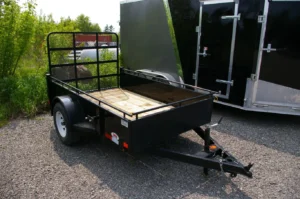
2026 5×8 utility trailer: $1,050
The 5×8 utility trailer is the cheapest pressure washing trailer in our range. It is a black steel, single axle trailer with a 2,990 lb (1,356 kg) GVWR. It suits a starter setup: one cold water skid, a hose reel, a surface cleaner and either a small tank or none, drawing from the customer’s tap.
- Year: 2026
- Size: 5 ft x 8 ft (1.5 x 2.4 m)
- Axle: single
- Frame: steel, black
- GVWR: 2,990 lb (1,356 kg)
- Price: $1,050
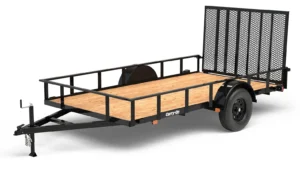
2026 5×10 utility trailer: $1,100
For $50 more, the 5×10 utility trailer gives you two more feet of deck and a higher 3,500 lb (1,588 kg) GVWR. That extra length lets you put the tank over the axle and the skid and reels ahead of it, which helps balance. It is the single axle pressure washing trailer we would pick for a 100 to 150 gallon tank.
- Deck size: 5 ft x 10 ft (1.5 x 3.0 m)
- Axle: single
- Frame: steel, black
- GVWR: 3,500 lb (1,588 kg)
- Price: $1,100
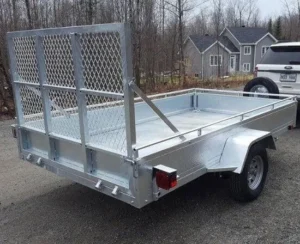
Aluminum single axle trailers: $1,780 and $2,150
Our 5×10 aluminum trailer at $1,780 and 6×12 aluminum trailer at $2,150 both have a 2,996 lb (1,359 kg) GVWR. Aluminum trailers are generally lighter than steel ones of the same size, which leaves more of the rating for water and equipment. Ask us for the empty weights to compare. The 6×12 gives room for two reels side by side and a chemical rack.
2026 7×14 utility trailer: $2,200
The 7×14 utility trailer is where a pressure washing trailer starts to feel like a proper rig. It is a black steel tandem with a 7,000 lb (3,175 kg) GVWR, which leaves room for a 200 to 325 gallon tank, a skid, reels and a surface cleaner, with deck space left for ladders and buckets. Two axles also keep it steadier when the tank is half full and the water moves.
- Deck size: 7 ft x 14 ft (2.1 x 4.3 m)
- Axle: tandem
- Frame: steel, black
- GVWR: 7,000 lb (3,175 kg)
- Price: $2,200
2027 7×18 utility trailer: $3,800
The 7×18 utility trailer has an 18 ft deck and a 9,900 lb (4,491 kg) GVWR. It suits fleet washing and commercial crews running two machines, a large tank and plenty of hose. The extra deck length also fits a soft wash system next to the pressure washer.

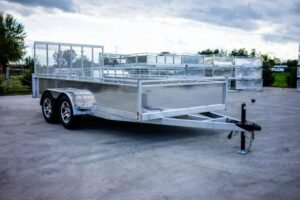
Tandem aluminum trailers: $3,900 and $4,100
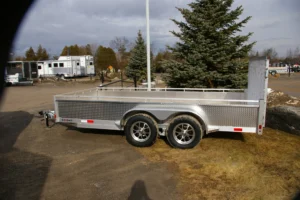
The 80×16 aluminum trailer at $3,900 and the 7×14 aluminum utility trailer at $4,100 both have a 7,010 lb (3,180 kg) GVWR. They give you the capacity of a tandem with a deck that stays rust-free in constant spray. For a pressure washing trailer that lives outside and gets wet every day, that is worth paying for.
Enclosed pressure washing trailers
An enclosed pressure washing trailer keeps expensive equipment locked away and out of the weather. It also gives you big flat walls for a company wrap. The trade-offs are cost, weight and ventilation.
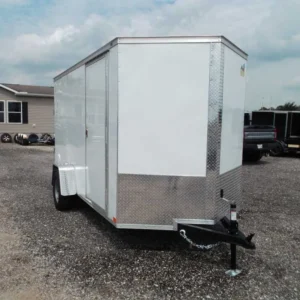
2027 6×12 enclosed cargo trailer: $2,900
The 6×12 enclosed cargo trailer is a white steel single axle box with barn doors, a 78 inch (1.98 m) interior and a 2,990 lb (1,356 kg) GVWR. That rating rules out a big tank, so it suits a tap-fed setup or a small tank, with reels mounted at the back doors.
2026 6×10 aluminum cargo trailer: $3,500
The 6×10 aluminum cargo trailer has a rear ramp, a 78 inch interior and a 2,990 lb GVWR. The ramp makes it easy to roll a surface cleaner or a wheeled washer in and out. Like the 6×12, it suits a light setup.

2026 7×14 cargo trailer, 10,141 lb GVWR: $5,100
For a full enclosed pressure washing trailer with a real tank, the 7×14 cargo trailer is the one to look at. It is a white steel tandem with barn doors, an 84 inch (2.13 m) interior and a 10,141 lb (4,600 kg) GVWR. That is a lot of capacity for a 14 ft box, and it gives room for a 325 to 525 gallon tank plus equipment, depending on what everything weighs.
- Floor size: 7 ft x 14 ft (2.1 x 4.3 m)
- Axle: tandem
- Rear door: barn doors
- Interior height: 84 in (2.13 m)
- GVWR: 10,141 lb (4,600 kg)
- Price: $5,100
2026 7×16 cargo trailer, ramp door: $7,500
The 7×16 cargo trailer has a rear ramp door, an 84 inch interior and a 10,141 lb GVWR. The extra length fits two machines, a large tank and a workbench, and the ramp lets you roll heavy gear in and out.

Cold water, hot water and soft wash rigs
The kind of cleaning you do changes what goes on the trailer, and so changes the trailer you need.
Cold water rigs
A cold water pressure washer is the simplest setup: an engine, a pump, an unloader and a hose. It suits driveways, patios, fences, decks and most house washing. A cold water pressure washing trailer can be small, and a single axle often does the job if you keep the tank modest.
Hot water rigs
Hot water units add a burner and a fuel tank, usually diesel or kerosene, on top of the engine and pump. They clean oil and grease far better, which is why fleet washers, workshops and food businesses use them. They are also heavier and bulkier than cold water skids, so a hot water pressure washing trailer is usually a tandem. Ask the maker for the dry weight and the fuel tank size, then add the fuel to your sums. Keep the burner exhaust well clear of the tank, reels and anything that melts.
Soft wash systems
Soft washing uses low pressure and cleaning solutions for roofs, render and siding. A soft wash system adds a 12 volt pump, a chemical tank, a mixing setup and more hose. Many operators run a soft wash system and a pressure washer on the same trailer. That needs deck space and payload for two tanks, which pushes most combined rigs onto a 7×14 or longer pressure washing trailer. Keep the chemical tank upright, secured and separated from the fuel.
Laying out a pressure washing trailer
Tank position
Put the tank over the axles or just ahead of them. GMC’s tongue weight guide recommends 10 to 15 percent of total trailer weight on the hitch for a conventional setup, with about 60 percent of the load in the front half. A tank too far back takes weight off the hitch and can make the trailer sway. A tank too far forward can overload the hitch and the back of the truck.
Remember that the balance changes during the day. As the tank empties, the weight that was over the axles disappears, and whatever sits at the front or back has more effect. Keep heavy items like the skid close to the axles too, so the trailer stays balanced whether the tank is full or empty.
Baffles and sloshing
A part-full tank surges forward under braking and back when you pull away. A baffled tank reduces that movement. If your tank is not baffled, drive gently with it part full, and leave more room to stop.
Strapping the tank down
A full tank is one of the heaviest single items you will ever carry on a trailer, and it must not move. US cargo rules make a good benchmark. Under 49 CFR 393.106, the combined working load limit of the tiedowns has to be at least half the weight of the item being secured. For a 325 gallon tank with about 2,710 lb of water, that means tiedowns adding up to at least about 1,360 lb working load limit, before counting the tank itself. That sum is ours. Many operators bolt the tank frame through the deck or crossmembers as well. Ask us before drilling the frame.
Reels, hoses and chemicals
- Hose reels at the back make it easy to pull hose to the job.
- Surface cleaner and ladders fit along the sides on racks.
- Chemicals belong in a bunded tray or secured drums, upright and away from fuel.
- A toolbox at the tongue holds nozzles, spare O-rings, fittings and tools.
- A battery for transfer pumps and soft wash pumps, with a charger.
Wash water rules: do not skip this
It is easy to spend weeks planning the trailer and minutes thinking about the wash water, and that is how fines happen. In the US, Ohio EPA’s guidance on mobile power washing states that power washing wastewater is considered industrial wastewater and cannot be discharged directly into storm drains. It also notes that drains in parking lots usually lead to storm sewers, and that you must get permission from the local treatment plant to discharge to the sanitary sewer.
Cities apply similar rules. Portland, Oregon says wash water from commercial mobile washing is prohibited from entering the city’s stormwater system, streets or right-of-way, and requires mobile washers to apply for authorisation to discharge to the sanitary sewer. Rules in other countries vary, so check with your local water authority before you start trading.
For your pressure washing trailer, that can mean space for drain covers, berms, a reclaim vacuum or pump, and sometimes a recovery tank. A recovery tank adds even more weight, which is one more reason to choose a trailer with a high GVWR.
Safety on and around a pressure washing trailer
High-pressure injection injuries
Pressure washers can inject water through skin. The MSD Manual describes high-pressure injection injuries as rare but able to cause extensive tissue damage, with treatment that is surgical and sometimes includes amputation. Anyone hit by the jet should get medical help straight away, even if the wound looks small. Never point a wand at anyone, and release pressure before changing nozzles.
Exhaust and enclosed trailers
Gas engines and hot water burners give off carbon monoxide. The CDC warns that generators should be kept at least 20 feet from windows, doors and vents because of carbon monoxide. Our advice for an enclosed pressure washing trailer is to treat engines the same way: never run them with the doors closed, vent exhaust outside, and fit a carbon monoxide alarm inside. A common layout puts the machines at the rear doors with the exhaust pointing out.
Freezing
A pump, unloader or hose full of water can crack in a hard frost. Drain everything at the end of the day in cold weather, or run antifreeze through the system as the equipment maker recommends. An enclosed trailer with a small heater makes winter work easier.
Towing a pressure washing trailer
Check your vehicle’s towing capacity, tongue weight limit and gross combined weight rating against the loaded trailer with a full tank. A full tank at the start of the day is the heaviest the rig will ever be, so plan for that.
In the UK, GOV.UK says trailers weighing over 750 kg when loaded need working brakes. A 200 gallon tank alone is about 757 kg of water by our conversion, so almost any pressure washing trailer with a tank will need brakes there. Other countries set their own limits, so check yours.
In the US, the FMCSA requires a USDOT number for vehicles in interstate commerce with a gross vehicle weight rating or gross combination weight rating of 10,001 lb or more. A work truck plus a tandem pressure washing trailer can easily pass that figure, so check before you cross state lines for work. Our towing tips cover braking, sway and reversing.
Looking after your pressure washing trailer
A pressure washing trailer is wet most of its working life, and that is hard on steel, bearings and wiring.
- Rinse it off after jobs with chemicals or salt, especially a steel trailer.
- Touch up chips on a black steel trailer before rust starts.
- Bearings: water gets in. Check and repack them more often than on a dry trailer.
- Tires: check pressure and age. NHTSA notes many vehicle makers recommend replacing tires 6 to 10 years after manufacture, regardless of tread.
- Wiring and lights: check connectors for corrosion and test every time you hitch up.
- Tank mounts and straps: check for wear and loosening weekly.
- Recalls: US owners can check NHTSA’s recall search.
Our trailer maintenance guide has a full checklist.
Start small or buy for the business you want?
Plenty of new operators weigh this up. A small single axle pressure washing trailer costs very little and is easy to tow and park. But if the business grows, you may want a bigger tank, a soft wash system or a second machine within a year, and the small trailer will not carry them.
Our view is that if you are serious about the work, buy the tandem from the start. A 7×14 tandem costs $2,200, only $1,100 more than the 5×10, and it can carry a much larger rig. If you want to test the business first, the 5×10 steel trailer is cheap enough that keeping it as a second rig later is no loss.
A good pressure washing trailer also holds its usefulness. If you ever change direction, an open utility trailer still sells or works for landscaping, moving and general hauling. An enclosed one makes a mobile workshop or storage box. That makes the trailer one of the safer purchases in a new cleaning business.
Branding your pressure washing trailer
Your trailer is parked outside every job you do, often for hours, in front of the neighbours. A clean, well-organised pressure washing trailer with your name and number on it is advertising that costs nothing extra once it is done. An enclosed trailer gives the most space for a wrap. On an open trailer, a sign board on the tank frame or a branded tank works well.
Keep it tidy, too. Hoses wound on reels, chemicals in racks and a clean deck tell customers you take care with their property. A messy trailer says the opposite, whatever your results look like.
What does a pressure washing trailer cost?
In our range, an open pressure washing trailer starts at $1,050 for the 5×8 steel and $1,100 for the 5×10. Aluminum single axles run $1,780 to $2,150. Tandems start at $2,200 for the 7×14 steel and go to $4,100 for the 7×14 aluminum. Enclosed trailers run from $2,900 for the 6×12 to $7,500 for the 7×16 with a ramp door. These are listed prices at the time of writing and can change. Delivery depends on where you are in the world, so ask us for a delivered price.
The trailer is usually not the biggest cost in a pressure washing rig. The machines, tank, reels and soft wash gear often cost more. In our opinion, that is a good reason not to save a few hundred dollars by buying a trailer that is too small for the tank you will want in a year’s time.
Three example setups and the trailer we would suggest
A one-person residential start-up
You clean driveways, patios and house sides, drawing from the customer’s tap. A 5×10 steel trailer at $1,100 carries a skid, a 100 gallon buffer tank, a reel and a surface cleaner.
A two-person crew doing commercial and residential
You need 200 to 325 gallons for sites with poor water supply, plus a soft wash system. The 7×14 steel trailer at $2,200 or the 7×14 aluminum at $4,100 gives the rating and deck space.
A fleet washing business
You wash trucks and equipment at night, often with no water on site. The 7×18 steel trailer or the enclosed 7×14 cargo trailer with its 10,141 lb rating handles a 525 gallon tank and two machines, depending on equipment weights.
Common mistakes with a pressure washing trailer
- Choosing the tank before checking the GVWR.
- Forgetting the trailer’s own weight when doing the sums.
- Mounting the tank behind the axles.
- Weak tank straps or bolts through thin deck boards only.
- Running engines inside a closed trailer.
- Letting wash water run into storm drains.
- Skipping brakes on a heavy rig.
Pressure washing trailer buying checklist
- Decide how much water you need on board for your typical jobs.
- Work out the full tank weight at about 8.3 lb per gallon or 1 kg per litre.
- Get dry weights for the tank, skid, reels and other equipment.
- Ask us for the trailer’s empty weight and check the total against the GVWR.
- Choose open steel, open aluminum or enclosed.
- Plan the layout with the tank over or just ahead of the axles.
- Plan tiedowns or mounts rated for the full tank.
- Check your vehicle’s towing capacity and tongue weight limit.
- Check brake, registration and wash water rules where you work.
For more help, read our utility trailer guide, cargo trailer guide, tandem vs single axle guide, contractor trailer guide and trailer size guide.
Frequently asked questions
What size trailer do I need for pressure washing?
For a small setup with little or no tank, a 5×8 or 5×10 single axle works. For a 200 to 325 gallon tank, most operators need a tandem around 7×14 with about 7,000 lb GVWR.
How much does a 200 gallon water tank weigh when full?
The water alone weighs about 1,670 lb, or about 757 kg, by our conversion from USGS figures. Add the tank’s own weight on top.
Can a single axle trailer carry a water tank?
Yes, a small one. On a trailer rated around 3,000 to 3,500 lb, we suggest no more than 100 to 150 gallons, depending on the trailer’s empty weight and your equipment.
Where should the tank go on a pressure washing trailer?
Over the axles or just ahead of them, so the trailer keeps proper tongue weight whether the tank is full or empty.
Is an enclosed trailer good for pressure washing?
Yes, if you want security, a wrap and winter protection. Plan ventilation carefully and never run engines with the doors closed.
Is aluminum better than steel for a pressure washing trailer?
Aluminum resists rust from constant water and is usually lighter. Steel costs less and is easier to weld and modify. Both work if looked after.
Can I let wash water go down the storm drain?
In many places, no. US state and city guidance, such as Ohio EPA’s, treats power washing wastewater as industrial wastewater that cannot go into storm drains. Check your local rules.
Do I need trailer brakes for a pressure washing trailer?
Very often, yes. In the UK, trailers over 750 kg loaded need working brakes, and a 200 gallon tank alone is about that much water.
How long does a 325 gallon tank last?
By our calculation, about 81 minutes at a steady 4 gallons per minute, or about 41 minutes at 8 gallons per minute. Real working time is usually longer because the machine does not run at full flow all the time.
Can I put a hot water pressure washer on a trailer?
Yes. Hot water units are heavier and carry fuel, so plan for a tandem pressure washing trailer, keep the exhaust clear of everything else, and never run one inside a closed trailer.
Can one trailer carry a pressure washer and a soft wash system?
Yes, on a large enough trailer. Two tanks, two pumps and extra hose usually need a tandem of 14 ft or more with a GVWR around 7,000 lb or higher.
Do you sell pressure washing trailers outside the US?
Contact us with your country and the model you want, and we will confirm availability, delivery options and anything that needs to change for your local road rules.
Ready to buy your pressure washing trailer?
The right pressure washing trailer carries the tank you need, stays balanced as it empties, and keeps your equipment safe and legal on the road. Work out your water weight, pick a GVWR with room to spare, and choose open, aluminum or enclosed. Then browse our 5×10 steel, 7×14 tandem and 7×14 enclosed trailers, or contact us with your equipment list for a recommendation and quote.
Sources and References
- USGS: Water density
- Ohio EPA: Mobile power washing and environmental regulations
- City of Portland: Mobile washer program
- MSD Manual: High-pressure injection injuries
- CDC: Carbon monoxide dangers
- 49 CFR 393.106 (Cornell LII)
- GMC: Tongue weight
- GOV.UK: Towing with a car
- FMCSA: Do I need a USDOT number?
- NHTSA: Tires
- NHTSA: Recalls