

A good landscape trailer for most crews is an open, tandem axle steel trailer around 7 ft wide and 14 to 18 ft long, with a 7,000 lb GVWR, a fold-down rear gate that doubles as a ramp, and plenty of tie-down points. Solo operators with one walk-behind or a small zero-turn usually get by with a 5×10 or 6×12 single axle. Anyone hauling soil, rock or demolition debris every week should look at a hydraulic dump trailer as well, or instead. The deciding numbers are the weight of your heaviest mower, the deck width of your biggest machine, and how often you carry loose material.
That’s the quick answer. The rest of this guide walks through how to size a landscape trailer properly, which features earn their keep, how much loose material actually weighs, what the load and tarp rules say, and which trailers from our own stock fit which kind of business. We sell every trailer mentioned here and ship worldwide. Prices and specs come from our listings, outside facts are linked to their sources, and where something is our opinion, we say so.

Landscape trailer sizes at a glance
Here’s how we usually match a landscape trailer to the work. Treat it as a starting point. The sections after it show you how to check the numbers for your own kit.
| Type of work | Typical load | Landscape trailer to look at | Examples from our stock |
|---|---|---|---|
| Homeowner or solo start-up | Walk-behind mower, trimmers, a few bags of mulch | 5×8 or 5×10, single axle, about 3,000 lb GVWR | 5×8 steel, 5×10 steel |
| One-truck mowing route | One residential zero-turn plus a walk-behind and hand tools | 6×12 single axle or a light 7×14 tandem | 6×12 aluminum, 7×14 steel tandem |
| Full-service crew | Commercial zero-turn, second mower, blowers, edgers, materials | 7×16 to 7×18 tandem, 7,000 lb class or more | 7×16 aluminum, 7×18 steel 9,900 lb |
| Hardscape, planting and cleanup | Soil, rock, pavers, debris | Tandem dump trailer, 7,700 to 15,400 lb | 6×12 galvanized dump, 7×14 dump |
The pairings are our recommendation, based on what we sell and the jobs buyers describe to us.
What makes a trailer a landscape trailer?
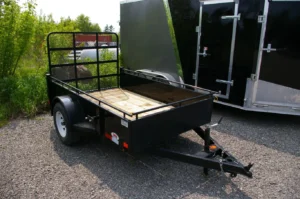
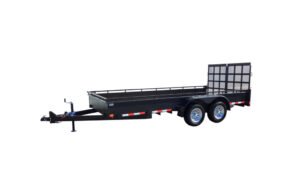
There’s no legal definition. In the trade, a landscape trailer is an open utility trailer set up for mowing and grounds crews: a low wood or steel deck, mesh or rail sides, a rear gate that folds down so mowers drive straight on, and somewhere to hang trimmers and blowers. Some crews add a front toolbox, a spare tire mount, and racks on the side rails. A dump trailer used for soil and mulch is often called a landscape trailer too, and so is a small gravity tilt that carries a ride-on mower.
What they have in common is a working day spent loading and unloading many times, often on lawns, kerbs and driveways. That’s why the details that matter on a landscape trailer are a bit different from those on a trailer that hauls one car across the country now and then.

Start with your heaviest machine
Every landscape trailer decision starts with the weight of the biggest thing you’ll put on it, plus everything that rides along with it. People often guess low here, because mowers look lighter than they are.
A couple of published figures show the range:
- Toro lists its 42 in TimeCutter residential zero-turn at 527 lb (239 kg), with an assembled width of 53 in and depth of 75 in.
- Toro’s commercial Z Master 4000 Series with a 60 in deck is listed at 1,193 lb (541 kg).
So a commercial mower can weigh more than twice what a homeowner machine does. Add a second mower, a walk-behind, fuel cans, a backpack blower or two, an edger, hand tools and the operator’s spare parts box, and a “light” mowing setup can easily come to 2,000 lb or more on the deck. Weigh what you actually carry, or add up the published weights, and size the landscape trailer for your busiest day, not your average one.
Don’t forget the trailer’s own weight
GVWR (gross vehicle weight rating) is the most the trailer may weigh in total, itself plus its load. The number that tells you what you can carry is payload: GVWR minus the trailer’s empty weight. A tandem landscape trailer rated 7,000 lb that weighs 1,800 lb empty can carry 5,200 lb. The same rating on a heavier build might leave you 4,600 lb. When you compare two trailers, compare payload. Our listings show GVWR. Ask us for the empty weight of any model and we’ll tell you before you buy.
Deck width: measure the mower, not the brochure
Width is where most mowing crews get caught out. The number that matters on a landscape trailer is the clear width between the side rails or fenders, and the number that matters on the mower is its overall width, which is usually wider than the cutting width. The Toro TimeCutter above cuts 42 in but measures 53 in across. A 60 in commercial deck will be wider again once you count the discharge chute.
Here’s how our trailer widths tend to line up:
- 5 ft class (about 60 in): walk-behinds, small riders and compact zero-turns. Check the overall width before buying for a 42 in zero-turn.
- 77 in and 80 in: the classic width for a landscape trailer. Fits most residential and many commercial zero-turns side-on or straight, with room for a walk-behind beside a smaller machine.
- 82 in and 7 ft (84 in): wide commercial decks, two machines side by side on a long deck, or a mower plus a stack of pallets.
If you run a 60 in or 72 in deck, take a tape measure to your mower and ask us for the exact rail-to-rail measurement on the trailer you’re considering. We’d rather you check than end up with a deck that has to go on at an angle.
Deck length: plan for the second machine
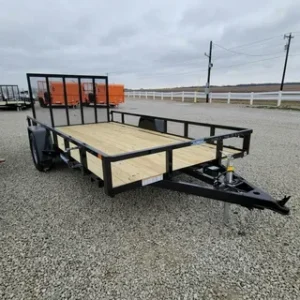
A single zero-turn needs roughly 7 ft of deck. Add a walk-behind and you’re at 10 to 12 ft. A full crew with two riders, a walk-behind, a blower rack and a few bags of fertilizer needs 16 ft or more. Length also gives you a choice about where the weight sits, which matters for towing (more on that below). A landscape trailer that’s slightly too long is a minor nuisance in tight streets. One that’s too short is a daily headache, and most growing businesses outgrow a short trailer within a season or two. That’s our experience from talking to buyers, not a statistic, but we hear it often.
Single axle or tandem?
Single axle trailers are cheaper, lighter, easier to push around by hand and easier to back into a narrow side yard. For a 5×8, 5×10 or 6×12 landscape trailer carrying one smaller mower, a single axle is fine. Most of ours in that size are rated around 3,000 lb.
Tandem axles carry more, share the load across four tires, keep going if one tire goes flat, and track more steadily at speed. Once you’re carrying a commercial mower plus a second machine, or loading materials, a tandem landscape trailer is the safer choice. Our full guide to tandem axle vs single axle trailers covers the trade-off in more detail.
Steel or aluminum?
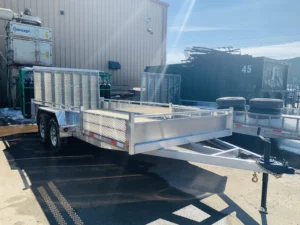
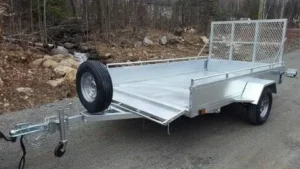
Steel is cheaper and easy to repair. Its weak spot is rust, especially where mower tires and tools chip the paint, and on crews that wash trailers down with fertilizer residue on them. Aluminum costs more but doesn’t rust the same way, weighs less, and so leaves more payload for the same rating and puts less strain on a smaller truck. Galvanized steel sits in between. For a landscape trailer that lives outside and gets hosed off weekly, aluminum or galvanized often pays for itself over the years. That’s our view, and our aluminum vs steel trailer guide goes deeper.
Features that earn their keep
You can spend a lot on options. These are the ones we think matter most on a landscape trailer used every day.
Rear gate
A fold-down gate is the standard landscape trailer ramp. Look at its length (longer means a gentler angle for low mower decks), whether it has a spring assist or lift-assist so one person can raise it, and whether it can fold flat for long loads. A gate that’s heavy to lift is lifted forty times a day by someone who will grow to hate it.
Side gate or ramp
A side ramp lets you load a walk-behind or a second mower without unloading the first. It’s handy on long decks and for crews who drop a machine at each stop.
Rails, mesh sides and tool racks
Rails give you somewhere to strap and hang things. Mesh or solid sides stop clippings and small tools sliding off. Trimmer racks, blower racks and lockable tool boxes keep the deck clear and stop theft. They bolt to most rail-sided trailers afterwards, so you don’t have to buy them all on day one.
Tie-down points
D-rings or stake pockets at each corner and along the sides. Count them. You want one near each corner of where every machine will sit.
Deck
Treated wood decks are quiet, grippy and cheap to replace a board at a time. Steel decks last longer but can be slippery when wet with grass. Aluminum decks are light and don’t rot.
Lights and wiring
LED lights last longer and stand up to wash-downs better than bulbs. Make sure the plug matches your truck and the lighting rules where you’ll tow.
Soil, mulch and rock: what loose material actually weighs
This is where many landscapers overload a trailer without realising it. A bed full of soil looks harmless and weighs a great deal.
The USDA Natural Resources Conservation Service notes that a medium-textured soil with about half its volume as pore space has a bulk density of about 1.33 g/cm³. Oklahoma State University extension reports field averages around 1.45 g/cm³ in its own study, and points out that bulk density is measured on dried soil, so water isn’t included.
Doing the arithmetic ourselves: 1.33 g/cm³ is 1,330 kg per cubic metre. A cubic yard is about 0.76 m³, so that’s roughly 1,000 kg, or about 2,200 lb, of dry soil per cubic yard. Damp soil straight from a supplier’s pile weighs more than that because of the water in it. Treat 2,200 lb per cubic yard as a floor, not a ceiling. Gravel and crushed rock are generally heavier for the same volume. Mulch is much lighter, but the weight varies a lot with wood type and moisture, so go by the weight ticket from your supplier.
A worked example: why you can’t fill a dump trailer to the top
Take our 7×14 dump trailer, rated 15,400 lb GVWR. Suppose its box sides are 2 ft high (an assumption for the example; ask us for the real side height of any model).
- Box volume: 7 × 14 × 2 = 196 cubic feet, a little over 7 cubic yards.
- Dry soil at about 2,200 lb per cubic yard: roughly 16,000 lb of soil.
- That’s more than the trailer’s entire GVWR before you add the trailer’s own weight.
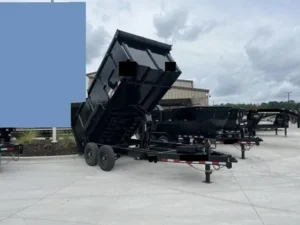
So a dump-style landscape trailer full of soil is overloaded, even though it doesn’t look it. With heavy material, load by weight, not by volume. Ask the yard how much each scoop weighs and stop when you reach your payload. A load of mulch, on the other hand, can fill the box comfortably on the same trailer.
Dump trailer or open landscape trailer?
Many crews end up with both. Here’s how they compare.
| Open landscape trailer | Dump trailer | |
|---|---|---|
| Best for | Mowers, tools, crew gear, palletized stone | Soil, mulch, rock, debris, green waste |
| Unloading loose material | Shovel it off by hand | Tip it in seconds |
| Weight and price | Lighter and cheaper | Heavier, more expensive |
| Deck height | Low, easy mower loading | Higher box, steeper ramps |
| Upkeep | Lights, tires, bearings, deck | The same plus hydraulics, battery and pump |
If you only move loose material a few times a month, an open landscape trailer and a shovel will do. If you install beds, lay patios or do cleanups most weeks, a dump trailer pays back in labour quickly. That’s a judgement based on how customers use ours, not a fixed rule. For a broader comparison of trailer styles, see our guide to the types of trailers.
Gravity tilt trailers for ride-on mowers
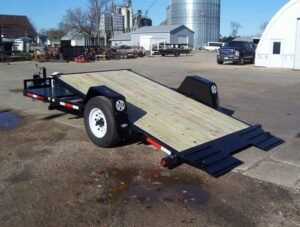
A small tilt deck is another way to build a landscape trailer. There’s no gate to lift. The deck rests on the ground at the back, you drive the mower on, and once it passes the balance point the deck settles level. Our TL612-5K gravity tilt trailer and TL614-5K suit one or two ride-on mowers. The TL612-7K carries more weight. The trade-off is that tilt decks usually have no sides, so tools and bags need strapping down or a separate box.
Towing a landscape trailer safely
Tongue weight and load position
GMC’s towing guide says a conventional ball-hitch trailer should carry roughly 10 to 15 percent of its loaded weight on the tongue, with about 60 percent of the load over the front half. On a landscape trailer, that means the heaviest mower goes nose-forward, just ahead of the axles, and the lighter kit goes behind it. A mower parked at the very back, on the gate, takes weight off the hitch and makes the trailer more likely to sway.
Brakes
Small single axle trailers often have no brakes. Larger tandem trailers usually do, and the rules on when brakes are required vary by country and state. In Great Britain, for example, GOV.UK says a trailer must have a working brake system if it weighs over 750 kg when loaded. A loaded tandem landscape trailer is almost always well over that. Check your local rule, and check your truck’s owner’s manual for its towing capacity and maximum tongue weight.
Width limits
The same GOV.UK page sets a 2.55 m maximum trailer width for towing. Our 77 in to 84 in trailers are all well inside that, but rules differ around the world, so check where you’ll tow.
For driving with a trailer behind you, from braking distances to reversing into a driveway, see our trailer towing tips.
Securing mowers and covering loose loads
Things falling off trailers is a real road safety problem, not just a fine. The AAA Foundation for Traffic Safety estimated an average of about 50,658 police-reported road debris crashes a year in the US between 2011 and 2014, with around 125 deaths a year, and said about two-thirds of debris crashes come from items falling from vehicles.
How many straps?
US federal cargo rules for commercial vehicles give a useful benchmark. Under 49 CFR 393.110, an article that isn’t blocked against moving forward needs one tiedown if it’s 5 ft or shorter and 1,100 lb or lighter, two if it’s longer than 5 ft up to 10 ft (or heavier than 1,100 lb), and one more for every extra 10 ft of length. Most mowers fall into the “two tiedowns” band at least. In practice, we’d strap every mower at all four corners and set the parking brake. Our guide to securing a load on a trailer goes through straps, chains and ratchets.
Covering soil, sand and gravel
Many places require loose loads to be covered. Washington State’s law is a clear example: RCW 46.61.655 says vehicles carrying dirt, sand or gravel on paved public roads must be covered to prevent spillage, unless six inches of freeboard is kept in the bed. Rules differ elsewhere, but a tarp is cheap insurance. Many dump trailers can be fitted with a roll tarp kit that makes this a ten-second job.
How to load a landscape trailer, step by step
A sensible loading routine saves time every day and keeps the trailer towing straight. This is the order we’d suggest for an open landscape trailer with a rear gate:
- Hitch first, load second. Load with the trailer coupled to the truck and the truck’s parking brake on. An unhitched trailer can tip up on its tail as soon as a mower climbs the gate.
- Check the gate angle. Low-deck mowers can catch their deck on the top of a short gate. If yours does, back the trailer onto a kerb edge or use a longer gate.
- Heaviest machine goes first, nose forward. Drive the big mower up to the front, just ahead of the axles. Reversing a zero-turn up a ramp is safer on many machines, so follow your mower’s manual on which way to climb.
- Lighter machines behind. Walk-behinds and small riders sit behind the main mower, never hanging over the gate.
- Strap each machine at four corners. Set parking brakes and lower the decks.
- Racks and boxes last. Trimmers and blowers go on their racks. Fuel cans go upright and strapped, away from hot exhausts.
- Walk round before you leave. Gate up and pinned, lights working, safety chains crossed under the coupler, nothing loose on the deck.
At the end of the day, the order is simply reversed. Crews that follow the same routine every time tend to forget fewer straps and break fewer gates.
A landscape trailer through the seasons
One reason a landscape trailer is such a good investment is that it works all year, not just in mowing season. How you use it changes with the calendar.
Spring
Cleanups, bed edging, mulch and planting. This is when an open landscape trailer and a dump trailer both earn their money. Mulch runs fill the box by volume. Soil and stone fill it by weight, so keep the payload sums from earlier in mind.
Summer
Peak mowing. The landscape trailer goes out loaded every morning and comes back full of clippings. A side gate, good racks and a deck you can sweep quickly matter most now.
Autumn
Leaf collection is bulky but light. Mesh or plywood side extensions on an open landscape trailer, or a dump trailer with taller sides, let you carry far more leaves per trip without going anywhere near the weight limit. Cover the load, because leaves blow off easily.
Winter
In snowy regions, many crews switch to snow removal and use the same landscape trailer to move a snow blower, salt spreader or a small tractor. Salt is hard on bare steel, which is one more reason galvanized and aluminum trailers are popular in cold climates. Rinse the trailer after salty runs, whatever it’s made of.
What a landscape trailer costs to run
The purchase price is only part of the cost, and it’s worth thinking about the rest before you choose. We can’t give you exact running costs, because tires, insurance and registration fees vary so much between countries and regions. But the main items are the same everywhere:
- Tires. A tandem landscape trailer has four. They wear faster if the trailer is overloaded or the tire pressures are low.
- Wheel bearings. Need regular greasing or repacking, more often if the trailer is washed down a lot.
- Brakes, if fitted: magnets, pads and wiring wear over time.
- Deck boards. A treated wood deck usually needs a few boards replaced every so often, starting near the gate.
- Registration, inspection and insurance, where your local rules require them.
- Hydraulics on a dump trailer: pump, battery, hoses and fluid.
An aluminum landscape trailer usually costs more to buy but less to maintain against rust. A steel one is cheaper up front and easy to weld if something bends. Spending a little more on a trailer with enough capacity also tends to cut running costs, because a trailer that isn’t worked at its limit every day wears its tires, springs and bearings more slowly. That last point is our experience rather than a measured figure.
Landscape trailers we sell
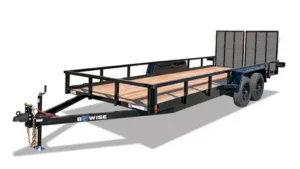
Here’s where each landscape trailer in our range fits. Prices are in US dollars and correct when this was written. Click through for current prices and photos.
Small landscape trailers: solo operators and homeowners
- 5×8 utility trailer: single axle, steel, black, 2,990 lb GVWR, $1,050. The cheapest way to move a walk-behind and tools.
- 5×10 utility trailer, steel: single axle, 3,500 lb GVWR, $1,100. Our best value small landscape trailer.
- 5×10 utility trailer with low rail sides: $1,450.
- 5×8 aluminum trailer: single axle, 2,996 lb GVWR, $1,800. Light enough to move by hand.
- 5×10 aluminum trailer: 2,996 lb GVWR, $1,780. Also see our lightweight 5×10 aluminum utility trailer at $1,850.
Mid-size landscape trailers: one-truck mowing routes
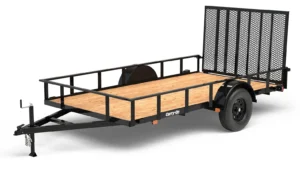
- 6×12 aluminum trailer: single axle, 2,996 lb GVWR, $2,150.
- 2027 6×12 single axle aluminum trailer: 2,996 lb GVWR, $2,450.
- 77×12 utility trailer: $1,750. The classic 77 in landscape trailer width.
- 77×14 utility trailer: $1,900. Room for a zero-turn plus a walk-behind.
- 7×14 utility trailer: tandem, steel, 7,000 lb GVWR, $2,200. Our pick for a growing mowing business on a budget.
Crew landscape trailers: full-service and multi-mower
- 77×16 utility trailer: $2,100. Two mowers and a blower rack.
- 7×14 aluminum utility trailer: tandem, 7,010 lb GVWR, $4,100.
- 7×16 aluminum trailer: tandem, 7,010 lb GVWR, $3,200.
- 80×16 utility trailer: tandem, aluminum, 7,010 lb GVWR, $3,900.
- 7×18 utility trailer: tandem, steel, 9,900 lb GVWR, $3,800. The most capacity in our open range.
- 82×18 utility trailer: $2,600, and the 82×20 utility trailer at $2,900, for crews running wide decks or a UTV.
- 7×20 aluminum trailer: tandem, 7,010 lb GVWR, $4,900. Long, light and rust-resistant.
Dump trailers for landscaping materials
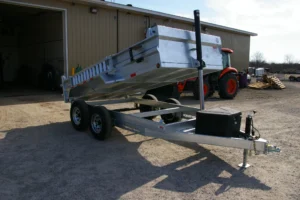
- 5×10 dump trailer: tandem, steel, 7,700 lb GVWR, $5,900. Fits narrow gates and smaller trucks.
- 6×12 galvanized dump trailer: tandem, 10,141 lb GVWR, $5,700. Galvanized for wet material and wash-downs.
- 7×14 dump trailer: tandem, steel, 15,400 lb GVWR, $7,800.
- 83×14 dump trailer: tandem, steel, 15,119 lb GVWR, $6,700.
- 82×16 galvanized dump trailer: tandem, 14,000 lb GVWR, $7,900.
Enclosed options
Some crews prefer a closed box so mowers and tools can stay loaded and locked overnight. Our 6×12 enclosed cargo trailer ($2,900) and 6×10 aluminum cargo trailer with ramp door ($3,500) work well for that. Our enclosed vs open trailer guide explains the trade-offs.
Three crews and the landscape trailer we’d match to each
These are typical situations buyers describe to us, with our suggestion for each. Run your own weights through the payload sum above before deciding.
The solo operator starting out
One residential zero-turn around 500 lb, a walk-behind, a trimmer and a blower, towed by a mid-size pickup or SUV. A 5×10 steel or 6×12 aluminum single axle landscape trailer covers this for very little money and is easy to manoeuvre into tight driveways. If the mower is a 42 in zero-turn, check its overall width against the trailer’s rail-to-rail measurement first.
The two-person mowing crew
A commercial zero-turn over 1,000 lb, a second smaller mower, a walk-behind, racks and fuel, out five or six days a week. Here we’d look at a 7×14 or 7×16 tandem landscape trailer in the 7,000 lb class. Aluminum if the trailer will be washed often or the truck is on the small side, steel if budget comes first.
The design-and-build company
Mowing plus planting, bed installs, patios and cleanups. One open landscape trailer for the mowing crew and a tandem dump trailer for materials is the combination we see most. A 6×12 galvanized dump suits soil and mulch runs. A 7×14 dump suits heavier rock work, loaded by weight as shown above.
New or used landscape trailer: what to inspect
Landscape trailers work hard, so a used one deserves a close look. Check these points, on ours or anyone else’s:
- Gate hinges and springs. A worn or sagging gate is common on old mowing trailers and annoying to fix.
- Deck boards. Push a screwdriver into the boards near the gate and the tie-downs. Soft wood means replacement soon.
- Frame and tongue. Look for bends or cracked welds, especially where the tongue meets the frame and around the spring hangers.
- Tires and bearings. Uneven tire wear can mean a bent axle. Spin each wheel and listen for rough bearings.
- Lights and wiring. Wash-downs are hard on wiring. Test every light.
- Dump hydraulics, if fitted: leaks, a weak pump, a tired battery.
Our trailer maintenance checklist covers what to keep on top of once you own it.
Landscape trailer buying checklist
- What’s the GVWR and empty weight? (So you know the payload.)
- What’s the clear width between rails or fenders?
- Deck length, and is there room for every machine you plan to own in the next two years?
- Single or tandem axle? Brakes fitted?
- Gate length, spring assist, and does it fold flat?
- Side gate or side ramp?
- How many tie-down points, and where?
- Steel, galvanized or aluminum?
- Wood, steel or aluminum deck?
- LED lights, and the right plug for your truck and country?
We’ll answer every one of these for any landscape trailer we sell. Not sure where to start at all? Our guide on how to choose a trailer covers the basics.
Mistakes we see people make
These come from our own conversations with buyers, so treat them as experience rather than statistics.
- Buying for today’s mower. A landscape trailer that fits one mower exactly has no room for the second one you’ll buy next spring.
- Using cutting width instead of overall width. The mower is always wider than its deck number.
- Filling a dump trailer with soil. It looks fine and weighs far more than the rating.
- Parking the heaviest mower on the gate. That’s how sway starts.
- Skipping the straps on short trips. Most loads shift on the first sharp corner.
Accessories worth adding later
You don’t need everything on day one. These are the add-ons we see crews bolt onto a landscape trailer once they know how they actually work:
- Trimmer racks. Lockable racks on the side rails keep string trimmers off the deck and stop them walking away at a busy job site.
- Blower and backpack racks. Same idea for backpack blowers and sprayers.
- Front tool box. A lockable box on the tongue holds hand tools, spare blades, line and straps.
- Spare tire and mount. A flat with no spare can cost a crew half a day. A spare on a bracket costs very little.
- Wheel chocks and a tongue jack with a wheel. Make it easy to unhitch and move the trailer by hand in a yard.
- Coupler lock and wheel lock. Cheap, and a real deterrent when the landscape trailer sits outside overnight.
- Side extensions or a mesh cage. Turn an open trailer into a leaf and green-waste hauler in autumn.
- Roll tarp on a dump trailer, so covering loose loads takes seconds.
Before you buy accessories, check where they’ll mount and make sure they don’t block the tie-down points you need for the mowers. A landscape trailer works best when every machine and tool has a fixed spot, so the crew loads it the same way every morning.
Delivery worldwide
We deliver landscape trailers to customers in many countries. Tell us where the trailer is going and what you’ll tow it with, and we’ll quote delivery on each model you’re considering and flag any width, lighting or braking points that matter where you are.
Landscape trailer FAQs
What size landscape trailer do I need for a zero-turn mower?
For one residential zero-turn, a 5×10 or 6×12 often works if the clear width is wider than the mower. For a commercial zero-turn plus other gear, most crews choose a 7×14 to 7×16 tandem.
Is a 5×10 trailer big enough for landscaping?
For a solo operator with a walk-behind or small rider, yes. Once you add a second machine or a commercial mower, you’ll want something longer and wider.
Should a landscape trailer be single or tandem axle?
Single axle for light loads and tight spaces. Tandem for commercial mowers, multiple machines or materials.
Aluminum or steel landscape trailer?
Aluminum costs more but is lighter and resists rust. Steel is cheaper and easy to repair. Galvanized steel is a middle ground.
How much soil can a landscape trailer carry?
Less than you’d think. Dry soil weighs roughly 2,200 lb per cubic yard by our calculation from USDA figures, and damp soil more. Divide your payload by that to find a safe limit.
Do I need to cover soil or mulch on a trailer?
Often, yes. Many places require loose loads to be covered or secured. Washington State’s law is one example. Check your local rules.
Can I put a dump trailer to work as a landscape trailer for mowers?
Yes, if the box is wide enough and has tie-down points, though the higher floor makes mower loading steeper.
Do you ship landscape trailers outside the US?
Yes, we deliver worldwide. Ask for a delivered quote.
Find your landscape trailer
Tell us your mowers, your usual loads and what you tow with, and we’ll recommend a landscape trailer that fits now and still fits when the business grows. Browse our utility trailers, lawn and garden trailers, dump trailers, tilt and load trailers and enclosed trailers, or see everything in the shop. Questions? Contact us. If you also haul a skid steer, read our skid steer trailer guide.
Sources and References
- Toro: 42 in TimeCutter zero-turn mower specifications
- Toro: Z Master 4000 Series 60 in zero-turn mower specifications
- USDA NRCS: Soil Quality Indicators, Bulk Density
- Oklahoma State University Extension: Basics of Soil Bulk Density
- GMC: Tongue weight and why it’s key to safe towing
- GOV.UK: Towing with a car
- AAA Foundation for Traffic Safety: Prevalence of Motor Vehicle Crashes Involving Road Debris, 2011 to 2014
- 49 CFR 393.110: Minimum number of tiedowns (Cornell LII)
- Washington State Legislature: RCW 46.61.655, Dropping load, other materials, covering