

The right horse trailer is one that’s tall and wide enough for your biggest horse, carries the number of horses you actually haul, is rated well above the loaded weight, and matches what your truck can tow. For one or two average-sized horses, a two-horse bumper pull with a 7 ft or taller interior is the usual starting point. Three horses usually means a three-horse slant load. If you travel to shows and stay overnight, look at a gooseneck with living quarters. Aluminum costs more but weighs less and won’t rust like steel. Whatever you buy, ventilation, a sound floor and working brakes matter more than the extras.
That’s the short answer. This guide goes through how to size a horse trailer, slant load versus straight load, bumper pull versus gooseneck, living quarters, floors, ventilation, weight and towing, travel paperwork, used trailer checks, and which horse trailers from our stock fit which kind of owner. We sell every trailer mentioned here and deliver worldwide. Prices and specs come from our listings, outside facts are linked to their sources, and where something is our opinion, we say so.
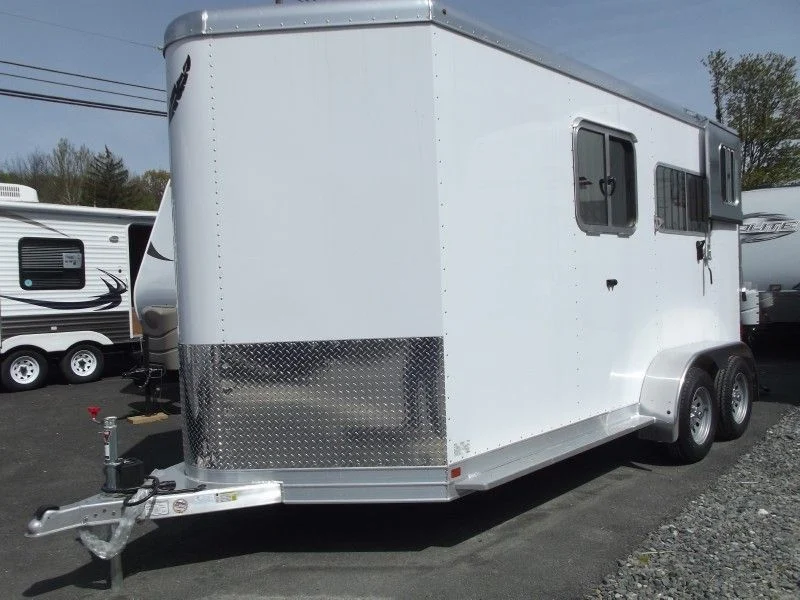
Horse trailer types at a glance
Here’s how we usually match a horse trailer to an owner. Use it as a starting point. The sections below explain how to check it against your own horses and truck.
| Who it suits | Horse trailer to look at | From our stock |
|---|---|---|
| One or two horses, local rides and lessons | Two-horse bumper pull, slant or straight load | 2 horse trailer, straight load horse trailer |
| Three horses, day trips and clinics | Three-horse slant load bumper pull | 3 horse slant load trailer, 3 horse trailer |
| Weekend shows, some overnight stays | Gooseneck with dressing room or short living quarters | used gooseneck horse trailer, 3 horse living quarters |
| Long-distance competition, several horses | Gooseneck with full living quarters | 4 horse living quarters, 6 horse trailer |
| Tight budget | A sound used gooseneck | used 4 horse trailer |
The pairings are our recommendation, based on what we sell and the way buyers describe their riding.
Start with your horse, not the brochure
A trailer that fits one horse comfortably can be cramped for the next. Before you look at models, measure your biggest horse.
Height
The University of Tennessee Extension gives a simple rule of thumb: the trailer should be about 10 inches taller than the normal resting position of the horse’s head. The University of Maryland Extension says the same, and adds that for an average horse an interior seven to eight feet tall and six to eight feet wide is sufficient.
So measure from the ground to the top of your horse’s head when it’s standing relaxed, then add 10 inches. That’s your minimum interior height. Our bumper pull horse trailers come with 84 in (7 ft) and 90 in (7 ft 6 in) interiors. A tall warmblood or draft cross will be happier in the taller one.
Width
Both extension guides recommend allowing about 3 inches of space on each side of the horse. Tennessee points out that a 30 inch stall might suit an Arabian but be much too narrow for a heavily muscled Quarter Horse. Measure your horse across its widest point, usually the barrel or the hips, and add at least 6 inches.
Length
The horse needs room to stand squarely on all four feet and shift its weight to balance. A horse that can’t spread its legs a little tends to scramble or lean on the walls. If your horse is long-bodied, check stall length as well as width.
Weight
You’ll need each horse’s weight for the payload sums later. A scale is best. If you don’t have one, University of Tennessee Extension gives a formula for mature light-breed horses: heart girth times heart girth times body length, divided by 330, all in inches. Its worked example, a horse with a 70 inch girth and 78 inch body length, comes to about 1,158 lb. The guide notes the formula doesn’t suit drafts, warmbloods, minis, young or pregnant horses.
Slant load or straight load?
This is one of the most argued-about choices in the horse world. The honest answer from the University of Maryland Extension is that there is very little research to support one load type being preferred or safer than the other.
| Slant load | Straight load | |
|---|---|---|
| How horses stand | At an angle, side by side in diagonal stalls | Facing forward, side by side |
| Horses per length | More horses in a shorter trailer | Usually two horses in a given length |
| Price | Often higher | Usually lower, according to Maryland Extension |
| Access | Horses usually unloaded in order | Each horse can often be reached and unloaded on its own |
| Handler safety | Maryland Extension notes a handler can be trapped between horse and exit | Front escape doors on many models |
Our view: if you haul three or more horses, slant load usually makes more sense, because it fits them into a shorter, lighter horse trailer. If you haul one or two, and especially if your horse has strong preferences, a straight load with a rear ramp is easy to load and easy to unload one horse at a time. Many horses go happily in either. Watch how your own horse travels before you commit.
Combo stalls
Some trailers, like our Colt Big Sky combo/slant two-horse and Strider combo/slant three-horse, use dividers that can swing to make a box stall. That’s handy for a mare and foal, a horse that travels better loose, or hauling one horse on its own.
Ramp or step-up loading?
Trailers load horses in two ways: up a ramp, or with a step-up where the horse steps straight into the trailer from the ground.
- Ramp: a hinged ramp at the back, and sometimes the side. Many horses that dislike stepping up into a dark space walk up a ramp quite calmly. Ramps are heavy, though, and can be slippery when wet unless they have good matting or cleats.
- Step-up: no ramp to lift, and nothing for a horse to slip off sideways. Some horses learn to step up and back down very neatly. Others find backing out of a step-up worrying at first.
Our view is that neither is better for every horse. If your horse already travels well, keep what it knows. If you’re buying for a young or nervous horse, a ramp is often the easier start. Our Ambassador straight load has a rear ramp. Ask us which loading style each of our other models uses.
Dressing rooms and tack storage
Even without living quarters, most riders want somewhere to keep saddles, bridles, rugs and grooming kit. The common options are:
- Front dressing room: on a gooseneck, the space over the hitch becomes a lockable room for tack and somewhere to change. Our used three-horse gooseneck has one.
- Front tack room: on a bumper pull, a small lockable compartment at the front with saddle racks and bridle hooks.
- Rear tack: a corner compartment at the back, often with swing-out saddle racks.
- Mid tack: on living quarters models, between the living area and the horse area. The Hart four-horse has a 4 ft mid tack.
Look for saddle racks that fold away, enough bridle hooks, a water tank if you go to places without water, and a lock. Tack theft from parked trailers is a real problem at busy events.
Bumper pull or gooseneck horse trailer?
A bumper pull hitches to a receiver at the back of the truck. A gooseneck hitches to a ball in the truck bed, over the rear axle. University of Maryland Extension notes that bumper pull trailers can be pulled by a smaller tow vehicle, while goosenecks, being heavier, need larger trucks.
- Bumper pull: cheaper, lighter, fits SUVs and half-ton trucks for one or two horses, and leaves the truck bed free.
- Gooseneck: more stable, turns tighter, carries more weight on the truck, and leaves room over the hitch for a dressing room or living quarters.
Our full gooseneck vs bumper pull guide goes through the trade-offs in detail. For most one- and two-horse owners, a bumper pull horse trailer is enough. Once you go to three or more horses with living quarters, a gooseneck is the normal choice.
Aluminum or steel?
Aluminum horse trailers cost more up front, but they’re lighter and don’t rust the way steel does. Maryland Extension notes that because aluminum is lighter, an aluminum trailer can accommodate a heavier load. That matters when the cargo is heavy and the tow vehicle often isn’t huge.
Steel trailers are cheaper and easier to weld if something bends, but they need regular checks for rust, especially on the floor frame where urine and manure sit. Many trailers mix the two: a steel frame with aluminum skin, or the other way round. Ask which parts are which. Our aluminum vs steel trailer guide covers weight, cost and corrosion in more detail. Every bumper pull horse trailer in our current new range is aluminum.
Floors, mats and dividers
Floor
The floor is the most important safety part of any horse trailer, and the one most often neglected. Urine and manure soak into wood and corrode metal. Maryland Extension recommends checking wood floors by sticking a knife into the wood and twisting; too much movement means rot, and checking metal floors for rust.
Mats
Rubber mats give horses grip and some cushioning. Maryland Extension says heavy-duty mats at least half an inch thick suit horses and livestock best. Tennessee Extension adds that mats should be lifted out from time to time so the floor underneath can dry completely. Many owners add shavings or straw on top to soak up urine.
Dividers
Tennessee Extension describes two main types: a solid divider about 4 feet tall running the full length of the trailer, and partial dividers that let horses spread their legs more for balance but carry some risk of one horse stepping on another. Padded dividers and adjustable stall widths are worth having on any trailer that carries different sizes of horse.
Ventilation and heat
Horses produce a lot of heat. Tennessee Extension notes that four horses in a trailer give off a tremendous amount of heat, and that overheating in summer is a bigger risk than cold in winter. It recommends vents overhead, on the sides and at the rear.
The University of California, Davis Center for Equine Health warns that temperatures inside a parked trailer can rapidly reach 140 degrees Fahrenheit. Its advice is to never leave horses standing in a parked trailer in the heat, to open vents and windows for cross-ventilation, to keep horses’ heads inside while moving, to haul in the cooler early morning or evening, and to give free access to water in hot weather.
When you compare horse trailers, look at:
- Roof vents that open both ways, so you can pull air in or let it out.
- Drop-down windows at head height, with bars or screens.
- Sliding windows or vents at the rear.
- Insulated or lined roofs, which help in strong sun.
- Light-coloured exteriors. White and silver reflect more heat than dark colours.
Living quarters horse trailers
A living quarters horse trailer puts a small apartment in the front: usually a bed over the gooseneck, a seating area, a kitchen and a bathroom. For owners who travel to shows, endurance rides or clinics and stay overnight, it saves hotel bills and keeps you close to your horses.
Things to compare:
- Length of the living area. Measured in feet. A short living area, around 8 ft, has a bed, a small kitchen and a basic bathroom. Longer ones, 14 ft and up, add proper seating, bigger bathrooms and sometimes slide-outs.
- Slide-outs. These widen the living area when parked. They add space but also weight and moving parts.
- Mid tack or rear tack. Storage between the living area and the horse area, or at the back, keeps saddles out of the living space.
- Water, power and waste. Fresh water tank, holding tanks, generator or batteries.
- Weight. Living quarters add a lot. Check the GVWR and the truck’s ratings.
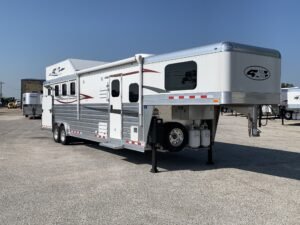
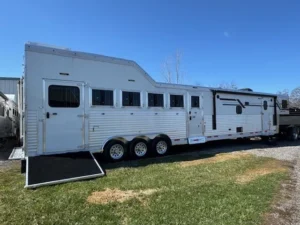
We have several living quarters horse trailers in stock, from a three-horse slant gooseneck with 14 ft living quarters to a six-horse slant with 16 ft living quarters and a 9 ft slide-out. See all our living quarters horse trailers.
Weight, payload and your tow vehicle
This is where many first-time buyers get caught. A loaded horse trailer is heavy, and horses move, which makes the load harder to control than a box of tools.
A worked example
Take our Strider three-horse slant load, rated at 7,000 lb GVWR. Suppose you haul three horses of around 1,150 lb each, close to the Tennessee Extension worked example.
- Three horses: about 3,450 lb.
- Tack, hay, water and buckets: let’s say 300 lb. That’s an assumption for the example, and it’s easy to exceed.
- Load: about 3,750 lb.
- That leaves about 3,250 lb for the trailer’s own empty weight before you hit the 7,000 lb rating.
So ask for the empty weight of any horse trailer you’re considering, ours included, and do this sum with your own horses. If the answer is tight, you either need a lighter trailer, fewer horses or a higher rating.
The truck
Check the truck’s towing capacity, maximum tongue weight, payload and gross combined weight rating in its owner’s manual. For tongue weight, GMC’s towing guide says a conventional trailer should put 10 to 15 percent of its loaded weight on the hitch, and a gooseneck or fifth wheel 15 to 30 percent. That weight comes off the truck’s payload, along with passengers and anything in the bed.
Tennessee Extension’s rough guide is that a half-ton truck can handle a two-horse trailer but is much too small for a six-horse van. It also warns against attaching a hitch to the bumper only. Use a proper frame-mounted receiver.
Brakes
Maryland Extension states that all trailers hauling animals must have brakes. Check that the brakes work on every axle, that the breakaway system is charged and connected, and that your truck has a brake controller set for the load. Our trailer towing tips cover braking, cornering and backing up with a heavy trailer.
Travel paperwork
The trailer gets your horse there. Paperwork lets it cross borders. Rules vary a lot between countries and states, so always check before you travel.
In the US, for example, the US Equestrian Federation explains that all states require a negative Coggins test before a horse can be transported across state lines, and most states want a certificate of veterinary inspection issued within about 30 days of travel. Coggins results are often accepted for six or 12 months, depending on the state. Other countries have their own passports, health certificates and movement rules. Your vet and the destination’s animal health authority are the people to ask.
Helping a nervous horse get used to the trailer
Plenty of horses that load badly were never taught properly, or had one bad trip. You can’t fix that with a trailer purchase alone, but the right trailer and a patient plan help a lot. Approaches many trainers use:
- Start with the trailer parked and hitched in a quiet spot, doors and windows open, nothing in a hurry.
- Feed near the trailer, then at the ramp or step, then just inside. Let the horse decide to step forward.
- Keep sessions short. Stop on a good moment, even if that’s one foot on the ramp.
- Practise unloading as much as loading. A horse that’s confident backing out is a calmer traveller.
- Take a short, smooth drive around the block before the first real trip, and unload at home afterwards.
- Bring a calm companion if your horse travels better with a friend.
If loading is a real problem, a qualified trainer or your vet can help, and it’s worth doing before a vet emergency forces the issue. A lighter, brighter interior with good ventilation also makes a difference for many horses.
Lights, cameras and electrics
Small extras that make a big difference on dark mornings and long trips:
- Interior LED lights in the horse area and tack room, so you can load and check horses after dark.
- Exterior loading lights over the ramp or doors.
- A trailer camera wired or wireless to the truck, so you can watch horses while driving.
- A breakaway battery charger, so the emergency brake system is always ready.
- Shore power and batteries on living quarters models, so the fridge and lights work at shows.
Make sure the trailer plug matches your truck socket and the lighting rules where you’ll tow. We can tell you what each model in our range comes with.
Loading and hauling tips
A good trailer makes loading easier, but practice does most of the work. A few habits that help:
- Practise at home before the day you need to go somewhere. Short, calm sessions work better than one long fight.
- Park on level ground with the trailer hitched, so it can’t tip or roll.
- Open everything up. A bright trailer with open windows looks less like a cave to a nervous horse.
- Tie with a quick-release knot or a breakaway tie, and only once the divider or butt bar is closed behind the horse.
- Drive smoothly. Slow starts, gentle braking and wide turns. Horses can’t brace for what they can’t see coming.
- Stop regularly on long trips to check horses, water and the trailer.
Tennessee Extension also recommends keeping tires properly inflated at all times and carrying a spare tire, a jack rated for the trailer, and wrenches that fit both truck and trailer wheels.
Hauling a single horse
Many owners haul one horse most of the time. A few points help:
- In a two-horse straight load, put a single horse on the driver’s side. Roads are usually crowned toward the kerb, so the trailer rides more level that way. This is common practice rather than a published rule, and it depends on which side of the road you drive.
- In a slant load, put a single horse in the front stall, so its weight sits forward over the axles.
- If the trailer has a swing divider, consider opening it into a box stall. Some horses travel much more calmly with room to find their own position.
- A horse that hates travelling alone may settle better with a companion. That’s worth knowing before you buy a trailer that only fits one.
Safety kit to keep in the trailer
A breakdown or injury on the road is far easier to manage with the right things on board. A basic kit:
- Spare tire, a jack rated for the trailer and wheel wrenches that fit, as Tennessee Extension recommends.
- Wheel chocks and reflective warning triangles.
- Equine first aid kit and your vet’s number.
- Spare halter and lead rope for each horse.
- Water and buckets, plus hay for longer trips.
- Torch and spare batteries.
- A copy of each horse’s travel papers.
- Fire extinguisher, especially in living quarters trailers.
What owning a horse trailer costs
The purchase price is the biggest cost, but there are others. We can’t give exact figures because they vary so much from country to country, but plan for:
- Registration, plates and inspection, where local rules require them.
- Insurance for the trailer, and separately for the horses in transit if you want that cover.
- Tires, which age out even on trailers that don’t travel far.
- Brakes and bearings, serviced on a regular schedule.
- Mats, bedding and cleaning.
- Storage, if you can’t keep the trailer at home or at the barn.
- Living quarters upkeep: appliances, water system, generator and roof seals.
- A bigger truck, if your current one isn’t rated for the trailer you need. For many buyers this is the biggest hidden cost.
An aluminum trailer usually costs more to buy and less to keep free of rust. A good used steel trailer costs less up front but needs closer watching. That balance is our opinion from what we see in trailers coming back to us, not a measured figure.
Horse trailers we sell
Prices are in US dollars and correct when this was written. Click through for current prices, photos and full specs.
Bumper pull horse trailers
- 2026 Colt Big Sky Series two-horse: combo/slant load, bumper pull, aluminum, silver, 7,000 lb GVWR, $13,400. Our most affordable new horse trailer.
- 2026 Ambassador straight load: 90 in interior, rear ramp, bumper pull, aluminum, white, 7,000 lb GVWR, $17,999.
- 2027 Strider Series Lite three-horse slant: 84 in interior, bumper pull, aluminum, white, 7,000 lb GVWR, $18,650.
- 2026 Strider Series combo/slant three-horse: 90 in interior, bumper pull, white, 7,000 lb GVWR, $18,900. The taller option for bigger horses.
Browse all bumper pull horse trailers.
Gooseneck and living quarters horse trailers
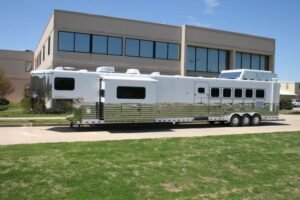
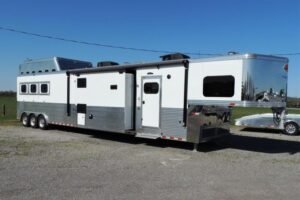
- 2025 three-horse slant gooseneck with 14 ft living quarters: white, 14,000 lb GVWR, $81,000.
- 2025 Hart four-horse with 8 ft living quarters and 4 ft mid tack: $141,000. Ask us for GVWR and fit-out details.
- 2025 Platinum Coach four-horse with Signature Quarters interior: aluminum, fully fitted interior, $175,000.
- 2025 luxury living quarters horse trailer: $191,000. Ask us for horse capacity and living area details.
- 2026 six-horse slant gooseneck: 16 ft living quarters with a 9 ft slide-out, aluminum, white, 24,000 lb GVWR, $65,000.
Browse all gooseneck horse trailers.
Used horse trailers
- 2006 used three-horse gooseneck with dressing room: $13,999.
- 2004 used four-horse gooseneck: $16,500. Ask us for GVWR and layout.
See all used trailers, or the full horse trailer range.
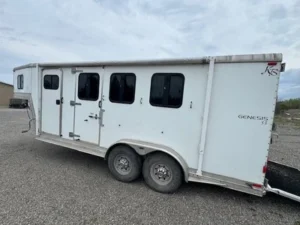
Three owners and the horse trailer we’d match to each
These are typical situations buyers describe to us, with our suggestion for each. Measure your horses and check your truck before deciding.
The weekend trail rider with two horses
Two average-sized horses, a half-ton pickup, rides of an hour or two from home. The Colt two-horse combo/slant is light, aluminum and easy to tow. If one horse is tall or long, or prefers to face forward, the Ambassador straight load with its 90 in interior and rear ramp is the better fit.
The family with three horses
Three horses of mixed sizes, lessons, clinics and the odd show, a three-quarter-ton truck. A three-horse slant bumper pull keeps the trailer shorter and lighter than a three-horse straight load would be. Choose the 90 in Strider combo if any horse is tall. Do the payload sum above with your own horses’ weights.
The competitor on the road every month
Several horses, long drives and overnight stays at shows. A gooseneck with living quarters pays for itself in hotel bills and lets you stay with your horses. Our three-horse 14 ft living quarters is a good entry point. The six-horse with slide-out suits a barn hauling several horses at once. Make sure the truck is rated for it: Tennessee Extension’s point that a half-ton is far too small for a six-horse trailer applies here.
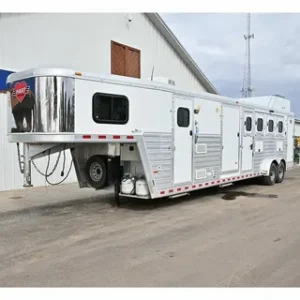
Buying a used horse trailer: what to inspect
A used horse trailer can be excellent value, but horses are hard on trailers. Maryland Extension’s advice is not to plan on major repairs unless you are an experienced technician yourself. Before you buy any used horse trailer, ours or anyone else’s, check:
- Floor. Lift the mats. Do the knife test on wood. Look for rust, cracks and soft spots on metal or aluminum.
- Frame. Look underneath for rust, cracked welds and bent cross-members, especially under the stalls.
- Hitch, chains and breakaway. Maryland Extension recommends checking that every part of the hitch, the safety chains and the breakaway brake is present and working.
- Brakes, bearings and tires. Old tires can look fine and still be unsafe because of age. Check date codes.
- Dividers, latches and doors. Sharp edges, sticking latches and broken hinges are all hazards for horses.
- Lights and wiring. Test everything with the truck attached.
- Living quarters, if fitted: water leaks, appliances, generator and roof seals.
Our trailer maintenance checklist covers what to look after once you own it.
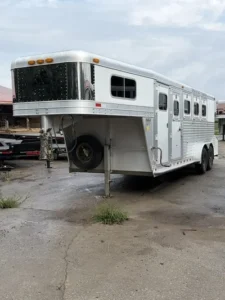
Looking after a horse trailer
A few habits keep a horse trailer safe for years:
- Clean it out after every trip. Manure and wet shavings sitting on the floor cause most floor damage.
- Lift the mats regularly and let the floor dry, as Tennessee Extension recommends.
- Grease hinges, latches and the coupler.
- Service the bearings and brakes on schedule.
- Check tire pressures before every trip.
- Wash off road salt in winter, especially on steel parts.
Horse trailer buying checklist
- How many horses, and how tall, wide and heavy is the biggest?
- Interior height at least 10 inches above your horse’s resting head height?
- Slant, straight or combo stalls?
- Bumper pull or gooseneck?
- Aluminum, steel or mixed construction?
- Floor type, mat thickness and condition?
- Vents and windows for cross-ventilation?
- GVWR, empty weight and payload with your horses and tack?
- Does your truck’s towing capacity, tongue weight and payload cover it?
- Brakes on every axle and a working breakaway?
- Dressing room, tack room or living quarters needed?
We’ll answer every question on this list for any horse trailer we sell. For general advice on picking any trailer, see our guide on how to choose a trailer, and our overview of the types of trailers.
Mistakes we see people make
These come from our own conversations with buyers, so treat them as experience rather than statistics.
- Buying for the horse you have now. Your next horse may be taller. A few extra inches of height cost little at purchase.
- Forgetting the truck. A great horse trailer behind an underrated truck is a dangerous combination.
- Ignoring the floor on a used trailer. A fresh coat of paint can hide a rotten floor.
- Too little ventilation. A dark, stuffy trailer is hard to load and risky in summer.
- Buying living quarters you won’t use. They add weight and cost. Be honest about how many nights a year you’ll stay over.
Delivery worldwide
We deliver horse trailers to customers in many countries. Tell us where the trailer is going and what you’ll tow it with, and we’ll quote delivery on each model you’re considering and flag any width, braking or lighting points that matter where you live.
Horse trailer FAQs
What size horse trailer do I need?
For an average horse, Maryland Extension suggests an interior 7 to 8 ft tall and 6 to 8 ft wide. Measure your biggest horse and allow about 10 inches above its resting head height and 3 inches on each side.
Is a slant load or straight load horse trailer better?
Neither is proven safer. Slant loads fit more horses in a shorter trailer. Straight loads usually cost less and let you reach each horse on its own.
Bumper pull or gooseneck horse trailer?
Bumper pull for one or two horses and smaller trucks. Gooseneck for three or more horses, living quarters and better stability.
Is aluminum worth it for a horse trailer?
For most owners, yes. It’s lighter, leaving more payload, and it resists rust. Steel costs less but needs more care.
What truck do I need to pull a horse trailer?
Check the truck’s towing capacity, tongue weight and payload against the loaded trailer. As a rough guide from Tennessee Extension, a half-ton suits a two-horse trailer but not a six-horse.
Do horse trailers need brakes?
Yes. Maryland Extension states that all trailers hauling animals must have brakes.
How hot does a horse trailer get?
UC Davis warns that a parked trailer can reach 140 degrees Fahrenheit. Never leave horses in a parked trailer in the heat, and keep vents open on the move.
Do you ship horse trailers outside the US?
Yes, we deliver worldwide. Ask for a delivered quote.
Find your horse trailer
Tell us about your horses, how far you travel and what you tow with, and we’ll recommend a horse trailer that fits them and your truck. Browse our horse trailers, bumper pull horse trailers, gooseneck horse trailers and living quarters horse trailers, or see everything in the shop. Questions? Contact us. You might also like our guides on the tandem axle trailer question and enclosed vs open trailers.
Sources and References
- University of Maryland Extension: Selecting a Horse Trailer (FS-948)
- University of Tennessee Extension: Tips on Trailering Your Horse (TNH-3001)
- University of Tennessee Extension: Evaluating Your Horse’s Body Weight and Condition (SP 795)
- UC Davis Center for Equine Health: Heat Advisory for Horses
- GMC: Tongue weight and why it’s key to safe towing
- US Equestrian: Interstate travel for horses