

A living quarters horse trailer is a horse trailer with a small apartment built into the front: usually a bed, a kitchen, a bathroom and seating, with the horse area behind it. It lets you sleep, cook and change next to your horses at shows, clinics and trail rides instead of driving to a hotel. Choosing one comes down to five things: how many horses you haul, how much living space you need, the trailer’s GVWR and whether your truck can pull it, the water, power and heating systems, and how the horse area is ventilated.
As a rough guide, a 3 horse living quarters horse trailer with about 14 ft of living space suits a couple or a family hauling two or three horses on weekends. A 4 horse rig suits regular competitors. A 6 horse trailer with a slide-out suits trainers, breeders and anyone on the road for weeks.
We sell all of the trailers in this guide, from $65,000 to $191,000, and we deliver worldwide. Specs and prices come from our own listings. Outside facts link to their source, and where something is our opinion, we say so.

Living quarters horse trailers we sell at a glance
| Model | Horses | Living quarters | Hitch | GVWR | Price |
|---|---|---|---|---|---|
| 2025 3 horse slant load | 3 | 14 ft | Gooseneck | 14,000 lb | $81,000 |
| 2025 4 horse with mid tack | 4 | 8 ft, plus 4 ft mid tack | Ask us | Ask us | $141,000 |
| 2025 aluminum 4 horse | 4 | Fully fitted | Ask us | Ask us | $175,000 |
| 2026 6 horse slant load | 6 | 16 ft with 9 ft slide-out | Gooseneck | 24,000 lb | $65,000 |
| 2025 luxury living quarters | Ask us | Ask us | Ask us | Ask us | $191,000 |
Where a cell says “ask us”, the listing doesn’t give that detail yet. We’ll send the full spec sheet, floor plan and photos for any unit on request.
What a living quarters horse trailer actually is
Every horse trailer has a horse area. Many have a small dressing room or tack room at the front for saddles and a change of clothes. A living quarters horse trailer goes much further: the front section is built out like a small RV, with insulation, a bed, a kitchenette, a bathroom, and water, power and heating systems.
The idea is simple. If you spend weekends at shows, you can stay on the grounds, check your horses late at night and early in the morning, and skip the hotel and the drive back and forth. For many riders it changes how the whole season works.
If you only need tack storage and somewhere to change, a standard trailer with a dressing room costs far less. Our main horse trailer guide covers those.
How living quarters length is measured
When you see “14 ft living quarters” or “16 ft living quarters” on a listing, that figure normally describes how much of the trailer’s length is living space. It’s usually measured along the side wall of the living area, which in the trade is often called the short wall. It isn’t the trailer’s total length, and it doesn’t include the gooseneck overhang, where the bed usually sits.
So two trailers both called “14 ft LQ” can feel quite different inside. One may put the space into a bigger bathroom, another into a longer sofa or a slide-out. Ask for the floor plan before you compare prices. We’ll send one for every living quarters horse trailer we sell.
What fits in each length
These are typical layouts, not a guarantee of any one build:
- Around 8 ft: compact. A bed over the gooseneck, a small kitchenette, a seat and sometimes a small toilet. Good for one or two people on short trips.
- 10 to 14 ft: the popular middle. Room for a dinette or sofa, a fuller kitchen and a proper bathroom with a shower.
- 15 ft and over: close to a small RV. Bigger kitchens, larger bathrooms, more storage, and often a slide-out.

How many horses, and how much room each one needs
Start with your horses, not the floor plan. UConn Extension’s guide to safe trailering cites research linking fewer injuries to a floor area of about 1.14 to 1.31 square metres per horse, roughly 12 to 14 sq ft. It also stresses that the trailer must be tall enough and wide enough for the horses you haul.
That matters on a living quarters horse trailer, because the living space takes length that could otherwise be horse space. When you compare two trailers with the same horse count, ask for:
- Stall length and width, measured inside the dividers.
- Interior height in the horse area.
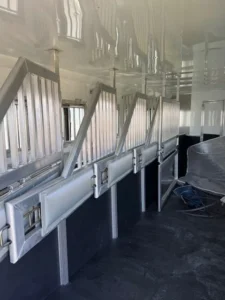
- Whether the head area has drop-down windows or bars.
- How much space is left behind the last stall.
Our view: buy a living quarters horse trailer with one more stall than you need now if you can. A spare stall becomes extra tack and hay storage, and plans change.
Slant load or straight load?
Most living quarters horse trailers are slant load, because angled stalls fit more horses into a shorter length. That keeps the overall trailer shorter once the living quarters are added. Our 3 horse and 6 horse models are slant load. Straight loads give each horse more room to brace front to back and suit some larger horses better. Our horse trailer guide compares the two in detail.
Why almost every living quarters trailer is a gooseneck
A living quarters horse trailer is heavy and long. A gooseneck hitch sits in the truck bed over the rear axle, which carries the weight better, turns tighter and tows more steadily than a bumper pull of the same size. GMC’s towing guide puts typical tongue weight at 15 to 30 percent of loaded weight for gooseneck trailers, against 10 to 15 percent for conventional ones. On a 14,000 lb trailer, 15 to 30 percent is about 2,100 to 4,200 lb sitting in your truck bed. That number has to fit inside your truck’s payload.
The gooseneck also gives a natural place for the bed, in the raised nose over the truck. That’s why you’ll see “gooseneck” on almost every living quarters horse trailer listing, including ours. Our gooseneck vs bumper pull guide explains the hitch types.
Weight: the part most buyers underestimate
GVWR is the most the trailer may weigh with everything in it. On a living quarters horse trailer, “everything” adds up fast:
- The trailer itself, with cabinets, appliances, generator and tanks.
- Your horses.
- Fresh water, and the grey and black waste tanks once they fill.
- Hay, feed, bedding and water for the horses.
- Tack, saddles, show clothes and food.
- Propane, batteries and tools.
Water is heavy
The US Geological Survey notes that water has a density of roughly 1 gram per millilitre, which means a litre weighs about a kilogram. A 60 gallon fresh water tank holds about 227 litres, or about 227 kg (500 lb) when full. Add horse water carried separately and the waste tanks, and water alone can account for close to half a ton.
A worked example
Here’s an illustration we put together, not a weighing of any one trailer. Take a 3 horse living quarters horse trailer rated 14,000 lb. Say it weighs 9,000 lb empty, and ask us for the real figure on any unit. That leaves 5,000 lb. Three mature riding horses can easily use 3,000 lb or more of that. A full fresh tank adds about 500 lb. Hay, tack, food, propane and gear can add several hundred pounds more. You can be near the limit before you’ve left the driveway.
That’s why we always tell buyers to weigh their horses, or at least use a weight tape, and to ask for the trailer’s empty weight before they decide. Travelling with the fresh tank partly empty and filling up near the show grounds is a common way to save weight.
Your truck, licence and the rules
Truck ratings
Check these on the truck’s door-pillar label and in the handbook:
- Towing capacity for a gooseneck, which is often different from the bumper-pull rating.
- Gross combined weight rating (GCWR): the truck, the trailer and everything in both.
- Payload: the gooseneck pin weight counts against it, along with passengers and gear.
- Rear axle rating: the pin weight lands mostly on this axle.
As a broad guide, a 14,000 lb living quarters horse trailer usually needs at least a three-quarter-ton or one-ton truck. A 24,000 lb six horse rig needs a heavy-duty one-ton or bigger, set up for gooseneck towing. Always go by your own truck’s ratings.
Licences
Licence rules for heavy combinations differ by country, and sometimes by state or province, so check before you buy. In the US, the Federal Motor Carrier Safety Administration defines a Class A commercial licence as covering a combination with a gross combination weight rating of 26,001 lb or more, where the towed unit is rated over 10,000 lb. Those federal rules apply to commercial driving, and states set their own rules for private use, so a big living quarters rig used for business can need a commercial licence. Ask your local licensing authority what applies to you.
Width and brakes outside North America
In Great Britain, GOV.UK sets a maximum trailer width of 2.55 m and requires brakes on any trailer over 750 kg loaded. Many living quarters horse trailers are around 8 ft wide (about 2.44 m), which is within that limit with any slide-out retracted. Other countries have their own limits on width, length, weight and licence categories. Tell us where you’ll tow, and we’ll check the unit you want against local rules before you order.
Inside the living quarters: what to look for
Sleeping
In most living quarters horse trailers, the bed sits in the gooseneck nose. Check the mattress size and the headroom, which is often low. Some trailers add a sofa bed or a dinette that converts, which helps if you travel with children or a groom.
Kitchen
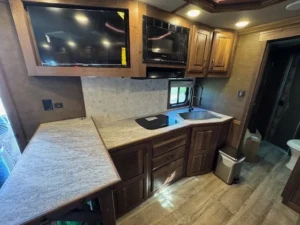
A typical living quarters horse trailer kitchen includes a sink, a two-burner hob, a microwave and a fridge. Larger quarters add an oven, more counter space and a bigger fridge. Check whether the fridge runs on propane, 12 V or mains power, because that decides what you can use when you’re not plugged in.
Bathroom
Look at the shower size, whether the toilet is a fixed flush toilet with a black tank or a cassette toilet, and the size of the water heater. A small water heater runs out fast after a dusty day.
Heating and cooling
Air conditioning normally needs shore power or a generator. Heating is usually a propane furnace. Insulation makes a big difference both ways, so ask what’s in the walls and roof.
Water and waste
Ask for the size of the fresh, grey and black tanks. Bigger tanks mean longer stays without hookups but more weight to carry. Check where the dump valves and hose storage are, and how the system is winterized.
Power
- Shore power: a plug-in lead for when the show grounds have electric hookups.
- House batteries: run lights, the water pump and the furnace fan when you’re not plugged in.
- Generator: for air conditioning and heavy loads off-grid.
- Solar panels: top up the batteries quietly during the day.
Living quarters horse trailer layouts compared
Floor plans vary a lot, but most fall into a few patterns. This table is our general summary, not the layout of any particular unit.
| Layout | What you get | Best for | Trade-off |
|---|---|---|---|
| Compact (around 8 ft) | Bed in the nose, kitchenette, small seat, sometimes a toilet | One or two people, weekend shows | Tight inside, small tanks |
| Rear kitchen | Kitchen near the horse wall, seating at the front | Couples who cook often | Less seating space |
| Side dinette | Table and benches that convert to a second bed | Families and grooms | Bed needs setting up each night |
| Rear bathroom | Larger shower and toilet at the back | Long stays without hookups | Takes length from the living area |
| Slide-out | Sofa or dinette in a section that pushes out when parked | Long trips, more people | More weight, seals to maintain |
When you compare one living quarters horse trailer with another, lay the floor plans side by side and picture a wet, muddy evening at a show. Where do the boots go? Where do you sit to eat? Can two people pass each other? Those small things matter more than the brochure photos.
Slide-outs: more room when parked
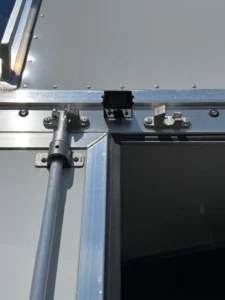
On a living quarters horse trailer, a slide-out is a section of wall that moves outward when the trailer is parked, adding floor space. On the road it retracts, so the trailer stays at its normal width. Our 2026 6 horse trailer has a 9 ft slide-out on its 16 ft living quarters, which turns a narrow space into somewhere you can actually sit and move around.
The trade-offs are weight, cost, and seals that need looking after. Keep the slide seals clean and lubricated, check for leaks after rain, and always retract it fully and check it’s locked before you move.
Mid tack and dressing rooms
Many living quarters horse trailers keep tack separate from the living space. A mid tack room sits between the living quarters and the horses, with its own outside door, so you’re not carrying saddles and dirty boots through your kitchen. Our 4 horse living quarters trailer has a 4 ft mid tack behind its 8 ft living area. Check for saddle racks, bridle hooks, blanket bars and an outside door that locks.

Looking after the horses on board
Ventilation and heat
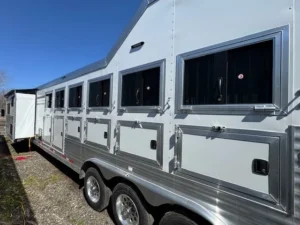
UConn Extension stresses that proper ventilation is very important to a horse’s respiratory health, and recommends adequate windows, slats and roof vents. The same guide says the inside of the trailer should stay below 75 to 90°F, which is the upper critical temperature range where horses struggle to shed heat. Humidity above 50 percent makes it harder still. On a living quarters horse trailer, the living area is insulated, but check that the horse area has enough roof vents and opening windows of its own.
Breaks on long trips
The same UConn guide suggests stopping at least every three to four hours for 15 to 30 minutes, and for about 45 minutes every 7.5 hours to change hay nets and remove manure. It recommends offering water at the start and end of each stop. On a long haul with a living quarters rig, you’ll have the kitchen and bathroom for yourself during those breaks, which makes it much easier to stick to that schedule.
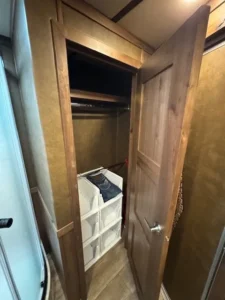
A weekend at a show with living quarters
To show why owners value them, here’s how a typical show weekend can go with a living quarters horse trailer. It’s an illustration, not a timed study.
- Friday evening: arrive, plug into shore power if there is any, settle the horses, and cook dinner in the trailer instead of hunting for a restaurant.
- Saturday morning: feed and check the horses before sunrise, without the drive from a hotel. Shower and change in the trailer.
- During the day: a cool, quiet place to rest between classes, and a fridge with your own food and drinks.
- Saturday night: a late check on the horses is a few steps away.
- Sunday: pack up at your own pace and drive home.
The real benefit is time and peace of mind. You’re close to your horses all weekend, and you’re not tied to hotel check-in times.
Summer and winter use
Hot weather
In summer, the living area needs air conditioning, which usually means shore power or the generator. The horse area needs as much airflow as possible. Open the vents and windows, park in shade when you can, and travel in the cooler parts of the day. Remember the UConn guidance on temperature and humidity, and keep a close eye on how the horses are coping.
Cold weather
The propane furnace keeps the living area warm, but the water system is the weak point. Pipes and tanks can freeze. Some trailers have heated tanks or enclosed underbellies. If yours doesn’t, carry water in containers and keep the system drained when temperatures drop well below freezing. Ask us whether the unit you want has any cold-weather features.
Generator safety
A generator is useful, but exhaust carries carbon monoxide. The CDC’s guidance is clear: always use a generator outdoors and at least 20 feet from windows and doors, and never indoors, in garages or carports. With a built-in generator, make sure the exhaust points away from your windows, your neighbours’ windows and the horse area. Fit and test a carbon monoxide alarm in the living quarters, and don’t run the generator while you sleep if the exhaust could drift toward an open window or vent.
Aluminum or steel?
A living quarters horse trailer is already heavy, so aluminum makes more sense here than on many other trailers. It saves weight that you can spend on horses and water, and it doesn’t rust when urine, rain and road salt get at the horse area. Steel is cheaper and easier to repair, but it needs more care against rust.
Our 2025 aluminum living quarters trailer and the 2026 6 horse trailer are both aluminum. Our aluminum vs steel trailer guide compares the two in more depth.
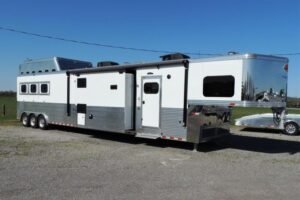
Who buys a living quarters horse trailer, and which one we’d match
These are typical buyers we hear from, with our suggestion for each. They’re recommendations, not rules.
The weekend show family
Two or three horses, two adults and maybe a child, most weekends from spring to autumn. The 2025 3 horse living quarters horse trailer with 14 ft of living space and a 14,000 lb GVWR is the natural fit. It’s a manageable size behind a one-ton truck.
The serious competitor
Four horses, long weekends and longer trips, with plenty of tack. The 4 horse trailer with mid tack keeps tack and living space apart. If you want an aluminum build with a fuller interior, look at the aluminum 4 horse.
The trainer or breeder
Six horses and weeks on the road. The 2026 6 horse trailer has 16 ft of living quarters with a 9 ft slide-out and a 24,000 lb GVWR. It needs a heavy-duty truck and possibly a different licence, so check both first.
The buyer who wants the best finish
Long seasons and comfort first. The 2025 luxury horse trailer sits at the top of our range. Ask us for the full spec and a video walk-through.
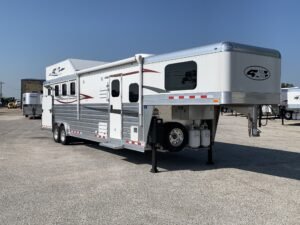
Living quarters horse trailers for sale
Prices are in US dollars and correct when this was written. Click through for current prices, photos and full specs.
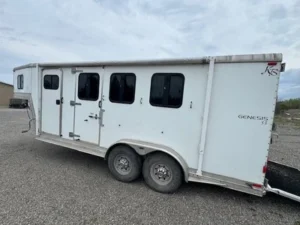
- 2025 3 horse living quarters horse trailer: slant load, gooseneck, 14 ft living quarters, white, 14,000 lb GVWR, $81,000.
- 2025 4 horse living quarters trailer: 8 ft living quarters, 4 ft mid tack, $141,000. Ask us for GVWR and hitch.
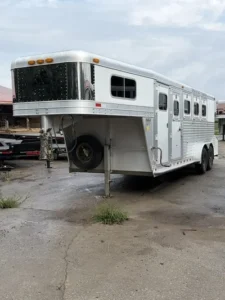
- 2025 aluminum living quarters trailer: 4 horses, all-aluminum, fully fitted living area, $175,000.
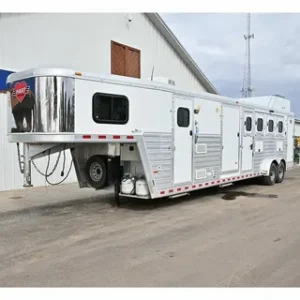
- 2026 6 horse trailer: slant load, gooseneck, 16 ft living quarters, 9 ft slide-out, aluminum, white, 24,000 lb GVWR, $65,000.
- 2025 luxury horse trailer: high-end living quarters, $191,000. Ask us for horse count and fit-out.
Browse the full living quarters horse trailers category, or see all horse trailers.
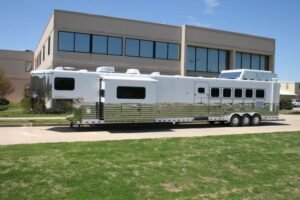
If living quarters aren’t right for you yet
Plenty of riders start with a standard trailer and move up to a living quarters horse trailer later. If you mostly do day trips, or your truck isn’t rated for a heavy gooseneck, look at these:
- 2026 2 horse trailer: Colt Big Sky Series, combo/slant, bumper pull, aluminum, 7,000 lb GVWR, $13,400.
- 2027 3 horse trailer: slant load, 84 in interior, bumper pull, aluminum, 7,000 lb GVWR, $18,650.
- 2026 3 horse slant load trailer: combo, 90 in interior, bumper pull, 7,000 lb GVWR, $18,900.
- 2026 straight load horse trailer: ramp, 90 in interior, bumper pull, aluminum, 7,000 lb GVWR, $17,999.
- 2006 used 3 horse gooseneck with dressing room, $13,999.
- 2004 used 4 horse gooseneck, $16,500.
See all bumper pull horse trailers and gooseneck horse trailers.
What a living quarters horse trailer costs to own
We can’t give exact figures, because they vary so much between countries. Plan for:
- Insurance that covers both the trailer and its contents. Some insurers treat the living quarters like an RV.
- Registration and inspections, where required.
- Tires, bearings and brakes, which work hard under this much weight.
- Propane, generator servicing and batteries.
- Winterizing each year if you live somewhere that freezes.
- Storage, if you can’t park it at home.
- Fuel, because a heavy gooseneck uses a lot of it.
- A suitable truck, if you don’t already have one.
Against that, owners stop paying for show-ground hotels and some meals out. Our view is that riders who compete most weekends usually feel the difference quickly. That’s an opinion based on what buyers tell us, not a calculation.
New or used: what to inspect
A used living quarters horse trailer can be good value, but it combines two sets of things that can go wrong: a horse trailer and an RV. Check both.
The horse side
- Floor: lift the mats. Look for soft spots, corrosion and urine damage.
- Frame and gooseneck: cracks, rust, and repairs around the hitch and spring hangers.
- Dividers, latches and windows: do they all work smoothly?
- Axles, tires, bearings and brakes: tire date codes and uneven wear.
The living side
- Water damage: stains on ceilings and walls, soft floors, a musty smell. Leaks are the most expensive problem to fix.
- Roof and seals: cracked sealant around vents, windows and the slide-out.
- Systems: run the water pump, water heater, furnace, AC, fridge and generator.
- Tanks and plumbing: check for leaks and freeze damage.
- Electrics: batteries, converter, shore power and all lights.
Our guide to trailer maintenance covers running gear in more depth.
Looking after a living quarters horse trailer
- Strip out bedding and wash the horse area after each trip so urine doesn’t sit on the floor.
- Lift and check the mats every few months.
- Check roof and window seals twice a year.
- Service the generator on schedule.
- Winterize the water system before the first freeze.
- Keep the batteries charged during storage.
- Grease the slide-out mechanism and seals if fitted.
- Service bearings, brakes and tires regularly.
Planning your first long trip with a living quarters horse trailer
- Weigh the loaded rig at a public scale before the trip, and compare it with the trailer’s GVWR and your truck’s ratings.
- Check the route for low bridges, steep grades and fuel stops that can take a long rig.
- Book overnight stops with horse facilities. Hand-walking or turning out horses overnight helps them recover.
- Carry spare tires for the trailer, a jack rated for it, and a basic tool kit.
- Pack horse paperwork, including health certificates where you cross state or national borders.
- Plan water: fill the fresh tank near your destination to save weight, and carry enough water for the horses.
- Give the horses time: UConn Extension suggests allowing about a week of recovery after a long haul before strenuous work.
Our trailer towing tips cover reversing, braking and sway.
Parking and setting up on site
A living quarters horse trailer is long, so think about parking before you arrive. Many show grounds have set areas for big rigs, and some have electric hookups that you need to book in advance.
- Pick level ground if you can. Use levelling blocks under the wheels and the jack to get the living area level, so the fridge, doors and drains work properly.
- Chock the wheels before you unhitch.
- Leave room for the slide-out and any awning, plus space to unload horses safely.
- Plug in or start the generator, keeping the exhaust away from your own and your neighbours’ windows.
- Set up the horses first: water, hay and a check of legs after the trip.
Can you try one before you buy?
Some riders hire or borrow a living quarters horse trailer for a weekend before buying. It’s a good way to learn which layout suits you, how much water you really use, and how your truck feels with the weight behind it. If that isn’t possible, ask us for a detailed video walk-through of the exact living quarters horse trailer you’re considering, and make a list of how you’d use each part of it on a typical show weekend.
Security on the road and at events
- Lock the living quarters and tack doors whenever you step away, even briefly.
- Use a gooseneck coupler lock when the trailer is unhitched.
- Keep valuables out of sight of windows.
- Record the VIN and photograph the trailer and its contents for insurance.
- Consider a GPS tracker, which is a small cost against the value of a living quarters horse trailer.
Should you buy new or used?
A new living quarters horse trailer gives you the layout you want, a warranty where offered, and systems that haven’t been through freezing winters. A used one costs less and loses value more slowly from that point, but you take on whatever the previous owner did or didn’t do. Our view: if you’re buying used, budget for an inspection by someone who knows both trailers and RV systems, and assume you’ll spend some money on seals, batteries and tires in the first year.
Mistakes we see buyers make
These come from our own conversations with buyers, so treat them as experience rather than statistics.
- Choosing the floor plan first and checking the truck last. Sort out weight and towing before falling for a kitchen.
- Forgetting water weight. A full fresh tank is heavier than most people think.
- Squeezing the horse area to get a longer living space.
- Skipping the floor plan and assuming two “14 ft” trailers are the same.
- Underestimating upkeep. An RV and a horse trailer in one needs both kinds of care.
- Not checking licence rules for heavy combinations where you live.
Questions to ask before you order
- What does the trailer weigh empty, and what’s the GVWR?
- What’s the pin weight with a typical load?
- Can I see the floor plan and a video walk-through?
- Stall sizes and interior height in the horse area?
- Fresh, grey and black tank sizes?
- Generator, batteries, solar and shore power: what’s fitted?
- Heating and air conditioning: what types, and what power do they need?
- Aluminum or steel construction?
- What paperwork comes with it for registration in my country?
- What’s the delivered price to my address or port?
We’ll answer every one of these for any living quarters horse trailer we sell.
Worldwide delivery
We deliver trailers to customers in many countries. A living quarters horse trailer is a large, high-value shipment, so ask for a delivered quote early. Tell us where you’ll tow, and we’ll check width, weight, braking and lighting points that matter there. We supply the paperwork you need for registration.
Living quarters horse trailer FAQs
What is a living quarters horse trailer?
A horse trailer with a small apartment at the front, usually with a bed, kitchen, bathroom and seating, so you can stay next to your horses at events.
How is living quarters length measured?
Usually along the side wall of the living area, often called the short wall. It doesn’t include the gooseneck overhang, where the bed usually sits.
What truck do I need?
It depends on the loaded weight. A 14,000 lb trailer usually needs at least a three-quarter-ton or one-ton truck set up for gooseneck towing. Heavier rigs need heavy-duty trucks. Go by your truck’s ratings.
Do I need a special licence?
Possibly. In the US, a commercial Class A licence covers combinations of 26,001 lb or more where the trailer is rated over 10,000 lb, for commercial use. Other countries have their own categories. Check locally.
How much does water add?
About a kilogram per litre, or roughly 500 lb for a full 60 gallon tank.
Is aluminum worth it on a living quarters horse trailer?
Usually, yes. It saves weight on an already heavy trailer and resists the rust that urine and road salt cause.
Can I run the generator overnight?
Only with the exhaust well away from any windows, doors and vents. The CDC advises at least 20 feet from windows and doors. Fit a carbon monoxide alarm.
Do you deliver living quarters horse trailers outside the US?
Yes, we deliver worldwide. Ask for a delivered quote.
Find your living quarters horse trailer
Tell us how many horses you haul, how long you stay away, and what you tow with, and we’ll recommend the living quarters horse trailer that fits. Browse our living quarters horse trailers, gooseneck horse trailers and all horse trailers, or see everything in the shop. For more background, read our horse trailer guide, securing a load and how to choose a trailer. Questions? Contact us.